

The 16 personality types are four-letter codes, like INFJ or ESTP, built by combining four preference pairs that describe how you direct energy, take in information, make decisions, and approach structure. This page runs through each of the 16 profiles in plain language, explains where the framework comes from, and shows you how to find your own type. Use it for insight into how you work and relate to others, not as a verdict on your worth or your resume.
TL;DR:
- The MBTI categorizes personality into 16 types based on four preference pairs, but results can vary depending on mood and interpretation.
- The official assessment is administered by certified practitioners, while most online tests are unofficial and should be treated as initial hypotheses.
- Type insights are most useful for self-awareness and team communication, not for hiring or clinical diagnoses, as the instrument lacks high reliability over time.
- The four-letter codes stem from Jungian theory and reflect a stack of cognitive functions that influence behavior and growth potential.
- Pairing your MBTI result with other continuous personality measures like the Big Five provides a fuller, more accurate profile.
Table of Contents
- What Are the Four Preference Pairs Behind the 16 Personality Types?
- What Are the 16 MBTI Personality Types?
- How Do You Find Your MBTI Type?
- How Can You Use Your Personality Type Day to Day?
- What Are the Limitations of the 16 Personality Types?
- Where Did the 16 Personality Types Come From?
- What Cognitive Functions Sit Behind Each Type?
- A Personal Take on Using Personality Tools Well
- Get Your 16-Type Personality Results in Minutes
- Sources
- FAQ
What Are the Four Preference Pairs Behind the 16 Personality Types?
Every one of the 16 personality types comes from mixing one letter out of four separate pairs. The Myers-Briggs Type Indicator sorts people along Extraversion (E) versus Introversion (I), Sensing (S) versus Intuition (N), Thinking (T) versus Feeling (F), and Judging (J) versus Perceiving (P).
Here's what each pair actually measures:
- E/I cover where you get your energy: from people and activity, or from solitude and internal reflection.
- S/N covers how you take in information: concrete facts and details, or patterns, possibilities, and the big picture.
- T/F covers how you decide: weighing logic and consistency, or weighing values and impact on people.
- J/P covers how you approach structure: planned and decided, or flexible and open-ended.
Pick one letter from each pair and you get a four-letter type, like ISTJ or ENFP. Picture two coworkers hearing the same vague instruction from a manager. The ISTJ asks for a written checklist before starting. The ENFP starts brainstorming five different ways to approach it and asks questions later. Same instruction, two different operating systems.
Pro Tip: Don't force yourself into a type because it sounds appealing. Read the descriptions honestly and ask which behaviors show up most under stress, not just on your best day.
What Are the 16 MBTI Personality Types?
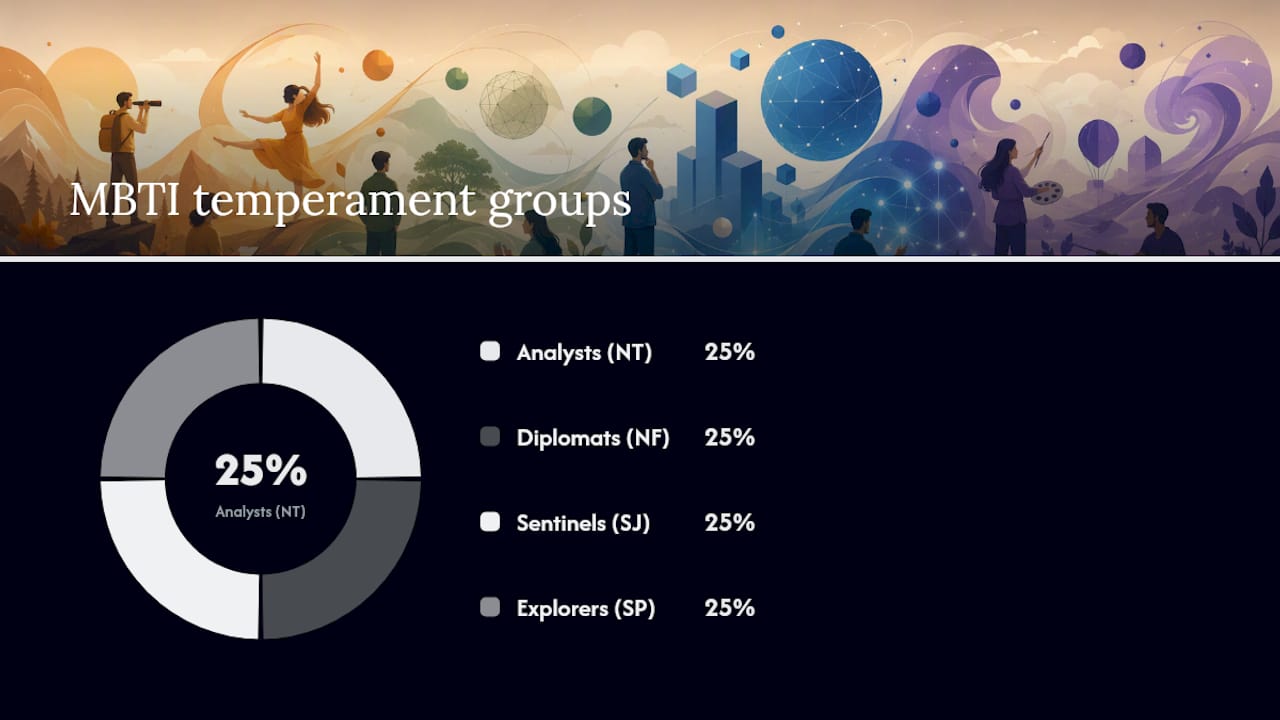
The Myers-Briggs Foundation groups the 16 types into four temperament clusters: Analysts, Diplomats, Sentinels, and Explorers. Each profile below gives you the code, its common nickname, two strengths, and one growth edge worth watching.
Analysts (NT types) — strategic, independent thinkers
- INTJ, "The Architect." Strong at long-range strategy and independent problem-solving. Growth edge: can dismiss input from people who think less systematically.
- INTP, "The Logician." Strong at abstract analysis and spotting logical inconsistencies. Growth edge: can overanalyze instead of deciding and moving.
- ENTJ, "The Commander." Strong at organizing people and resources toward a goal. Growth edge: can steamroll consensus in the name of efficiency.
- ENTP, "The Debater." Strong at generating ideas and arguing multiple sides. Growth edge: can lose interest before follow-through.
Diplomats (NF types) — values-driven and people-focused
- INFJ, "The Advocate." Strong at reading people and holding a long-term vision. Growth edge: can bottle up needs until burnout hits.
- INFP, "The Mediator." Strong at empathy and creative, values-driven work. Growth edge: can avoid conflict past the point of usefulness.
- ENFJ, "The Protagonist." Strong at motivating groups and organizing shared purpose. Growth edge: can neglect personal needs while managing everyone else's.
- ENFP, "The Campaigner." Strong at enthusiasm and connecting people to possibility. Growth edge: can scatter energy across too many projects.
Sentinels (SJ types) — practical and structure-oriented
- ISTJ, "The Logistician." Strong at reliability and methodical execution. Growth edge: can resist change even when it's warranted.
- ISFJ, "The Defender." Strong at quiet loyalty and attention to others' needs. Growth edge: can struggle to say no or set boundaries.
- ESTJ, "The Executive." Strong at organizing systems and enforcing standards. Growth edge: can be rigid about rules over context.
- ESFJ, "The Consul." Strong at building community and reading social needs. Growth edge: can seek approval at the cost of honest feedback.
Explorers (SP types) — adaptable and hands-on
- ISTP, "The Virtuoso." Strong at hands-on troubleshooting and staying calm under pressure. Growth edge: can withdraw instead of communicating.
- ISFP, "The Adventurer." Strong at aesthetic sense and living by personal values. Growth edge: can avoid long-term planning.
- ESTP, "The Entrepreneur." Strong at quick action and reading immediate situations. Growth edge: can act before thinking through consequences.
- ESFP, "The Entertainer." Strong at spontaneity and lifting the mood of a room. Growth edge: can avoid the unglamorous parts of follow-through.
How Do You Find Your MBTI Type?
Two very different things get called an "MBTI test" online, and the distance between them matters. The official MBTI® instrument is administered by a certified practitioner and typically includes a feedback session to interpret results in context. Most free online 16-type tests, by contrast, are independent tools inspired by the same four preference pairs but built and scored by other companies entirely, and they aren't the official instrument.
That doesn't make free tests worthless. It just means you should treat the result as a starting hypothesis, not a verdict.
- Retake the test if your result feels off, especially if you were tired, stressed, or answering how you wish you behaved rather than how you actually do.
- Reflect on long-term patterns rather than one bad week. Type is about consistent preference, not a mood.
- Consider a facilitated session with a certified practitioner if you're using results for coaching, team-building, or career planning, since professional interpretation reduces misreads in ways a self-scored quiz cannot.
Testuno's 16-personality type test gives you an instant read with no signup, which makes it a solid first pass before you decide whether deeper interpretation is worth pursuing.
How Can You Use Your Personality Type Day to Day?
Type differences show up fastest in how people prefer to communicate and work. A Sensing type wants the concrete plan; an Intuitive type wants the reasoning behind it. A Thinking type wants the tradeoffs spelled out; a Feeling type wants to know who's affected.
Applying that well means a few clear dos and don'ts:
- Do use type language to explain preferences ("I process out loud, give me a minute"), not to excuse behavior ("I'm a J, deal with it").
- Do adjust your delivery: if you're pitching an ISTJ manager, lead with the plan and the risks, not the vision.
- Don't use someone's type to predict what they're capable of or to sort people into hierarchy at work, an idea some designers borrow for personalization but that breaks down fast in real teams.
Pro Tip: Before a tense conversation, ask yourself what information the other person actually needs first, facts or context, and lead with that instead of your natural default.
What Are the Limitations of the 16 Personality Types?
The MBTI's biggest weakness is test-retest reliability. Because it forces a binary choice on each pair, someone near the middle can land on opposite letters on two different days, and comparisons with trait models like the Big Five consistently find MBTI offers less precision.
The Myers-Briggs Company itself is explicit that the assessment is built for insight and self-reflection, not for predicting job performance or screening candidates.
- Use it for self-awareness, communication style, and understanding teammates.
- Don't use it for hiring decisions, clinical diagnosis, or as a stand-in for a mental health evaluation.
- Everyone uses all eight preferences to some extent; your type just names which side you lean toward, not a rule you're locked into.
Pairing a type result with a continuous measure like the Big Five gives a fuller, more reliable picture than type alone.
Where Did the 16 Personality Types Come From?
Katharine Briggs began cataloging personality differences in the early 1900s, fascinated by how differently people in her own family approached decisions and relationships. Her daughter, Isabel Briggs Myers, later built on that groundwork using Carl Jung's theory of psychological types, and together they developed the indicator to describe differences in attention, information processing, decision making, and structure.
Myers formalized the instrument during World War Two, driven partly by a practical goal: helping people identify wartime jobs that suited their natural strengths. The first manual for general use arrived in 1962, and the framework has been refined and republished multiple times since, always keeping Jung's original distinctions between extraversion and introversion, and between the different ways people gather and judge information, as its backbone.
What's easy to miss is that Myers and Briggs were not academic psychologists by training. They were self-taught researchers who spent decades observing behavior before formalizing a system, which is part of why the instrument reads more like a practical typology than a clinical scale. That history explains both its enduring popularity in workplaces and classrooms, and the persistent academic skepticism about its measurement rigor. Understanding where it came from helps explain what it's good for and where its limits sit.
What Cognitive Functions Sit Behind Each Type?
Each of the 16 personality types isn't just four static letters, it represents a stack of mental functions operating in a specific order. The four core functions are Sensing, Intuition, Thinking, and Feeling, each expressed in either an extraverted or introverted form, giving eight total functions.
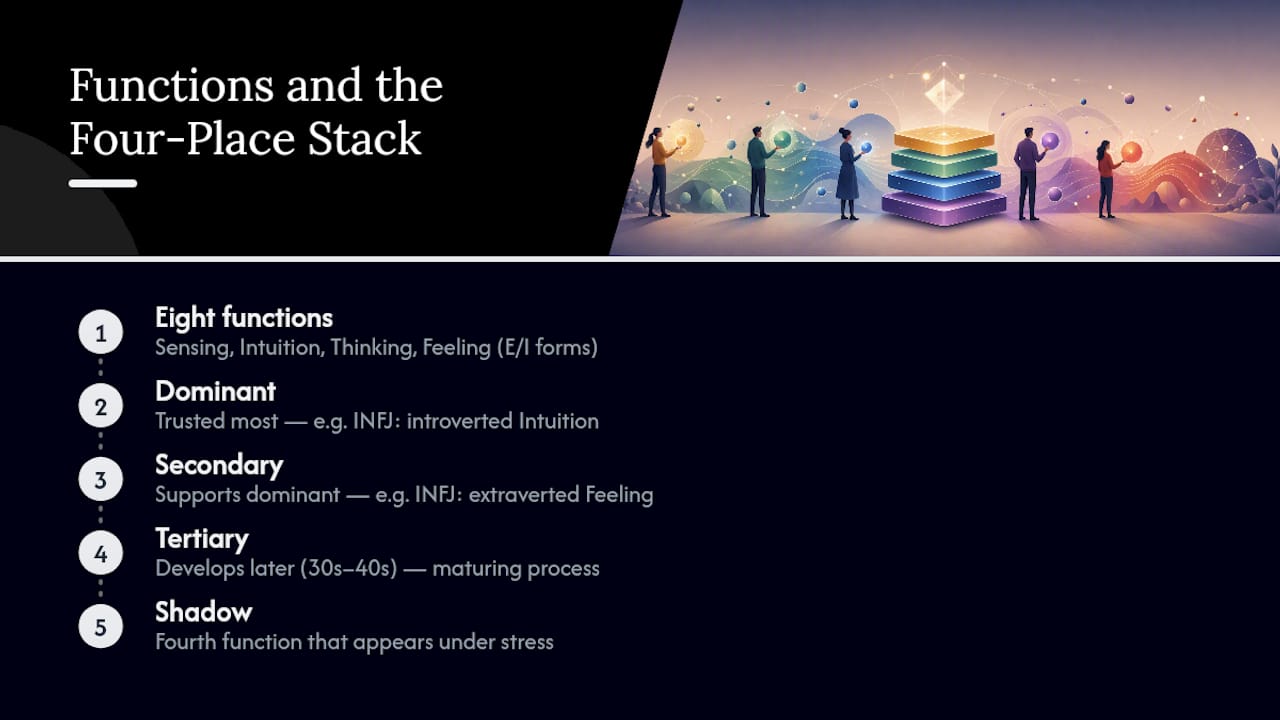
Every type leads with one dominant function it trusts most, backed by a secondary function that supports it, then a tertiary function that develops later in life, and a fourth "shadow" function that tends to show up under stress. An INFJ, for instance, leads with introverted Intuition, meaning they naturally synthesize patterns and future implications internally, backed by extraverted Feeling, which turns those insights into consideration for other people.
This stack is why two people who share three of four letters can still feel different to talk to. An ENFP leads with extraverted Intuition (scanning for outward possibility) while an INFJ leads with introverted Intuition (synthesizing inward), even though both are "N" types. The function order also explains why growth edges shift with age. Many people report their tertiary function becoming more accessible in their thirties and forties, a maturing process practitioners sometimes call developing the "stack." Cognitive functions add texture to the four letters. They explain not just what someone prefers, but the order in which they reach for those preferences.
A Personal Take on Using Personality Tools Well
The real value of the 16 personality types isn't the label, it's the pause it creates. Reading a profile and thinking "that's uncomfortably accurate" is often the first honest look someone takes at their own patterns in years. There are tools that offer quick, no-signup assessments delivering results in minutes so you can sit with them, not just file them away. Treat your type as a conversation starter, not a conclusion, and pair it with reflection or a second assessment before you act on it.
— Steve
Get Your 16-Type Personality Results in Minutes
Testuno's 16-personality type test gets you a full four-letter profile with instant, downloadable results and no signup wall between you and your answer. That matters if you've ever abandoned an online quiz halfway through because it demanded an email address before showing you anything.

If you want a fuller picture, pair your type result with Testuno's Big Five personality test for a continuous trait measure, or try the introvert-extrovert test if you just want to isolate that one axis. Every result comes with real-time context so you're not staring at a code with no explanation. Start with the 16-type test, see what it surfaces, and decide from there whether the Big Five or an archetype test adds anything new.
Sources
- The Myers‑Briggs Type Indicator (SimplyPsychology)
- Historical and theoretical context of MBTI (NCBI Bookshelf)
- MBTI® Assessment - The Myers‑Briggs Company
- The 16 MBTI® Personality Types (The Myers‑Briggs Foundation)
FAQ
What Are the 16 Personality Types?
The 16 personality types are four-letter codes built from four preference pairs: Extraversion/Introversion, Sensing/Intuition, Thinking/Feeling, and Judging/Perceiving. Examples include INFJ, ESTP, and ENTJ, each with a nickname and a short profile of common strengths.
What Are the Rarest MBTI Types?
Estimates vary by source and sample, but INFJ, INTJ, and ENTJ are commonly cited among the least frequently reported types in general population surveys. Because MBTI results shift with mood, context, and phrasing of questions, treat any rarity ranking as a rough pattern rather than a fixed statistic.
What Do the MBTI Letters E, I, S, N, T, F, J, and P Stand For?
E and I stand for Extraversion and Introversion, covering where you draw energy. S and N stand for Sensing and Intuition, covering how you take in information. T and F stand for Thinking and Feeling for decision making, and J and P stand for Judging and Perceiving for how you handle structure.
Is MBTI Type A, B, C, or D the Same as the 16 Types?
No. Type A, B, C, and D personality labels come from a completely separate framework originally tied to stress and heart-health research, not from Myers-Briggs theory. The 16 personality types use four-letter codes like INFP or ESTJ, while the A/B/C/D system uses single-letter behavioral categories built around competitiveness and stress response.
Can I Take a 16-Type Personality Test Online for Free?
Yes. Testuno's 16-personality type test is free to take with no signup required and gives instant results you can act on right away. Just remember that free online versions, including this one, are independent tools inspired by the same framework rather than the official certified MBTI® instrument.