

Aptitude is your potential to learn or excel at something you have not yet mastered; ability is what you can already do right now. A kid who picks out melodies by ear without ever touching sheet music has musical aptitude. A concert pianist who has drilled scales for a decade has musical ability. One points forward, the other measures the present.
That distinction matters more than it looks. Confuse the two and you end up hiring based on potential when you need proven performance, or dismissing a slow starter who actually has the raw capacity to outpace everyone in six months. Here is what the rest of this article covers:
- Precise definitions of aptitude, ability, skill, and talent
- The practical axes that separate them (innate vs. learned, stable vs. changeable)
- Real examples across verbal, numerical, spatial, and physical domains
- How aptitude tests, IQ tests, and achievement tests actually differ
- What the distinction means for students, jobseekers, and employers
- A concrete path for turning raw aptitude into demonstrated ability
TL;DR:
- Aptitude predicts future learning speed and potential across domains, but does not guarantee current performance or mastery.
- Ability reflects proven, current capability, typically measured through direct work samples or practical tests rather than predictive scores.
- Standardized tests like the SAT or ASVAB often blend aptitude and achievement, requiring careful interpretation to avoid misjudging real skill levels.
- Converting aptitude into demonstrated ability depends on deliberate practice, real feedback, and regular reassessment over time.
- Employers and educators should combine test scores with credentials and tangible work evidence for better assessments and decision-making.
Table of Contents
- Aptitude Meaning vs Ability: The Definitions That Matter
- Key Differences Between Aptitude and Ability
- Aptitude and Ability Examples Across Common Domains
- How Aptitude Testing vs Ability Tests Actually Work
- What the Aptitude vs Ability Distinction Means for You
- Turning Aptitude Into Ability: A Realistic Path
- Measuring Aptitude and Ability With Testuno
- How Aptitude and Ability Became Separate Ideas
- Theoretical Models That Separate Aptitude From Ability
- Where Aptitude and Ability Tests Fall Short
- Why the "Fixed Potential" Myth Persists
- Key Takeaways
- Sources
Aptitude Meaning vs Ability: The Definitions That Matter
The Cambridge Dictionary defines aptitude as a natural talent or potential for a particular activity, and ability as the capacity to perform an action or task. That's the cleanest version you'll find, and it holds up under scrutiny.
Psychology adds a layer worth knowing. The Stanford Encyclopedia of Philosophy treats ability as something closer to competence: it includes strategic control and adaptability, not just the capacity to execute a fixed routine on command. That's why a chess player with real ability can adjust mid-game when an opponent surprises them, while someone who only memorized openings gets stuck the moment the script breaks.
Skill sits between the two, usually referring to a trained, specific capability, like typing at 80 words per minute or reading a topographic map. Talent overlaps heavily with aptitude but leans more toward exceptional, sometimes unusually early, potential.
A few quick contrasts:
- Aptitude: unrealized capacity, oriented toward future learning
- Ability: demonstrated capacity, oriented toward present performance
- Skill: a specific, trained ability tied to a task
- Talent: aptitude that appears unusually strong or early
Quick fact: Merriam-Webster's entry on aptitude notes the word covers both potential and suitability, which is why you'll see it used for career fit as often as for raw cognitive promise.
Key Differences Between Aptitude and Ability
Five practical axes separate these concepts, and understanding them changes how you interpret test scores, job applications, and even your own frustration with slow progress.
- Origin. Aptitude leans on natural predisposition; ability results from a mix of aptitude plus practice, instruction, and time invested.
- Stability. Aptitude tends to be relatively stable over a person's life, while ability is dynamic. You can lose a skill through disuse even if the underlying aptitude never changed.
- Measurement method. Aptitude gets measured through predictive testing, tasks designed to estimate how quickly someone will learn something new. Ability gets measured through direct observation of current performance, whether that's a driving test, a coding challenge, or a live audition.
- Scope. Aptitude usually describes a domain, like spatial reasoning or verbal fluency. Ability can be domain-wide or narrowly task-specific, like "can operate this particular software."
- Predictive value. High aptitude predicts faster learning curves, but it does not guarantee mastery. Plenty of people with strong verbal aptitude never become good writers because they never wrote consistently.
Pro Tip: If you're evaluating someone (including yourself), ask two separate questions: "How fast will this person likely improve?" and "What can this person do today?" Mixing those questions into one judgment is where most misreadings of potential happen.
Aptitude and Ability Examples Across Common Domains
Abstract definitions only go so far. Seeing aptitude and ability paired by domain makes the distinction concrete.
- Verbal: Someone with strong verbal aptitude picks up new vocabulary and grammar patterns quickly. Verbal ability shows up as writing a clear, persuasive email today, no learning curve required.
- Numerical: Numerical aptitude predicts how fast someone will grasp algebra or financial modeling. Numerical ability is being able to calculate a tip or balance a budget right now, tested directly through a numerical reasoning test.
- Spatial: Spatial aptitude suggests someone will learn CAD software or navigation quickly. Spatial ability is actually reading a blueprint or parallel-parking without hitting the curb.
- Mechanical: Mechanical aptitude hints at quick uptake of engineering concepts. Mechanical ability is fixing a leaking faucet today.
- Social: Social aptitude predicts how fast someone develops leadership skill. Social ability is actually running a meeting well right now.
- Physical: Athletic aptitude points to fast skill acquisition in a new sport. Physical ability is your current 40-yard dash time.
How Aptitude Testing vs Ability Tests Actually Work
This is where a lot of confusion sets in, because the tests overlap more than the theory suggests.
Aptitude tests are built to be predictive: they estimate how well someone will learn or perform in the future, often before formal training begins. Achievement tests measure what someone has already learned, a snapshot of accumulated knowledge. IQ and general ability tests aim at broad cognitive capacity across multiple domains rather than one narrow skill.
The trouble is that real-world tests blur these categories constantly. The SAT was originally framed as an aptitude measure but functions largely as an achievement test tied to curriculum exposure. The ASVAB mixes aptitude-style subtests with knowledge-based sections. Even the WAIS, a widely used adult intelligence scale, combines tasks that predict learning capacity with tasks that reflect accumulated verbal knowledge, according to the iResearchNet overview of career assessment tools.
A few things to keep in mind when interpreting any score:
- A high aptitude score means faster likely learning, not guaranteed mastery.
- Achievement scores reflect exposure and effort as much as raw capacity.
- General ability tests estimate broad reasoning power, useful for screening but weak for predicting narrow, specific job performance.
Quick fact: Modern aptitude research increasingly treats intelligence as a set of domain-specific potentials, verbal, spatial, numerical, rather than one number, according to Wikipedia's summary of aptitude research. That's a meaningful shift from the old single-IQ-score mindset.
What the Aptitude vs Ability Distinction Means for You
Knowing the difference only helps if it changes what you actually do.
- Choosing training or education: Lean on aptitude data. If you're picking a college major or a training program, an aptitude signal tells you where you'll likely progress fastest, not where you're strongest today.
- Hiring for immediate performance: Lean on ability evidence. Work samples, portfolios, and practical tests beat aptitude scores when a role needs someone productive on day one.
- Writing a resume: Frame demonstrated ability with specifics ("reduced processing time by handling 200 tickets weekly") rather than vague aptitude claims ("quick learner").
- Interviewing candidates: Ask for evidence of past performance for ability, and ask about learning speed on unfamiliar tasks for aptitude. CareerBuilder's guidance notes that employers who combine test results with credentials and actual work samples make better hiring calls than those relying on a single aptitude score.
Turning Aptitude Into Ability: A Realistic Path
Potential doesn't convert itself. It takes a structured process, and skipping steps is why so many people with obvious aptitude never build matching ability.
- Assess honestly. Use a structured test or direct observation to identify where your aptitude is genuinely strong, not where you wish it were strong.
- Set a deliberate practice goal. Vague goals like "get better at math" fail. Specific, measurable targets, like "solve 20 algebra problems daily for three weeks," work.
- Get real feedback. Progress stalls without correction. A coach, mentor, or structured course catches errors you can't see in your own work.
- Measure and adjust. Retest periodically. If progress plateaus, the practice method needs to change, not just the effort level.
Distributed practice, spacing study sessions instead of cramming, consistently beats marathon sessions for converting aptitude into lasting ability.
Pro Tip: Don't wait for motivation to assess your aptitude. Take a short, structured test first. Motivation tends to follow evidence of real potential, not the other way around.
Measuring Aptitude and Ability With Testuno
Testuno's platform gives you a fast way to see where your aptitude actually stands, not just where you assume it does. The flagship IQ test runs six research-grounded subtests and reports percentile benchmarking instantly, so you're not guessing how your spatial or numerical reasoning compares to others.
A typical workflow looks like this: take a short domain test, like the spatial reasoning test or verbal reasoning test, review your percentile results, then use that profile to pick where deliberate practice will pay off fastest. Testuno's own assessment data shows this kind of quick, no-signup profiling helps users prioritize training instead of practicing blindly across every domain at once.
- Six IQ subtests with percentile benchmarking
- Domain-specific reasoning tests
- Quick results, no signup required
- Downloadable reports for tracking progress over time
How Aptitude and Ability Became Separate Ideas
The split between aptitude and ability isn't new vocabulary invented for HR departments. It traces back to early 20th-century psychometrics, when researchers like Alfred Binet built the first practical intelligence tests to predict which schoolchildren would struggle academically, a fundamentally aptitude-oriented goal: forecasting future learning, not grading current knowledge.
The distinction sharpened during World War I and World War II, when the U.S. military needed fast ways to sort recruits into roles they'd likely master quickly. Aptitude batteries like the Army General Classification Test were built explicitly to predict trainability, separate from what a recruit already knew how to do.
By mid-century, psychologists like J.P. Guilford and Louis Thurstone pushed back against the idea of a single general intelligence factor, arguing instead for multiple distinct aptitudes: verbal, spatial, numerical, reasoning. That multi-factor view is closer to how modern aptitude research frames things today, as a set of domain-specific potentials rather than one score.
Meanwhile, "ability" stayed tied to observable performance throughout this history, showing up in achievement testing, vocational assessment, and later in competency-based hiring models. The two concepts developed side by side, one chasing prediction, the other chasing measurement of the present, and that parallel history is why they still get confused in everyday language.
Theoretical Models That Separate Aptitude From Ability
Several frameworks try to formalize where aptitude ends and ability begins, and they don't all agree.
Trait-and-factor theory, the oldest model, treats aptitude as a stable trait that predicts fit for specific occupations or tasks, largely fixed and measurable through standardized testing. This is the model behind most classic vocational aptitude batteries.
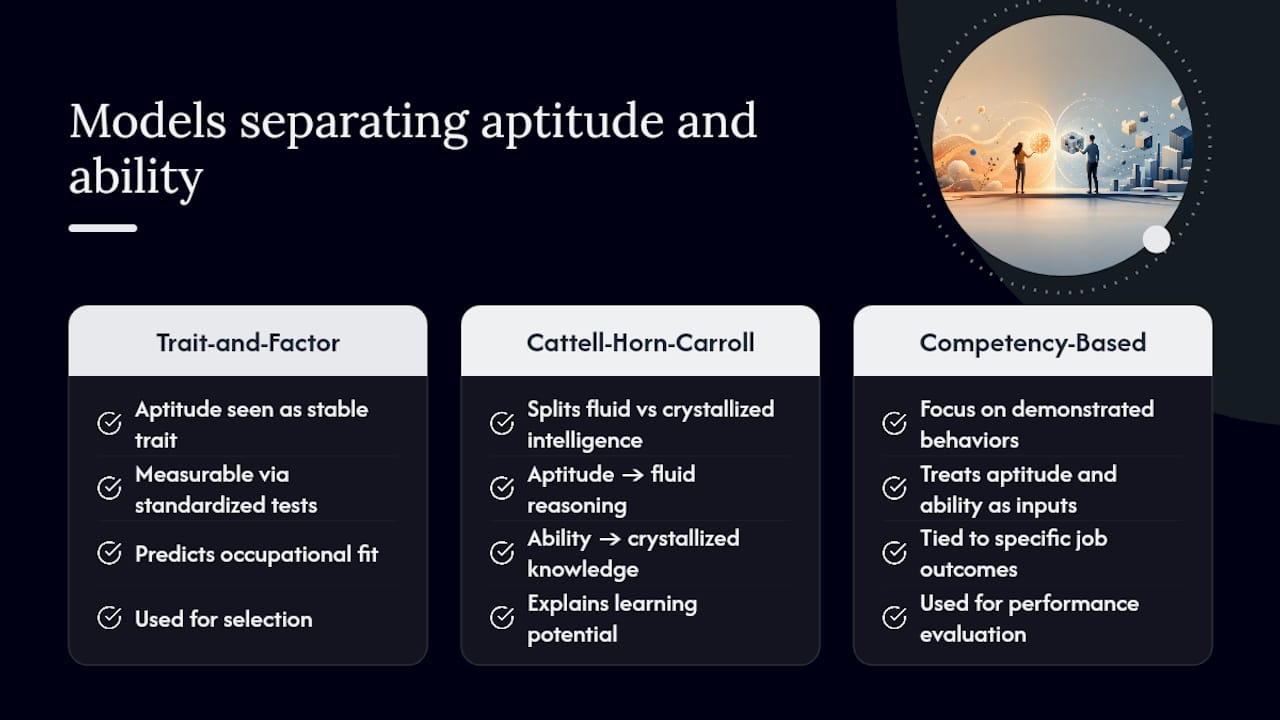
Cattell-Horn-Carroll (CHC) theory, a widely cited model in modern cognitive psychology, splits intelligence into fluid reasoning (closer to aptitude, the capacity to solve novel problems) and crystallized knowledge (closer to ability, accumulated learned information). This split explains why someone can have high fluid reasoning aptitude yet score lower on knowledge-heavy achievement tests simply because they haven't been exposed to the content yet.
Competency-based models, popular in modern HR and education, sidestep the aptitude/ability split almost entirely. They focus on demonstrated behaviors and skills tied to specific job outcomes, treating both aptitude and ability as inputs to a broader competence profile rather than separate categories worth measuring independently. The Stanford Encyclopedia's entry on abilities leans this direction, framing ability as something that includes strategic, adaptive control, not a static score at all.
None of these models is simply "correct." They answer different questions: trait-and-factor theory helps with selection, CHC theory helps with understanding learning potential, and competency models help with real-world job performance evaluation.
Where Aptitude and Ability Tests Fall Short
Testing has real limits, and pretending otherwise leads to bad decisions in hiring, education, and self-assessment alike.
The biggest issue is treating a predictive aptitude score as a guarantee. A high aptitude score estimates likely learning speed under reasonable conditions. It says nothing about motivation, access to training, or whether someone will actually put in the practice hours needed. Employers who use aptitude scores as a hard cutoff, rather than one input among several, routinely screen out capable people who simply test poorly under timed, artificial conditions.

Cultural and socioeconomic bias is another persistent problem. Standardized aptitude tests were often normed on populations that don't reflect the diversity of today's test-takers, and vocabulary-heavy sections can penalize non-native speakers regardless of underlying reasoning capacity.
There's also the issue of narrow scope. A single test session captures a snapshot, not a trend. Someone having a bad day, dealing with test anxiety, or unfamiliar with a test's format can score well below their actual capability. That's part of why CareerBuilder's hiring guidance recommends combining test scores with credentials and real work samples rather than relying on either alone.
Finally, aptitude and ability tests rarely measure adaptability, judgment under ambiguity, or interpersonal skill well, even though those traits often matter more for long-term success than raw cognitive scores.
Why the "Fixed Potential" Myth Persists
Most advice on this topic treats aptitude like a ceiling you either have or don't. That's backward. The research consistently shows aptitude predicts speed of learning, not a hard limit on final skill. Someone with moderate aptitude and disciplined, feedback-driven practice will often outperform someone with high aptitude and no structured effort.

Where conventional advice really fails is in assessment habits. People take one test, get one score, and treat it as identity. A single aptitude snapshot is a starting point for deciding where to invest practice time, not a verdict on your worth or your career ceiling.
If you take one thing from this article, prioritize measurement over assumption. Test your actual domain strengths before guessing at them, then build a practice plan around what the results actually show, not around what you've always assumed about yourself.
— Steve
Key Takeaways
Aptitude predicts how fast you'll learn something new, while ability measures what you can already do, and confusing the two leads to bad hiring calls and misguided self-assessment.
| Point | Details |
|---|---|
| Aptitude is potential | It predicts learning speed in a domain, not guaranteed mastery or final skill level. |
| Ability is current performance | Measured through direct observation, work samples, or practical tests, not predictive scoring. |
| Tests often overlap | The SAT and ASVAB blend aptitude and achievement elements, so score interpretation matters. |
| Development requires structure | Deliberate practice, feedback, and periodic retesting convert aptitude into demonstrated ability. |
| Combine evidence for decisions | Employers and educators get better results pairing test scores with credentials and real samples. |
Sources
- Aptitude — Wikipedia
- Achievement, aptitude, and ability tests — iResearchNet
- Abilities — Stanford Encyclopedia of Philosophy
- Aptitude — Cambridge Dictionary
- Skills vs abilities — CareerBuilder