

Attachment styles are the habitual ways you seek closeness, handle conflict, and respond to distance in relationships, shaped by two underlying dimensions: anxiety and avoidance. The four recognized styles are secure, anxious (preoccupied), avoidant (dismissive), and disorganized (fearful-avoidant). These patterns form in childhood but keep operating in adult romantic relationships, friendships, and even workplace dynamics, and none of them are fixed for life.
TL;DR:
- High scores on both anxiety and avoidance scales indicate a likelihood of disorganized attachment, which is the most complex and hardest to self-diagnose.
- The Experiences in Close Relationships inventory measures attachment dimensions on a continuum, offering nuanced insights than simple labels.
- Attachment styles formed in childhood are shaped by caregiving consistency, but they can evolve through targeted therapy, small repeated interactions, and structured self-work.
- Under stress, insecure attachment styles tend to activate maladaptive responses, with anxious individuals seeking reassurance and avoidant individuals withdrawing, decreasing relationship satisfaction.
- Taking a benchmarked attachment test like Testuno's provides a clear profile, guiding actionable steps such as mindful reflection or therapy conversations.
Table of Contents
- What Are Attachment Styles? The Theory Behind Anxiety and Avoidance
- The Four Attachment Styles in Everyday Behavior
- How Attachment Styles Develop in Childhood
- Anxious vs. Avoidant vs. Secure Attachment Under Stress
- Measuring Your Attachment Style: ECR Scores vs. Quick Quizzes
- Can You Change Your Attachment Style? What "Earned Security" Looks Like
- How Testuno's Relationship Assessments Turn Insight Into Action
- Why Understanding Your Attachment Style Changes How You Fight, Not Just How You Love
- Take the Next Step: Try Testuno's Attachment-Style Test
- Sources
What Are Attachment Styles? The Theory Behind Anxiety and Avoidance
Attachment styles explained simply come down to one question researchers have chased since the 1950s: how do you behave when you need someone and aren't sure they'll show up? British psychiatrist John Bowlby proposed that infants build "internal working models," mental blueprints for whether other people can be trusted to meet their needs. Mary Ainsworth tested this with her famous "strange situation" experiment, observing how toddlers reacted when a caregiver left and returned. Some kids were upset briefly, then settled once reunited. Others panicked or, strangely, ignored the parent entirely.
Modern attachment theory types are best understood not as four separate boxes but as a map with two axes:
- Attachment anxiety: fear of abandonment, hunger for reassurance, hypervigilance to a partner's mood shifts.
- Attachment avoidance: discomfort with closeness, a pull toward self-reliance, and a tendency to shut down during emotional conversations.
Where you land on each axis determines your style, according to SimplyPsychology's breakdown of the four attachment styles. Low anxiety and low avoidance is secure. High anxiety with low avoidance is anxious. Low anxiety with high avoidance is avoidant. High scores on both produce disorganized attachment. Clinicians and researchers increasingly favor this dimensional scoring over rigid labels, since it captures nuance, like someone who is moderately anxious but only mildly avoidant, that a single category would flatten. The validated tool behind most of this research is the Experiences in Close Relationships (ECR) inventory.
The Four Attachment Styles in Everyday Behavior
None of these patterns are moral failings. Each one made sense as a survival strategy for a child adapting to the caregiving they actually received. Here's what they look like once that same wiring shows up in an adult relationship.
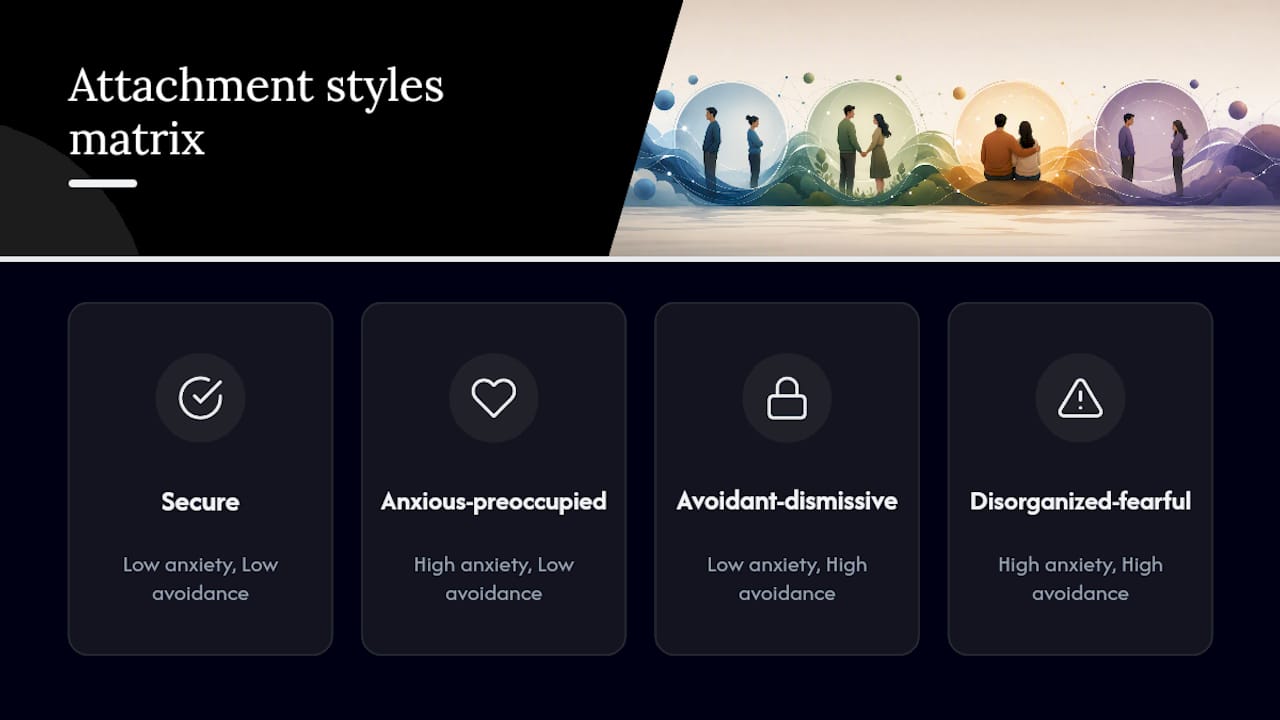
1. Secure attachment
Low anxiety, low avoidance. Securely attached people tend to trust that a partner's love won't vanish over a bad mood or an argument. They ask for what they need directly, tolerate a partner's independence without spiraling, and recover from conflict without holding grudges for days. A securely attached person in a heated argument might say, "I'm frustrated, but I know we'll work through this," and mean it. Many adults studied across attachment research fall closer to this end of the spectrum, though everyone drifts toward insecurity under enough stress.
2. Anxious (preoccupied) attachment
High anxiety, low avoidance. This style craves closeness but doubts it will last. Anxiously attached adults often overanalyze texts, need frequent reassurance, and feel a partner's silence as a personal threat rather than a busy afternoon. In conflict, they tend to pursue: calling repeatedly, over-apologizing, or escalating to get an emotional response, any response, rather than sit with uncertainty. A classic example: a partner doesn't reply for hours, and the anxious partner may already imagine the relationship ending shortly after.
3. Avoidant (dismissive) attachment
Low anxiety, high avoidance. People with this style equate independence with safety. They often pride themselves on not "needing" anyone, minimize their own emotional needs, and pull away exactly when a relationship starts to deepen. During conflict, they tend to withdraw, change the subject, or intellectualize feelings instead of naming them. A dismissive-avoidant partner might respond to "I miss you" with a joke or a logistics question, not because they don't care, but because vulnerability feels like exposure.
4. Disorganized (fearful-avoidant) attachment
High anxiety, high avoidance. This is the push-pull style: a deep desire for closeness fighting an equally deep fear of it. Disorganized attachment often traces back to caregiving that was frightening or unpredictable, meaning the person who should have been a source of safety was sometimes also a source of fear. In relationships, this shows up as approach-withdrawal cycles: pulling a partner close, then panicking and creating distance once they arrive. It's the hardest style to self-diagnose because it can look anxious one week and avoidant the next.
Pro Tip: In the middle of a fight, pause and ask yourself one question: am I chasing reassurance right now, or am I trying to escape the conversation? That single distinction tells you whether anxious or avoidant wiring just took the wheel, and naming it out loud to a partner ("I notice I want to shut down") does more to defuse tension than almost anything else you can say.
How Attachment Styles Develop in Childhood
Attachment styles aren't chosen. They're built, largely in the first two years of life, from thousands of small interactions between an infant and a caregiver. Consistent, responsive caregiving, showing up when a baby cries, reading their cues accurately, tends to produce secure attachment. Caregiving that's loving but unpredictable, sometimes attentive, sometimes distracted or overwhelmed, tends to produce anxious attachment, since the child learns that connection is good but unreliable.
Emotionally distant or dismissive caregiving, where a parent meets physical needs but rarely engages emotionally, often produces avoidant patterns: the child learns not to bother asking. Disorganized attachment frequently traces back to caregiving that involved fear, whether from trauma, abuse, or a caregiver's own unresolved distress, according to Cleveland Clinic's overview of attachment theory.
A few other factors shape the final picture:
- Temperament: some infants are naturally more reactive, which interacts with caregiving quality.
- Later relationships: friendships, mentors, and romantic partners can reinforce or slowly rewrite early patterns.
- Major life events: divorce, loss, or trauma at any age can shift someone toward more anxious or avoidant functioning.
The practical takeaway matters more than the diagnosis: these patterns are expectations your brain formed early, not permanent verdicts. Expectations can be updated with enough new evidence.
Anxious vs. Avoidant vs. Secure Attachment Under Stress
Stress is where attachment style stops being theoretical and starts running the show. Anxious attachment tends to trigger hyperactivation: bigger emotional displays, more urgent bids for reassurance, difficulty self-soothing without a partner's input. Avoidant attachment tends to trigger deactivation: shutting down, minimizing the problem, physically or emotionally leaving the room. Secure attachment tends to produce problem-focused coping, staying present, naming the issue, and working toward resolution without catastrophizing or checking out, according to a review of adult attachment, stress, and romantic relationships.
The research signal: That same review found that insecure attachment, both anxious and avoidant, correlates with lower relationship satisfaction and weaker conflict recovery compared to secure attachment, largely because each insecure style manages stress in ways that block the very reassurance or space the partner needs to see.
Picture a couple after a canceled date night. The anxious partner reads it as rejection and pushes for immediate reconnection. The avoidant partner reads it as a chance to catch a breath and pulls back further than needed. The secure partner reschedules and moves on. None of these reactions are irrational in isolation, but repeated over years, they compound into very different relationship trajectories.
Measuring Your Attachment Style: ECR Scores vs. Quick Quizzes
If you want more than a vibe check, the gold standard instrument is the Experiences in Close Relationships (ECR) inventory, a 36 item questionnaire split evenly between an avoidance subscale and an anxiety subscale, validated through decades of attachment research. Instead of spitting out a single label, it gives you two continuous scores, which is why clinicians favor it: someone scoring moderate on both axes needs a very different conversation than someone scoring extreme on just one.
Free online quizzes borrow language from the ECR but rarely match its psychometric rigor. Worth knowing before you take one:
- What quizzes get right: they're fast, low-pressure, and a legitimate starting point for self-reflection.
- What they miss: test-retest reliability, larger validated samples, and the nuance that comes from two separate dimensional scores rather than a forced category.
- How to read your numbers: a high score on one axis and low on the other usually points to a single dominant pattern (anxious or avoidant); high scores on both suggest disorganized tendencies; low scores on both suggest a secure baseline.
Treat any quiz result, from Testuno's attachment-style test or elsewhere, as a conversation starter rather than a diagnosis. It's a mirror, not a verdict.
Can You Change Your Attachment Style? What "Earned Security" Looks Like
Yes, and this is the part most people skip past too fast. Attachment researchers call it "earned security," a shift toward secure functioning built through corrective relationships, therapy, or sustained self-work, even when childhood attachment was anxious, avoidant, or disorganized, according to Verywell Mind's summary of how attachment styles form and change. The change is gradual. Nobody flips from avoidant to secure after one good conversation.
Three approaches show up repeatedly in clinical practice, including insights from healing inside out and outside in:
- Attachment-based and emotionally focused therapy (EFT): helps partners identify the underlying fear behind a reactive behavior, so a shutdown reads as "I'm scared of failing you" instead of "I don't care."
- Small, seemingly insignificant moments (SIMIs): researchers and clinicians point to tiny repeated interactions, a partner responding calmly instead of defensively, a caregiver showing up consistently, as the actual mechanism behind changing someone's internal expectations, according to BBC's reporting on attachment and SIMIs.
- Structured self-work: worksheets and guided exercises that build self-awareness around triggers, such as those outlined in PositivePsychology's attachment worksheets for adults, give people language for patterns they've never named out loud.
Pro Tip: Pick one specific interaction to change this month, not your whole personality. If you're anxious, practice waiting 20 minutes before sending a follow-up text when you feel ignored. If you're avoidant, practice naming one feeling out loud during a disagreement instead of changing the subject. Security is built in reps, not revelations.
How Testuno's Relationship Assessments Turn Insight Into Action
Reading about attachment theory only gets you so far. Testuno's attachment-style test takes the anxiety and avoidance framework covered above and turns it into a scored, benchmarked profile in about 15 minutes, no sign-up required. You get an immediate read on where you fall on each dimension, plus a downloadable report you can revisit later or bring into a therapy session.
Pair it with the relationship-style test or emotional-availability test for a fuller picture of how your patterns play out with a specific partner. The most useful move after any of these tests isn't just reading the result. It's journaling one recent conflict through that lens, or bringing the report to a conversation with a partner or a licensed therapist who can help you build a concrete plan.
Why Understanding Your Attachment Style Changes How You Fight, Not Just How You Love
The most underrated use of attachment theory isn't romantic at all. It's the moment mid-argument when you recognize "this is my anxious wiring talking" instead of believing every panicked thought your brain hands you. That half-second of recognition is the entire mechanism behind earned security. It's not therapy, it's not a breakthrough, it's just noticing the pattern one more time than you gave in to it.
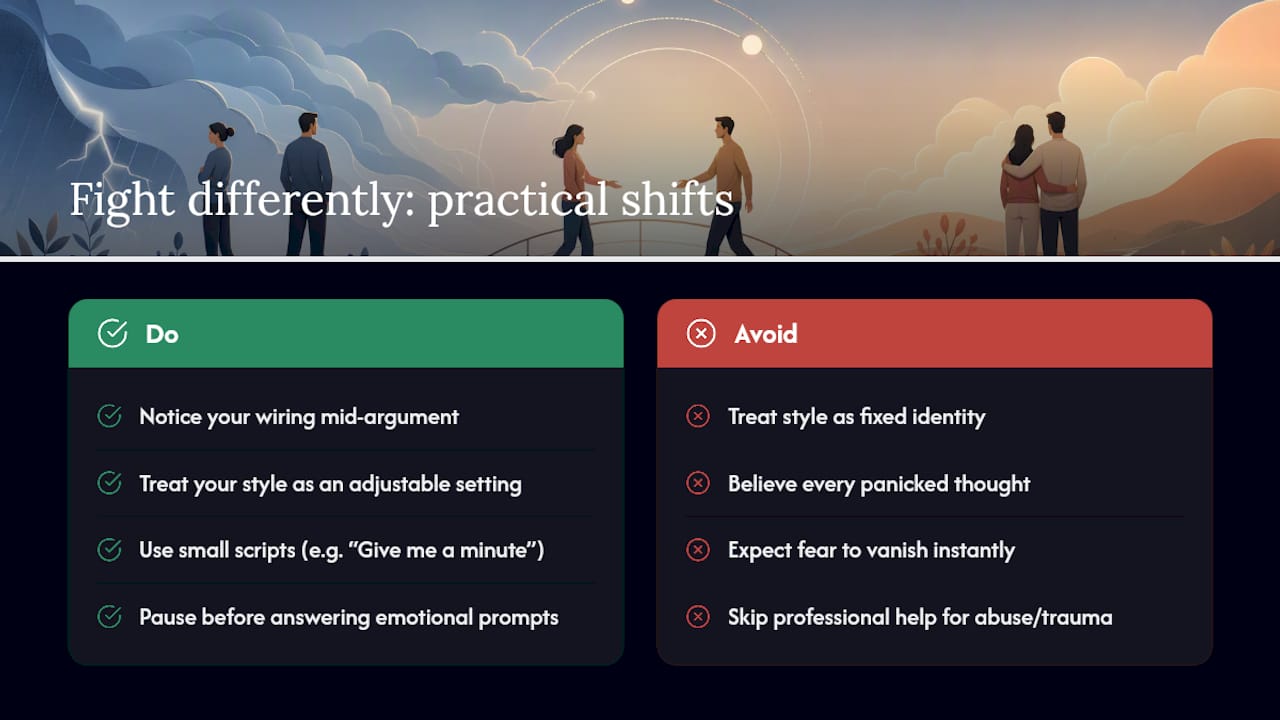
I've seen the reframe work fastest for people who stop treating their style as an identity and start treating it as a setting they can adjust. A dismissive-avoidant client I'd describe (details changed) went from deflecting every emotional check-in to simply saying "give me a minute, I want to answer this right" within a few months, not because the fear of closeness vanished, but because one small script gave the old reflex somewhere else to go.
None of this replaces professional support. If your relationship involves abuse, coercive control, or trauma that surfaces intensely during this kind of reflection, a licensed therapist or a domestic violence resource is the right next step, not a self-assessment.
— Steve
Take the Next Step: Try Testuno's Attachment-Style Test
Understanding the four styles in theory is one thing. Seeing your own anxiety and avoidance scores mapped out, with benchmarking against broader results, makes the pattern real in a way an article never quite can. Testuno's attachment-style test takes about 15 minutes, requires no sign-up, and gives you a downloadable report you can revisit whenever a relationship hits a rough patch.

Once you have your results, do three things: sit with them for a day before reacting, save the report somewhere you'll actually reopen it, and if a pattern feels heavier than expected, bring it into a conversation with a therapist rather than trying to self-diagnose your way out of it alone. If you're curious how your attachment profile connects to your broader personality wiring, Testuno's Big Five personality test is a natural next stop for a fuller self-portrait.
This article is general information, not a substitute for advice from a qualified doctor. Consult a qualified healthcare professional about your own circumstances before acting on anything here.
Sources
- The 4 Attachment Styles Explained
- Attachment theory and attachment styles (Shaver, 2009 chapter/extract)
- Adult attachment, stress, and romantic relationships (PMC review)
- Attachment theory — Cleveland Clinic