

Attention is best assessed by mapping the specific component you need to measure, whether that's selective, sustained, orienting, divided, or executive attention, onto validated task paradigms and standardized tests. The strongest approach combines objective computerized metrics like reaction time variability and omission rates with normative data from batteries like the TEA or TMT, rather than relying on a single test to characterize a multidimensional cognitive system.
TL;DR:
- Most attention assessments should focus on specific components like alerting, orienting, or executive control rather than relying on a single general score.
- Laboratory paradigms such as Stroop, Posner, and ANT tests isolate distinct mechanisms and should be matched carefully to the research question.
- Standardized batteries like TEA or TMT provide normative data and are more suitable for clinical diagnosis than isolated lab tasks.
- Reaction time variability often reveals attentional lapses more effectively than average response times, especially in vigilance tasks.
- Proper test administration requires controlled environments, clear instructions, and consistent metrics, with multiple assessments recommended for reliable interpretation.
Table of Contents
- What Attention Assessment Methods Measure: Core Components
- Task Paradigms for Selective, Orienting, and Executive Attention
- Measuring Sustained Attention and Vigilance
- Standardized Batteries and Clinical Instruments
- Adapting Attention Tests Across Populations
- How to Administer and Score Attention Tests
- Building an Attention Test Battery: A Decision Framework
- Common Pitfalls When Interpreting Attention Test Results
- Where Testuno's Tools Fit Into an Attention Assessment Workflow
- A Clinician-Researcher's Take on Getting Attention Testing Right
- Try Testuno's Attention and Cognitive Assessment Tools
- Sources
What Attention Assessment Methods Measure: Core Components
Attention isn't one thing. It's a set of loosely related systems that happen to share a name, and that's the root cause of half the confusion in this field. A patient can ace a sustained-attention task and still fail miserably at dividing attention between two simultaneous demands. Treating "attention" as a single score is the most common mistake in both research design and clinical reporting.
The taxonomy most reviews now use, including the framework laid out in a comprehensive review of attention tests, breaks attention into distinct, testable components:
- Alerting (tonic and phasic): the baseline readiness to respond and the short-term boost from a warning cue. Tonic alertness drifts across a session; phasic alertness spikes after a cue and fades within seconds.
- Orienting: the ability to direct attention toward a spatial location or sensory channel, either voluntarily or reflexively.
- Selective attention: filtering relevant information while suppressing distractors, the classic Stroop and Flanker territory.
- Sustained attention/vigilance: maintaining performance over an extended, often monotonous, period.
- Divided attention: allocating cognitive resources across two or more concurrent tasks or streams.
- Executive control/shifting: switching rules or task sets, resolving conflict, and updating goals on the fly.
- Spatial attention: attending to specific locations in space, frequently disrupted after right-hemisphere stroke and easy to miss without the right paradigm.
These components overlap in practice. A Trail Making Test score reflects visual scanning, processing speed, and set-shifting all at once, which is exactly why no single test can stand in for a full assessment. This is also why the field has moved toward batteries rather than isolated tools. A test that looks like it measures "sustained attention" often leans just as heavily on motor speed or working memory, and separating those contributions requires more than one instrument. Researchers building an experimental protocol should decide up front which component answers their research question, then work backward to the paradigm, rather than picking a popular test and hoping it fits.
Task Paradigms for Selective, Orienting, and Executive Attention
Laboratory paradigms exist because they let researchers isolate one attentional mechanism while holding everything else constant. Clinical tests are built for norms and diagnosis; lab tasks are built for precision.
Stroop, Flanker, and Eriksen tasks measure interference and inhibitory control by pitting an automatic response against a controlled one. In the classic Stroop, patients name the ink color of a word like "RED" printed in blue; the automatic pull to read the word competes with the instructed task. The dependent measures are the interference cost (the RT difference between congruent and incongruent trials), error rate, and raw reaction time. The Labvanced summary of attention tasks notes these interference paradigms remain a mainstay because they're quick to administer and sensitive to frontal-lobe dysfunction.

Posner cueing and visual search target orienting and spatial attention specifically. In a Posner task, a cue predicts (or misleads about) where a target will appear; the difference in RT between validly and invalidly cued trials is the cue validity effect, a direct measure of how efficiently attention shifts location. Visual search tasks manipulate the number of distractors and measure the search slope, milliseconds added per additional item, which indexes how much attention operates serially versus in parallel.
Attentional Blink and RSVP paradigms probe temporal rather than spatial selection. Two targets appear in rapid succession within a stream of distractors, and if the second target lands within roughly 200 to 500 milliseconds of the first, detection often drops sharply. This tells you something spatial tasks never will: how attention recovers after being captured.
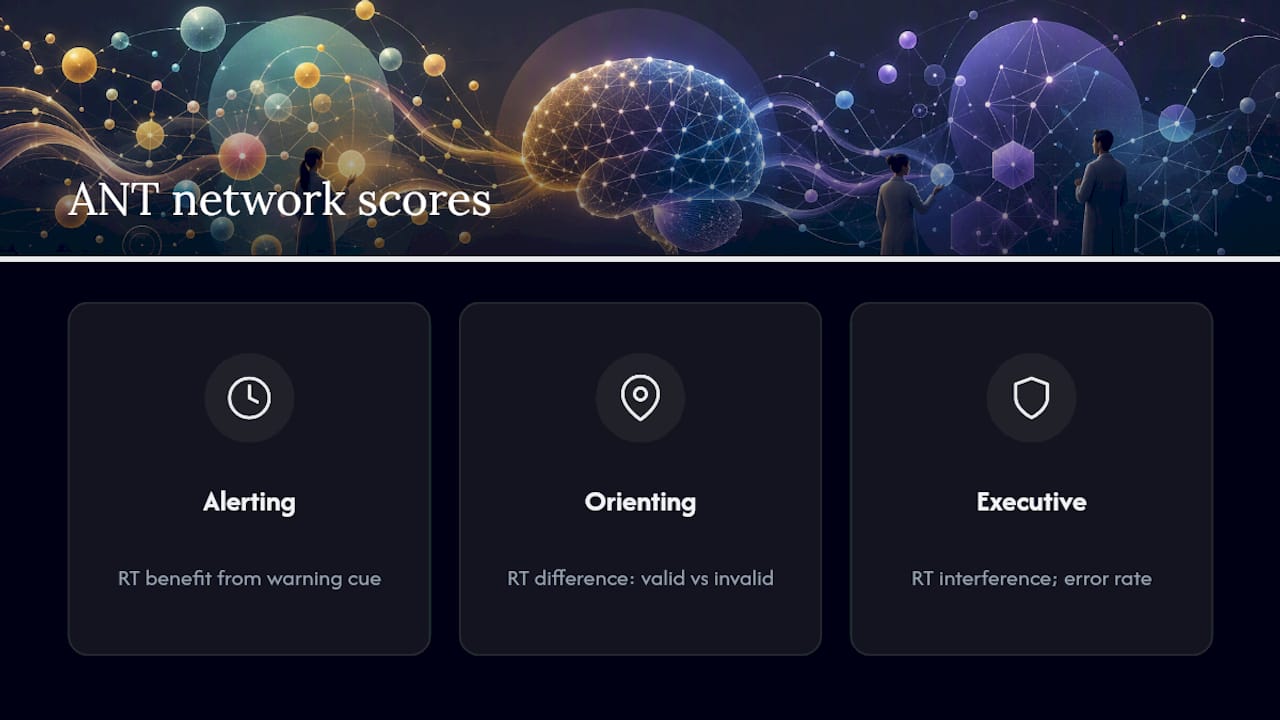
The Attention Network Test (ANT) deserves special mention because it does the dissociation work for you. It layers a spatial cueing procedure on top of a flanker task, producing three separate scores in one session: an alerting effect, an orienting effect, and an executive/conflict effect. For researchers who need to know which network is impaired rather than just that attention is "off," the ANT is often the most efficient single instrument available.
Pro Tip: When choosing between paradigms, match the dependent variable to your question. If you care about accuracy under distraction, prioritize error rate over RT. If you care about processing efficiency, RT and its variability tell a more complete story than accuracy alone, since ceiling effects on accuracy are common in high-functioning samples.
Measuring Sustained Attention and Vigilance
Sustained attention breaks down in a way selective attention doesn't: not through a single dramatic failure, but through creeping lapses over time. That's why vigilance tasks are built to run long and boring on purpose.
The Continuous Performance Test (CPT) family, including commercial variants like TOVA, uses a go/no-go structure. Patients respond to frequent target stimuli and withhold responses to rare non-targets (or vice versa, depending on the variant). Omission errors, missed targets, index inattention. Commission errors, responding when you shouldn't, index impulsivity. Mean reaction time and RT variability round out the profile, and RT variability often carries more diagnostic weight than people expect.
- SART (Sustained Attention to Response Task) flips the usual ratio: frequent go stimuli with rare no-go trials, designed to induce automatic responding so that lapses show up as commission errors on the rare stop trials.
- PVT (Psychomotor Vigilance Task) is the field's gold standard for pure vigilance and sleep-deprivation research, using simple RT to a visual stimulus with no cognitive load beyond staying alert.
- TOVA adds standardized norms and a fixed stimulus set, making it more clinically portable than a generic CPT built in-house.
Reaction time variability, specifically the intra-individual standard deviation across trials, is frequently more informative than the mean RT itself. A patient with a normal average response time but wildly inconsistent trial-to-trial performance is often "zoning in and out" across the session, a pattern common in ADHD and post-concussive presentations. Method summaries on attention measurement techniques point to omission rate, commission rate, mean RT, and RT variability as the four numbers worth extracting from nearly any vigilance task, regardless of the specific software running it.
Task duration matters more than most protocols acknowledge. A vigilance decrement, the gradual worsening of performance over time, typically needs at least 10 to 15 minutes to emerge; shorter tasks risk missing the exact phenomenon they're meant to detect. Practice effects are the other trap: retesting within days on the same CPT variant can inflate scores independent of any real cognitive change, which matters enormously for longitudinal or pre/post designs.
Standardized Batteries and Clinical Instruments
Clinical practice generally can't rely on raw lab paradigms alone, since a reaction time of 480 milliseconds means nothing without a normative reference point. This is where standardized, manualized instruments take over.
The Test of Everyday Attention (TEA) stands apart because its subtests use everyday materials, map searching, phone directories, lottery-style tasks, rather than abstract stimuli. According to Pearson's TEA product documentation, the battery measures selective attention, sustained attention, and attentional switching, with adult norms and a 45 to 60 minute administration window. The child version, TEA-Ch, adapts the same logic for younger populations with age-appropriate stimuli. That ecological grounding raises real-world relevance but costs some experimental precision compared to a stripped-down lab task.
The Trail Making Test (TMT), in its A and B forms, remains one of the most widely used instruments in clinical neuropsychology. Part A requires connecting numbered circles in sequence, measuring visual scanning and processing speed. Part B alternates between numbers and letters, adding a set-shifting demand on top. The B minus A difference score isolates the executive component from raw motor and visual speed.
Several other instruments round out the standard toolkit:
- IVA-CPT combines visual and auditory channels in one continuous performance test, useful for detecting modality-specific attention problems.
- d2 Test of Attention is a paper-and-pencil cancellation task widely used in European clinical and occupational settings, yielding a concentration performance score.
- PASAT requires adding sequentially presented numbers under time pressure, taxing working memory alongside sustained attention, and it appears repeatedly in stroke assessment protocols for its brevity.
- CANTAB subtests, particularly Reaction Time (RTI) and Rapid Visual Processing (RVP), offer computerized, standardized alternatives with tablet-based administration and are common in pharmaceutical trials.
Several of these require formal training or licensure to purchase and administer. The TEA and TOVA both carry proprietary manuals with restricted access, and CANTAB requires a software license through Cambridge Cognition. Researchers designing multi-site studies should budget for this administrative overhead well before data collection starts, since manual acquisition and rater training can take weeks.
Adapting Attention Tests Across Populations
The right instrument for a healthy 25-year-old research participant is rarely the right instrument for a 4-year-old, a stroke survivor three days post-event, or an 80-year-old with mild processing-speed decline. Test selection has to bend to the population, not the other way around.
Preschoolers and young children present unique constraints: limited literacy, short attention for the test itself, and motor demands that can masquerade as cognitive ones. The NIH review of preschool attention assessment recommends performance-based tasks like TEA-Ch alongside simplified, adapted CPTs, but stresses that rating-scale and observational methods from parents or teachers should complement direct testing rather than substitute for it. A four-year-old's "inattention" on a screen task might just reflect an unfamiliar interface, not a cognitive deficit.
Stroke and traumatic brain injury populations need phase-sensitive test selection. A scoping review of 24 attention assessment tools in stroke found that TMT Part A and PASAT were used most frequently across acute, subacute, and chronic phases, largely because both are brief and sensitive enough to administer at bedside. Acute-phase patients generally can't tolerate hour-long batteries; chronic-phase rehabilitation planning benefits from broader, more comprehensive testing once the patient has stabilized. That same review flags spatial attention as commonly under-assessed in stroke protocols, which is a real gap given how frequently right-hemisphere strokes produce hemispatial neglect. Cancellation tasks or Posner-style cueing paradigms fill that gap better than standard CPTs.
Neurodevelopmental disorders and intellectual disability call for nonverbal, simplified formats. Instruments like the Leiter-R or adapted IVA protocols reduce language demands, and administrators need to account for sensory or motor limitations that could otherwise be misread as attentional failure.
Older adults require age-normed instruments specifically, since raw processing-speed decline is a near-universal feature of healthy aging and will otherwise get misattributed to pathology. A 70-year-old scoring "below average" on adult norms built from a 25-year-old sample isn't showing impairment; they're showing an outdated comparison group.
How to Administer and Score Attention Tests
Consistency in setup matters as much as the instrument itself. Two labs running the identical CPT can generate incompatible data if one tests at 9 AM in a quiet room and the other tests at 4 PM in a busy clinic hallway.
- Control the testing environment. Minimize ambient noise and visual distraction, and hold time-of-day constant across repeated measures whenever a longitudinal comparison is planned.
- Document medication and sleep status. Stimulant medication timing, sedating drugs, and prior night's sleep all shift baseline performance independent of any underlying condition.
- Standardize instructions and include practice trials. Unfamiliarity with a novel interface inflates early error rates in ways that look like genuine deficits but aren't.
- Extract the core metrics consistently: accuracy, omission and commission counts, mean RT, RT standard deviation, and, where the design allows, an interference score or d-prime sensitivity index.
- Apply clear exclusion criteria. Flag outlier trials, sessions with excessive missing data, or evidence the patient misunderstood instructions before treating a session as valid.
- Report a full methods checklist in any publication or clinical note: exact task parameters, the normative dataset used, known reliability coefficients, sample demographics, and the scoring thresholds applied.
Pro Tip: Before trusting a low score as a "deficit," check RT variability first. A patient with unremarkable mean RT but a standard deviation well above their own baseline is often lapsing in and out of attention rather than showing a stable, trait-level impairment, and that distinction changes the entire clinical interpretation.
Building an Attention Test Battery: A Decision Framework
Choosing tests in isolation, without a guiding question, is how batteries end up bloated with redundant measures and missing the one component that actually matters for the case at hand.
Work through the selection in order:
- Define the question first. Are you screening for a possible disorder, diagnosing severity, or tracking change over an intervention?
- Map the question to a component. A complaint about "losing focus while reading" points toward sustained attention and executive control, not spatial orienting.
- Check feasibility constraints. Session length tolerance, literacy, motor ability, and available equipment all narrow the realistic options.
- Select one to three validated tasks plus a questionnaire. A brief CPT paired with a Stroop-type interference task and a self-report scale, like the Attention Control Scale, covers objective and subjective ground without excessive testing burden.
The right battery size depends entirely on the purpose, and it scales up as the stakes and available time increase.
| Battery type | Duration | Typical components | Best fit |
|---|---|---|---|
| Screening battery | 45 to 60 minutes | One CPT-type task, one interference task, brief questionnaire | Initial workup, pre-visit triage, research pre-screening; see an overview of CASPer vs PREview: What Every Premed Must Know for related screening approaches |
| Diagnostic battery | 45 to 60 minutes | TEA or TMT A/B, PASAT or CANTAB subtests, rating scales, clinical interview | Formal neuropsychological evaluation |
| Experimental battery | Task-specific, often 45 to 60 minutes | ANT, Posner cueing, RSVP/Attentional Blink, tailored to the research question | Hypothesis-driven lab research |
Ecological validity and experimental control sit in permanent tension. Tasks built on everyday materials, the TEA's map-reading subtest is the textbook example, generalizes better to daily function but sacrifices the tight stimulus control a lab paradigm offers. Cost and training requirements matter just as much in practice: a proprietary CANTAB license and rater certification represent a real budget line, while a well-validated open-access CPT variant costs nothing but researcher time.
Common Pitfalls When Interpreting Attention Test Results
A single low score on a single task is weak evidence of anything. That single sentence would save a lot of misdiagnosed patients and a lot of failed replications if researchers and clinicians actually internalized it.
- Cross-task correlations are often inconsistent. A patient can perform normally on a Stroop task and abnormally on a CPT, because the two measure genuinely different mechanisms, not because one test is "wrong."
- Confounds routinely masquerade as attention deficits. Fatigue, low motivation, medication timing, and language or cultural unfamiliarity with the testing format can all suppress scores independent of true attentional capacity. Document each of these explicitly rather than assuming a clean result.
- A single test rarely justifies a diagnostic label. Findings that suggest impairment should trigger a fuller neuropsychological evaluation or medical workup, not an immediate conclusion.
- Repeated measures beat single snapshots. Testing on more than one occasion, ideally with alternate forms to reduce practice effects, and triangulating with questionnaires or informant reports produces a far more defensible picture than any one session can.
Conservative interpretation isn't a weakness in this field. Given how many nonattentional factors can drag down a score, treating any single result as provisional until corroborated is simply good practice.
Where Testuno's Tools Fit Into an Attention Assessment Workflow
Testuno's short, interactive tools are built for the screening and monitoring end of this spectrum, not as a replacement for formal neuropsychological testing. The distinction matters, and it's worth being direct about it.
The platform's attention-test delivers a brief, structured task with instant feedback on speed and consistency, useful as a first-pass check or as a between-visit monitoring tool for someone already under clinical care. Related tools extend the same logic across adjacent domains:
- The visual-reaction-time-test captures raw RT and variability, the same metrics that anchor CPT and PVT interpretation in clinical settings.
- The working-memory-test covers a component that interacts heavily with sustained and divided attention, since holding information online while filtering distraction taxes both systems together.
- The cognitive-profile report bundles results across domains into one summary, which mirrors, on a smaller scale, the logic behind a full clinical battery.
None of these tools replace a TEA administration, a TMT scored against clinical norms, or a clinician's judgment. They take about 15 minutes, require no account creation, and are best used as a low-friction screen: something a patient completes before an appointment, or something a researcher uses to flag participants who may need a fuller workup. Anyone using these results in a professional context should export or record scores and share them directly with a treating clinician rather than treating the output as a standalone conclusion, and any result suggesting impairment warrants a proper clinical referral.
A Clinician-Researcher's Take on Getting Attention Testing Right
The biggest mistake I see in both clinics and labs isn't picking the wrong test. It's picking one test and stopping. Three habits fix most of what goes wrong.
First, control the environment obsessively. Same room, same time of day, same instructions, every session. Second, always pull RT variability, not just accuracy or mean RT. A patient who looks fine on average but swings wildly trial to trial is telling you something a summary score hides. Third, know when to stop testing: once a patient shows clear fatigue or frustration, additional trials produce noise, not data.
For a fast, defensible screen, I'd run a brief CPT, a short Stroop-style inhibition task, TMT Part A, and one self-report questionnaire. Twenty to thirty minutes, covers sustained attention, inhibitory control, and processing speed, and gives you a subjective anchor to compare against the objective numbers. The most common mistake in clinics is skipping that questionnaire entirely and missing the gap between how someone performs and how they actually experience their own attention day to day.
— Steve
Try Testuno's Attention and Cognitive Assessment Tools
If you've read this far, you already know a single test score never tells the whole story, but you still need a fast, reliable starting point before committing to a full battery. That's exactly the gap Testuno's screening tools are built to fill: no sign-up, about 15 minutes, and immediate feedback on the metrics that actually matter, reaction time, consistency, and accuracy, rather than a vague overall impression.

Start with the attention-test to get a baseline read, then pair it with the cognitive-profile if you want attention results contextualized alongside memory and processing speed in one report. Researchers and students exploring related domains can also check the nonverbal-iq-test for a broader cognitive snapshot. None of this substitutes for a clinical evaluation. If your results, or a patient's, point toward a real deficit, treat that as a reason to seek a formal neuropsychological workup, not a final answer. Take the screening test now and see where your numbers land.
Sources
For readers building a protocol or writing up methods, four sources are worth reading in full rather than secondhand. The NIH review on preschool attention assessment covers developmental testing constraints in depth. The stroke scoping review maps 24 tools across recovery phases. The Springer 2023 review of attention tests offers the broadest cross-instrument comparison available. And the TEA manual through Pearson remains the primary reference for administration and norms. Always consult the specific test manual before clinical use rather than relying on secondary summaries alone.
- Assessment of Attention in Preschoolers - PMC - NIH
- A comprehensive review of attention tests: can we assess what we exactly do not understand? - Springer