

Attention is the brain's spotlight, the part of your mind that picks what deserves notice out of everything competing for it. Concentration is what happens after that spotlight lands: the sustained, effortful work of keeping your mind fixed on one thing while everything else tries to pull it away. Practice attention control first, since concentration is nearly impossible to sustain if your spotlight keeps jumping to the wrong target.
TL;DR:
- Attention automatically filters stimuli and is easily hijacked by notifications or environmental distractions, making focused tasks difficult without control.
- Concentration requires deliberate effort, deepens over time, and is highly susceptible to fatigue, benefiting from structured breaks like the Pomodoro technique.
- Improving attention involves environmental adjustments to reduce interruptions, while enhancing concentration depends on short, focused work sessions with minimal external disruptions.
- Tasks measuring attention and concentration use the CPT test, with duration and target frequency affecting what cognitive processes are evaluated, but self-assessment can track personal progress.
- Disruptions like ADHD, trauma, or emotional stress mainly impair sustained concentration, not the ability to notice stimuli, which is crucial for effective learning and safe response.
Table of Contents
- Attention vs. Concentration: The Brain's Filtering System
- Types of Attention You Use Every Day
- What Makes Concentration Different From Attention
- How Attention and Concentration Work Together
- Why the Difference Between Attention and Concentration Matters
- How to Actually Improve Attention and Concentration
- How Scientists Actually Measure Attention and Concentration
- Key Takeaways on Attention vs. Concentration
- The Brain Circuits Behind Focus and Sustained Effort
- Conditions That Disrupt Attention and Concentration
- Attention and Concentration Change Across the Lifespan
- Motivation, Emotion, and How They Shape Focus
- Why This Distinction Actually Changes How You Work
- Track Your Own Attention and Concentration Skills
- Sources
Attention vs. Concentration: The Brain's Filtering System
Attention is the mechanism your brain uses to decide what matters right now, out of the flood of sound, light, and thought hitting it every second. Cognitive psychologists often describe it with the spotlight metaphor: a beam of mental awareness that can swing toward a voice, a flash of movement, or a stray thought, then swing away just as fast. This filtering happens automatically most of the time. Your name spoken across a noisy room, a phone buzzing on the desk, a car horn outside. None of those require effort to notice; your attention grabs them before you've decided to look.
That automatic pull is one mode. The other is controlled: you deliberately point your spotlight somewhere, like scanning a page for a specific word or watching a single runner in a crowded race. Researchers sometimes break this down further into three functional pieces: alerting (staying ready to respond), orienting (aiming attention at a specific location or stimulus), and executive control (resolving conflict between competing signals). You don't need to memorize those labels to understand the difference between attention and concentration, but they help explain why attention feels effortless one moment and demanding the next.
A few everyday triggers show both modes in action:
- Hearing your name in a crowded restaurant, even mid-conversation with someone else.
- Flinching at a sudden loud noise before you've consciously registered what made it.
- Glancing at a phone notification the instant the screen lights up.
- Scanning a parking lot specifically for your own car among fifty identical models.
Cognitive psychology treats attention as the brain's initial filtering mechanism, the gatekeeper deciding what gets processed further. Concentration, as the next section explains, is what happens once something makes it through that gate.
Types of Attention You Use Every Day
Attention isn't one skill; it's a set of related but distinct abilities, and knowing the difference between them explains why some mental tasks feel easy and others wear you out fast.
- Selective attention is the ability to focus on one input while ignoring competing ones, like following a single conversation at a loud party while other voices blur into background noise.
- Sustained attention is holding that focus over time without drifting, the skill tested when you monitor a slow-moving process, like watching a pot for the moment it boils.
- Divided attention is trying to process two or more streams of information at once, such as listening to a podcast while replying to texts. It works for simple, low-stakes tasks but breaks down fast under complexity.
- Alternating (executive) attention is the skill of switching between tasks or mental sets on purpose, like moving from reading a spreadsheet to answering a phone call and back again.
The costs show up mostly in divided attention. Attention has a limited capacity, and splitting it across tasks doesn't create two smaller streams of full focus. It usually creates rapid switching that feels like multitasking but performs closer to doing two things badly than one thing well. That's part of why sustained selective attention, the kind measured in cognitive testing, is treated as a separate skill from working memory, even though the two are closely related in practice.
What Makes Concentration Different From Attention
Attention notices. Concentration stays. That's the core split: attention is the act of selecting a target, while concentration is the sustained, effortful work of keeping your mind locked on that target once distractions start showing up.
Concentration has a few signature traits attention doesn't:
- It requires conscious effort rather than happening automatically.
- It resists distraction actively, rather than simply not encountering one.
- It deepens over time, often building toward the immersive state researchers and writers call flow.
- It depletes with use, which is why an hour of deep concentration feels more draining than an hour of casual attention.
Pro Tip: If you notice your mind wandering after some time of focused work, that's not a personal failing. Concentration naturally tends to fluctuate, requiring breaks to maintain effectiveness.
That rhythm is exactly why the Pomodoro technique, working in 25 minute focused intervals followed by short breaks, has held up as a practical structure rather than a productivity fad. It matches concentration's natural limits instead of fighting them. Attention can flicker on and off all day with no cost. Concentration can't; every time it breaks and restarts, you pay a small tax in ramp up time before you're back at full depth.
How Attention and Concentration Work Together
The two function in sequence more often than not. Attention notices something worth engaging with; that noticing narrows into focus, the intent to work on it; and if the task holds your interest long enough, focus deepens into concentration, the sustained state where distractions stop registering.
A student flipping through a textbook, for example, moves through all three stages in seconds: attention catches an interesting diagram, focus narrows onto that page, and concentration takes over once she starts working through the underlying formula. Sustained selective attention and working memory overlap here, since holding a problem "in mind" while working it out draws on both systems simultaneously.
The two can also split apart. You can have attention without concentration: noticing a dozen things in a busy room without settling on any of them. And you can have concentration collapse attention's flexibility: deep focus on a single task can make you miss an obvious change happening right in front of you, a phenomenon closer to tunnel vision than to normal noticing.
Why the Difference Between Attention and Concentration Matters
The gap between attention and concentration shows up directly in how well you learn, work, and stay safe. Skimming a textbook with scattered attention produces recognition without retention; you'll recognize the material on a re-read but struggle to recall it cold. Real retention needs the sustained, effortful state of concentration, not just repeated exposure.
The same split shows up in daily scenarios. A driver who notices a pedestrian (attention) but is deep in a phone conversation (divided attention pulling against concentration) reacts slower than one giving the road full sustained focus. A meeting where someone nods along while mentally drafting an email is present in attention only, and it shows in what they contribute afterward.
Modern environments make this harder by design. Notification pings, open browser tabs, and app badges are built to hijack attention constantly, and each hijack costs you the ramp up time needed to rebuild concentration. Information overload doesn't just distract you; it trains your brain to expect frequent interruption, which makes sustained concentration feel unfamiliar and effortful even when nothing is actively pulling at you.
How to Actually Improve Attention and Concentration
Environment control does more work than willpower ever will. Put your phone in another room, not just face down on the desk; studies on attention consistently show that visible devices pull at cognitive resources even when you're not touching them.
A few habits move the needle further:
- Silence notifications during focused blocks instead of trying to ignore them as they arrive.
- Automate small recurring decisions (what to eat, wear, or check first) so your limited concentration goes toward the task that actually needs it.
- Use spaced repetition rather than cramming when you're trying to retain information long term. A structured spaced repetition approach builds retention that single sustained sessions can't match.
- Practice short mindfulness sessions; research on attention training suggests regular short practice improves the ability to resist distraction over a matter of weeks.
- Protect sleep, movement, and hydration; all three directly affect how long sustained attention holds up before it degrades.
Some people also find guided sound-based practices useful for training the shift into a focused state; structured sound meditation methods are one option worth trying if traditional mindfulness apps haven't clicked.
Pro Tip: Start with a single 25 minute block of protected, notification-free work today. Don't try to overhaul your whole routine at once. Concentration improves through repeated short wins, not one dramatic reset.
How Scientists Actually Measure Attention and Concentration
Attention and concentration aren't measured with a stopwatch and a gut feeling. The standard tool in cognitive research is the Continuous Performance Task, or CPT: a computer-based test where you respond to specific targets (a letter, a shape, a sound) while ignoring similar-looking non-targets over an extended period.
Task length and design change what a CPT is actually capturing. Task parameters like duration and target frequency determine whether the test measures pure vigilance, inhibition control, or something closer to working memory, which is why comparing results across different tests can be misleading.
A few practical notes worth knowing if you ever look at attention test results:
- Typical CPT durations in published research vary within a range sufficient to measure different aspects of attention, depending on the focus of the test.
- Target frequency (how often the thing you're watching for actually appears) shapes difficulty and what mental process gets taxed.
- Sustained attention and working memory show only modest correlation on these tasks, confirming they're related but separate skills, not the same thing measured twice.
- Longer tasks measure vigilance more accurately but introduce fatigue, which can quietly distort the results if a test runs too long.
Short, well-designed self-assessments can be genuinely useful for tracking whether your concentration is improving over weeks, though they're not a substitute for formal evaluation if you suspect an underlying attention disorder. If you're curious how your working memory holds up alongside sustained attention, a working memory test shows how those two systems interact in practice.
Key Takeaways on Attention vs. Concentration
Attention picks the target; concentration holds it. That's the whole distinction in one line, and everything else builds on it.
- Practice controlling where attention lands first; concentration can't stick to a target that keeps shifting.
- Cut environmental noise (notifications, open tabs, phone visibility) before trying to force longer focus sessions.
- Track your progress with short, repeatable check-ins rather than trying to judge concentration by feel alone.
- Build in short breaks every 25 minutes or so; concentration has a natural rhythm, not an unlimited tank.
The Brain Circuits Behind Focus and Sustained Effort
Attention and concentration aren't run by one brain region acting alone. Alerting, orienting, and executive control draw on at least three partially separate neural networks, which is part of why you can be alert but poorly oriented (jumpy and distractible) or well oriented but low on executive control (locked onto the wrong thing and unable to switch).
The frontal and parietal lobes coordinate most of the deliberate, controlled side of attention, the part responsible for choosing a target and holding it. The brainstem's reticular activating system handles the more basic alerting function, keeping you generally ready to respond to anything. Concentration leans harder on the prefrontal cortex, the region responsible for sustained goal-directed effort and resisting the pull of competing stimuli. That's part of why concentration feels metabolically expensive; you're recruiting more deliberate, resource-hungry circuitry than you use for casual, automatic noticing.
Neural signatures also differ between a failure of sustained attention (drifting off mid-task) and a failure of orienting (missing something entirely). These show up as distinct patterns in brain activity, which supports treating attention and concentration as genuinely separable mental states rather than two words for the same experience. Dopamine and norepinephrine both play a role in how well these networks stay engaged, which is part of why fatigue, stress, and even blood sugar swings can knock concentration out before attention itself seems affected.
Conditions That Disrupt Attention and Concentration
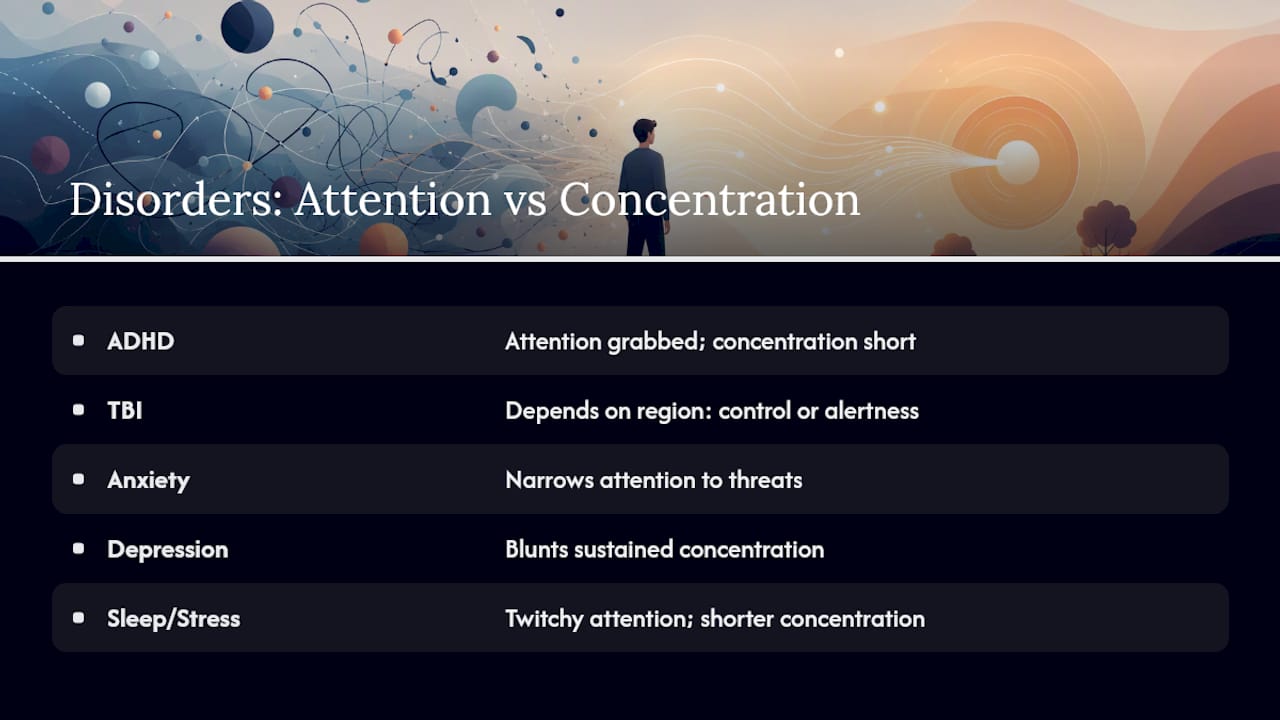
ADHD is the most familiar disorder tied to attention and concentration problems, and it illustrates the difference between the two better than almost any other condition. People with ADHD often don't struggle to notice things; if anything, their attention gets pulled toward stimuli more easily than most people's. What breaks down is sustained concentration: holding focus on one target long enough to finish it, especially when the task isn't inherently interesting.
Traumatic brain injury affects the two differently depending on which brain regions are damaged. Damage to frontal or parietal regions tends to disrupt controlled attention and executive switching, while damage closer to the brainstem can affect basic alertness itself. Recovery patterns vary widely, and a person recovering from a concussion might notice things fine but exhaust their concentration within minutes of sustained effort.
Anxiety and depression also interfere, though through a different mechanism. Anxiety tends to narrow attention onto perceived threats, making it harder to select the right target. Depression more often blunts concentration directly, draining the effortful, sustained side of focus while leaving basic noticing relatively intact. Sleep disorders and chronic stress produce a milder version of the same pattern: attention becomes twitchy and easily grabbed, while concentration shortens and becomes harder to re-enter after any interruption.
Attention and Concentration Change Across the Lifespan
Attention and concentration develop on separate timelines, and neither matures fully until well into adulthood. Young children show strong automatic attention (they notice everything) but very limited sustained concentration, which is why a five-year-old can spot a tiny detail across a room yet struggle to sit through ten minutes of quiet reading.
Concentration capacity extends gradually through childhood and adolescence as the prefrontal cortex matures, a process that isn't fully complete until the mid-twenties. That's a big part of why school schedules for younger students build in more frequent breaks than college courses do; it's matched to the sustained concentration capacity typical for the age group, not just tradition.
Adults generally hit peak sustained concentration capacity in their late twenties through forties, though the pattern isn't universal, and individual variation is considerable. Aging brings a different shift: automatic attention (noticing sudden stimuli) tends to hold up reasonably well into older adulthood, while sustained concentration, especially on tasks requiring rapid switching or high working memory load, tends to decline gradually. This isn't uniform decline across every cognitive domain, which is one reason age related cognitive change is usually described in terms of which specific skills shift rather than a blanket loss of sharpness.
Motivation, Emotion, and How They Shape Focus
Motivation doesn't just make concentration feel easier; it changes how long your brain is willing to sustain effortful focus before switching to something else. A task that feels personally meaningful or urgent recruits concentration far more easily than one that feels arbitrary, even when the cognitive demand is identical.
Emotion works on both attention and concentration, but in different ways. Strong emotional stimuli (a threat, a reward, a social cue) grab attention almost automatically, often overriding whatever you intended to focus on. That's adaptive in genuinely dangerous situations, but it's exactly why an anxious thought or a tense email notification can hijack your spotlight mid-task even when you know intellectually it can wait.
Concentration responds to emotion more gradually. Chronic stress and low mood tend to drain the sustained effort concentration requires, which is one reason productivity often drops during emotionally difficult periods even when attention itself seems unaffected; you notice things fine, but holding focus on any one of them for long feels harder than usual. Positive engagement, on the other hand, tends to extend concentration, which is the underlying mechanism behind flow states: when a task is challenging but achievable and personally rewarding, concentration sustains itself with far less conscious effort than it normally requires.
Why This Distinction Actually Changes How You Work
Most advice on focus treats attention and concentration as interchangeable, and that's the mistake worth calling out directly. Telling someone to "just concentrate" when their real problem is a chaotic, notification-heavy environment hijacking their attention is solving the wrong layer of the problem. You can't concentrate your way out of an attention problem, and you can't fix a concentration deficit by removing distractions alone if the underlying task genuinely bores you.
What surprises people once they separate the two is how much of what feels like "bad focus" is actually an attention problem in disguise. The fix isn't more willpower; it's reducing how often your spotlight gets forcibly redirected. Fix the environment first, then work on the sustained effort piece. Doing it in the wrong order is why so many productivity systems fail within a week.
— Steve
Track Your Own Attention and Concentration Skills
Reading about attention and concentration only gets you so far; knowing where your own skills actually stand is more useful than guessing. Testuno's cognitive assessments give you a concrete read on that, with interactive tests covering attention, processing speed, and related skills, delivered with instant feedback and no sign-up required.

A short attention or concentration check-in works well as a baseline before you start applying the strategies above, then again a few weeks later to see whether shorter Pomodoro-style sessions or a quieter workspace actually moved the needle. Since concentration draws heavily on working memory, pairing an attention check with Testuno's working memory test gives a fuller picture of where your cognitive bottlenecks really are. If you want the broader context those scores sit inside, Testuno's full IQ test takes about 15 minutes and returns a detailed cognitive profile with percentile benchmarking, so you can see exactly how your attention and concentration scores compare against real population data.
Sources
- Module 3: Attention and memory | Lumen Learning (SUNY HVCC)
- Article on sustained selective attention and working memory (PMC)
- What is attention? | Verywell Mind
- Understanding Attention vs Concentration: Key Differences and Benefits | Upbility