

On modern, age-normed IQ tests, the average score for any age group is 100. That's true whether you're comparing 8 year olds against other 8 year olds or 70 year olds against other 70 year olds, because modern IQ tests are built to set the population mean at 100 for each age bracket. The catch is that "average" hides a lot of movement underneath it.
Two things complicate the picture. First, different tests use different subtests and different norm samples, so reported averages can shift depending on which test someone took and when it was normed. Second, the skills that make up intelligence don't age the same way. Fluid reasoning (the raw problem-solving speed you bring to a novel task) and crystallized knowledge (what you've learned and stored over time) follow separate, sometimes opposite, trajectories across a lifespan.
Most people score between 85 and 115, which covers the broad middle of the bell curve.
If you're holding an IQ score for yourself or your child, here's what to do with it:
- Treat it as one data point, not a verdict
- Ask which test was used and how recently it was normed
- Consider a retest if the score seems inconsistent with everyday performance
- Get a full educational or psychological assessment if you need decisions made about school placement or support
Key Takeaways
Age-normed IQ tests fix the population mean at 100 for every age group, so meaningful comparison depends on percentile, subtest profile, and norm sample, not the raw number alone.
| Point | Details |
|---|---|
| Mean is always 100 | Every age bracket is normed so the average score sits at 100, by design, not by coincidence. |
| Most scores cluster tightly | Roughly 68% of people score between 85 and 115; above 130 covers about 2.5%. |
| Fluid and crystallized diverge | Fluid reasoning often peaks in the 20s while crystallized knowledge can keep rising into older adulthood. |
| Context changes the number | Test type, language, fatigue, and norm sample all shift results, so treat one score cautiously. |
| Testuno gives a fast benchmark | Testuno's IQ test offers age-normed scoring and percentile feedback in about 15 minutes. |
Table of Contents
- Average IQ by Age: How Scores Get Standardized
- What Is the Average IQ for Each Age Group?
- Fluid vs. Crystallized Intelligence: Why the Same Score Hides Two Different Stories
- How to Interpret Your IQ Score and Percentile
- What People Get Wrong About IQ Staying "The Same" Forever
- Get an Age-Benchmarked IQ Score in About 15 Minutes
- Frequently Asked Questions
- Sources
Average IQ by Age: How Scores Get Standardized
IQ measures how well someone solves problems, reasons abstractly, and processes information relative to others. It is not a measure of knowledge alone, and it's not fixed at birth. The major tests in use today, the Wechsler scales and the Stanford-Binet among them, all rely on the same core trick: age-norming.
Age-norming means your raw score, the number of items you got right, gets converted into a standard score by comparing you only to people your own age. That's why a 9 year old and a 45 year old can both score 100 despite answering very different sets of questions with very different speed and accuracy. The comparison group, not the test content, determines the number.
Here's the standardization logic in three steps:
- A large, representative sample takes the test and their raw scores form a bell curve for each age band.
- Statisticians set the mean of that curve to 100 and the standard deviation to 15, the near-universal convention across major scales.
- Every future test-taker's raw score gets mapped onto that curve, so a score of 115 always means "one standard deviation above same-age peers," regardless of age.
That standard deviation of 15 is what makes IQ bands meaningful. One SD above or below 100 covers roughly two-thirds of the population, which is why 85 to 115 is called the "average" range. Two SDs out, in either direction, is where the rarer labels start applying.
Pro Tip: If you're comparing scores from two different tests, or the same person tested years apart, don't assume the numbers are directly comparable. Norm samples and test editions vary by country and by publisher, so a 110 on one test and a 110 on another aren't always measuring the identical thing.
What Is the Average IQ for Each Age Group?
Because every age-normed test centers its mean at 100, the honest answer to "what's the average IQ at age 30?" or "what's the average IQ at age 8?" is the same number: 100. What changes across ages isn't the center of the curve. It's the raw cognitive performance underneath that gets rescaled to keep landing on 100.
The table below draws from the norm tables published by BBC's Test the Nation project and the general population data summarized by MedicineNet, both of which describe age-normed centers rather than raw, un-adjusted scores.
The most counterintuitive row for most readers is older adulthood. People assume IQ drops sharply late in life, but the composite score stays anchored at 100 because the test is renormed for that age group. What actually shifts is the internal mix: fluid tasks (matrix reasoning, novel puzzles) get harder relative to a person's own younger self, while vocabulary and general knowledge tasks often hold up or even improve.
A few things worth flagging about this data before you read too much into any single row:
- These are population centers, not individual predictions. Your own trajectory depends on health, education, and genetics.
- The BBC and MedicineNet tables reflect specific norm samples, mostly Western, English-speaking populations, and results can differ meaningfully in other countries or with other test editions.
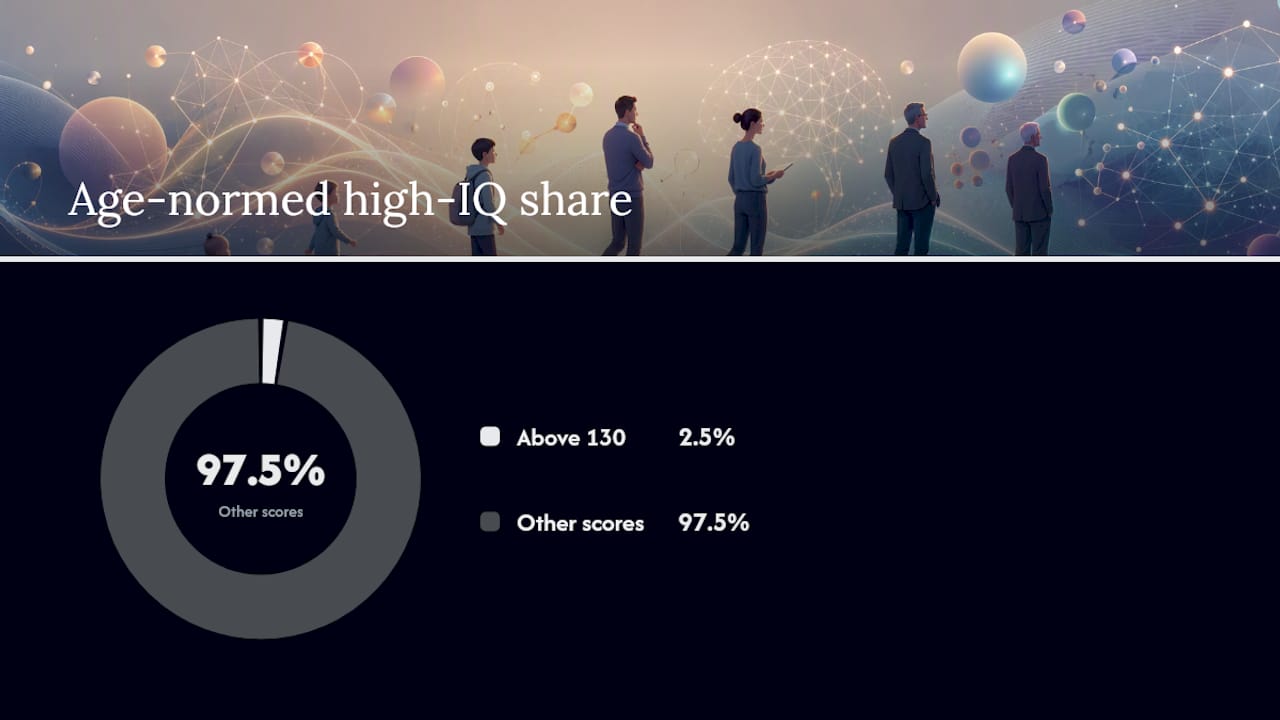
- Roughly 2.5% of any age-normed sample scores above 130, a consistent statistical feature of the age-normed model rather than a fact about any particular age being "smarter."
- Composite scores can look stable across a decade of testing even when a person's fluid and crystallized subtest scores are moving in opposite directions.
That last point deserves its own explanation, because it's the single biggest source of confusion in how people read age-specific IQ data.
Fluid vs. Crystallized Intelligence: Why the Same Score Hides Two Different Stories
Fluid intelligence is your raw capacity to reason through something you've never seen before: a new pattern, an unfamiliar puzzle, an abstract sequence. Crystallized intelligence is the opposite side of the coin. It's what you've accumulated: vocabulary, facts, procedures, learned strategies. Research on cognitive aging shows these two systems age on almost opposite schedules.
Fluid intelligence tends to peak in your early to mid-20s, then declines gradually and fairly steadily from there. Crystallized intelligence, by contrast, often keeps rising into middle age and can hold steady well into your 60s or 70s, since it's built on decades of accumulated learning rather than raw processing horsepower.
Here's why this matters for interpreting an age-specific score:
- A composite IQ score is an average of subtests, so it can stay flat even as fluid and crystallized components move in opposite directions underneath it.
- A 50 year old and a 25 year old can both land on a composite of 110, but the 50 year old likely got there with stronger vocabulary and knowledge scores offsetting slower processing speed, while the 25 year old's fluid reasoning is doing more of the lifting.
- Subtest-level results (not just the single composite number) are what actually tell you where someone's cognitive strengths lie.
- Career and educational implications differ by which channel is stronger: fluid strength tends to predict how fast someone picks up something brand new, while crystallized strength predicts depth of existing expertise.
Pro Tip: If a full report breaks your score into index scales instead of just one number, read those subscores before you read the composite. The composite is useful for a quick benchmark, but the subscores tell you whether you're a fast learner, a deep knowledge-holder, or both.
How to Interpret Your IQ Score and Percentile
Once you have a number, the next question is what it actually says about you relative to everyone else your age. Here's how the standard bands break down:
- 70 and below is generally labeled "borderline impaired," sitting more than two standard deviations under the mean and covering roughly the bottom 2% of the distribution.
- 85 to 115 is the broad "average" range, covering roughly 68% of test-takers, the middle two-thirds of the bell curve.
- 116 to 130 falls into "above average" to "superior" territory, still common enough that plenty of high-achieving students and professionals land here.
- Above 130 is labeled "very superior" and covers roughly the top 2.5% of scores, the threshold groups like Mensa use for entry qualification.
A single test score is a snapshot, not a permanent label. Test conditions matter more than most people assume: fatigue, anxiety, language fluency, socioeconomic background, and even the room you're tested in can nudge a score up or down several points. A child tested while sick or a non-native speaker tested in a second language will often score below their real capability, not because the test is measuring intelligence incorrectly, but because it's measuring something else that day too.
For parents wondering what to do with a number, three steps generally make sense. Get a full educational assessment before making any placement decisions, since a single screening test is not the same as a comprehensive evaluation. Track strengths and struggles across schoolwork and daily life, not just the test score. And treat the IQ figure as one input among many, alongside teacher feedback, grades, and behavioral observations.
Pro Tip: If you're evaluating a child's score, check whether the test used was individually administered by a psychologist or a group screening test. The two carry very different reliability, and only the former should factor heavily into placement decisions. Parents navigating this for younger children may find Omniprism's resources on child development useful as a complementary reference point.
What People Get Wrong About IQ Staying "The Same" Forever
The idea that IQ is fixed at birth and never moves is one of the most persistent myths in psychology, and it's simply not supported by how these tests are built or how cognition actually behaves across a lifespan. Composite scores can look remarkably stable for a given person over decades, but that stability is partly an artifact of age-norming, not proof that the underlying brain never changes.
What's actually happening underneath a "stable" composite score is a slow trade: fluid reasoning erodes a little while crystallized knowledge often compensates, sometimes for decades. That's not stagnation. That's two systems moving in opposite directions and canceling each other out on paper.
The other place people overreach is comparing scores across countries or test editions as if they're all measuring the exact same yardstick. Country-level average estimates vary, and norm samples differ by test publisher and by decade. A score of 100 on a test normed in one country in one decade isn't automatically identical to a 100 on a different test normed elsewhere. None of this means IQ scores are meaningless. It means the number needs context: which test, which norm sample, what age, and what else was going on in the room that day.
Get an Age-Benchmarked IQ Score in About 15 Minutes
If you've read this far wondering where your own number falls, Testuno's IQ test gives you an age-benchmarked estimate built from six research-grounded subtests, with real-time percentile ranking so you can see exactly where you land against people your own age, not a generic average across every age group lumped together. It takes about 15 minutes, requires no sign-up, and gives you instant feedback the moment you finish.

Students sizing up their reasoning skills, parents curious about where their teen's abstract thinking stands, and adults who just want a fast, credible benchmark all tend to get the most out of it. If you'd rather test a narrower skill first, Testuno's nonverbal IQ test strips out language dependence, which is useful if English isn't a test-taker's first language.
Want the fastest possible read? Try the quick IQ test for a shorter estimate, then upgrade to a full downloadable report with detailed percentile breakdowns if you want the complete picture.
Frequently Asked Questions
Is the average IQ different for kids versus adults? No, not on the composite score. Age-normed tests set the mean at 100 for every age bracket, from early childhood through older adulthood. What differs is the mix of fluid and crystallized skills producing that score.
Does IQ go down as you get older? Fluid reasoning, the speed of solving unfamiliar problems, tends to decline gradually after your 20s. Crystallized knowledge, built from accumulated learning, often holds steady or improves, which is why composite scores can stay level well into later life.
What is considered a "genius" IQ score? There's no single official cutoff, but scores above 130 are typically labeled "very superior" and represent roughly the top 2.5% of test-takers. Organizations like Mensa use a similar threshold for membership eligibility.
Can two people my age have very different IQ scores and both be "normal"? Yes. The average range, 85 to 115, covers about two-thirds of the population, so plenty of variation exists within what's considered typical.
Why did my child score differently on two IQ tests? Different tests use different subtests and norm samples, and factors like fatigue, anxiety, or unfamiliarity with the test format can shift results by several points. A single score is a snapshot, not a permanent measurement.
Sources
- What Is the Normal Range for IQ? (MedicineNet)
- Average IQ (Psych Central)
- BBC - Test the Nation - IQ norms
- What is IQ? (Mensa)
- PMC article on cognitive aging (example)