
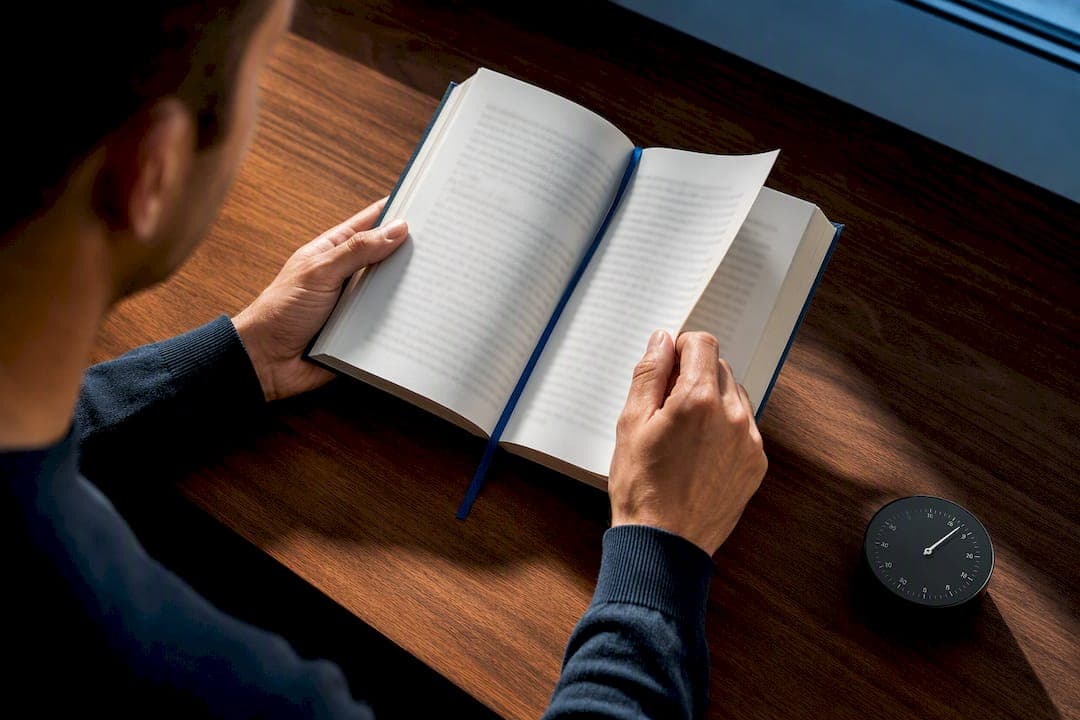
The average adult reads about 238 words per minute silently for non-fiction and roughly 260 wpm for fiction, while reading aloud runs closer to 183 wpm. At about 238 wpm, a standard 300-word page takes just over a minute, or roughly forty to fifty pages an hour. Comprehension, vocabulary, and text difficulty push that number up or down, so treat it as a starting point, not a ceiling.
TL;DR:
- Silent reading speed for non-fiction averages 238 to 250 wpm, while fiction is typically faster at around 260 wpm, depending on familiarity with the text.
- Reading aloud slows down the process to about 183 wpm, usually for pronunciation, speech practice, or reading to others.
- Effective reading speed varies with the purpose: studying requires about 200 wpm, whereas skimming can exceed 700 wpm but with reduced comprehension.
- Testing your reading speed through a timed passage and comprehension questions provides a more accurate measure tailored to your actual ability.
- Improving reading efficiency involves techniques like previewing text, grouping words, reducing subvocalization, and gradually increasing pace without sacrificing understanding.
Table of Contents
- How Researchers Calculated the Average Reading Speed
- Silent Reading vs. Reading Aloud vs. Skimming
- Average Reading Speed by Age and Grade Level
- How to Test Your Own Reading Speed
- What Actually Determines How Fast You Read
- Reading Speed Conversions: Minutes per Page and Pages per Hour
- Can You Actually Read Faster Without Losing Comprehension?
- How Testuno's Reading Speed Test Fits the Research
- Choosing the Right Pace for the Job
- Measure Your Reading Speed in Minutes
- Sources
How Researchers Calculated the Average Reading Speed
Those 238 and 260 wpm figures aren't guesses. They come from a meta-analysis of 190 studies covering roughly 18,000 participants, led by Marc Brysbaert and published in the Journal of Memory & Language in 2019. It remains the most cited synthesis of English reading-rate data available, and it's why so many WPM claims online trace back to the same handful of numbers.
The breakdown looks like this:
- Silent reading of non-fiction averages 238 wpm, with a standard deviation of about 51.2 and a 95% confidence interval between 230 and 246 wpm.
- Silent reading of fiction runs faster, around 260 wpm, likely because narrative prose uses shorter, more familiar words than technical text.
- Reading aloud averages about 183 wpm, based on 77 studies and nearly 6,000 participants, since your mouth simply can't keep pace with your eyes.
That spread matters more than the average itself. Most adults land somewhere between 175 and 300 wpm.pdf) for silent non-fiction reading, which means a "normal" pace covers a wide range depending on the reader and the material. Non-fiction drags the average down partly because it packs in longer words, denser sentence structure, and unfamiliar terminology that force more frequent pauses. Test design plays a role too: shorter passages produce noisier estimates, while five to ten minute samples tend to settle into a more stable number.
Silent Reading vs. Reading Aloud vs. Skimming
Your task should dictate which benchmark you use, because the three modes aren't interchangeable.
- Silent reading averages 238 to 260 wpm and works best for studying, novels, or anything you need to actually retain.
- Reading aloud averages 183 wpm because articulation caps your speed. It's the right choice for proofreading scripts, practicing a speech, or reading to a child.
- Skimming can push past 700 wpm, but comprehension drops sharply. It's fine for previewing a chapter or scanning an email, not for anything you'll be tested on.
Proofreading actually runs slower than average silent reading, often near 200 wpm or below, because catching errors requires more regressions and longer pauses on each word. Faster isn't always better here. The right speed depends entirely on what you're trying to accomplish with the page in front of you.
Average Reading Speed by Age and Grade Level
Reading speed climbs steadily through school, then levels off once fluency solidifies in adulthood. A rough map looks like this:
- Early elementary (grades 1 to 3): roughly 50 to 100 wpm, as decoding still competes with comprehension.
- Upper elementary (grades 4 to 6): roughly 100 to 150 wpm, as word recognition becomes automatic.
- Middle school: roughly 150 to 200 wpm.
- High school: roughly 200 to 250 wpm, approaching adult norms.
- College and adults: roughly 200 to 300 wpm, consistent with the Brysbaert benchmarks.
Growth isn't purely a function of age. It tracks vocabulary size, exposure to print, and how automatic word recognition has become. English-language learners often read below native-speaker averages at first, not because of lower intelligence but because decoding an unfamiliar language demands more conscious effort. Older adults sometimes see modest speed declines tied to vision changes or slower word retrieval, even while comprehension stays strong. Readers with dyslexia frequently read well below typical ranges regardless of age, since the challenge sits in decoding rather than intellect. None of these variations are failures. They're simply different starting points for the same skill.
How to Test Your Own Reading Speed
A reliable self-test takes less time than most people assume, and you don't need special equipment.
- Pick a representative passage, something in the genre and difficulty level you actually read, and set a timer for one to five minutes.
- Read at your normal pace, no rushing, no performing for the clock.
- Stop when time runs out and count the words you covered (or estimate using average words per line times lines read).
- Divide word count by minutes to get your words per minute.
- Answer three or four comprehension questions about what you just read to make sure the number reflects real reading, not just eye movement.
- Repeat across two or three passages and average the results for a more stable figure.
Longer tests produce steadier estimates because they smooth out the noise from a slow sentence or a distracting line. Watch for common pitfalls: a noisy room, an unfamiliar topic loaded with jargon, or a passage that's unusually easy will all skew your number in one direction. If you'd rather skip the stopwatch math, Testuno's reading speed test runs this exact process automatically and reports your WPM alongside a quick comprehension check.
Pro Tip: Test yourself on material you'd normally read, not a Victorian novel you've never opened. Your "true" reading speed varies by genre, and testing on unfamiliar or overly formal text will underestimate what you can actually do with a report, article, or textbook chapter.
What Actually Determines How Fast You Read
Reading speed isn't fixed. It shifts based on a handful of measurable factors, most of which trace back to how your eyes and brain process text.
- Word length and vocabulary familiarity, since recognizing a common word takes less mental work than parsing a technical term you've rarely seen.
- Prior knowledge of the topic, because context lets you predict what's coming next instead of decoding cold.
- Fixation duration, the tiny pause your eyes make on each word or word cluster.
- Saccade length, how far your eyes jump between fixations.
- Regressions, the backward eye movements that happen when something doesn't make sense the first time.
- Attention and fatigue, which affect all of the above even when the text itself hasn't changed.
Eye-tracking research consistently shows that faster readers make shorter fixations, longer forward saccades, and fewer regressions than slower readers. Word-identification skill, essentially how automatically you recognize words, turns out to be one of the strongest predictors of raw speed. Subvocalization, the habit of silently "sounding out" words in your head, also caps speed for many readers, since your inner voice can't outrun articulation any better than your actual voice can.
Reading Speed Conversions: Minutes per Page and Pages per Hour
Once you know your WPM, converting it into planning terms is simple arithmetic, assuming a standard 300-word page:
- 150 wpm: 2 minutes per page, 30 pages per hour.
- 200 wpm: 1.5 minutes per page, 40 pages per hour.
- 238 wpm: 1.26 minutes per page, about 48 pages per hour.
- 260 wpm: about 1.15 minutes per page, roughly 52 pages per hour.
- 300 wpm: 1 minute per page, 60 pages per hour.
These numbers assume you're reading to understand, not to memorize or critique. Studying for an exam or editing a contract will slow your effective rate well below your tested WPM, since comprehension checks and note-taking eat into raw speed. Save this table for planning a reading list or estimating how long a report will take. It won't hold up for dense academic papers or anything you need to reread twice.
Can You Actually Read Faster Without Losing Comprehension?
Yes, within limits, and the gains come from fixing habits rather than chasing exotic techniques.
- Preview before you read. Skim headings, topic sentences, and any bolded terms so your brain has a map before you start.
- Read in phrases, not single words. Grouping two or three words per fixation reduces the total number of stops your eyes make.
- Control regressions. Notice when you're rereading out of habit rather than genuine confusion, and consciously push forward.
- Reduce subvocalization gradually. You won't eliminate your inner voice, but softening it frees up processing speed.
- Build vocabulary in your subject area. Familiar words get recognized instantly; unfamiliar ones force a full stop.
- Practice in small increments. Add about 25 wpm at a time, check comprehension after each stage, and only move up once you're retaining what you read.
What doesn't work is the promise behind most speed-reading courses: reading at 1,000+ wpm while retaining everything. Multiple literature reviews confirm a real trade-off between speed and accuracy, and there's no evidence for a special high-speed "gear" that bypasses normal comprehension limits. Skimming has its place for previewing or low-stakes scanning, but treating it as a replacement for real reading during exam prep or contract review is how people miss the details that actually matter. The realistic ceiling for sustained, comprehending reading sits closer to 400 to 500 wpm for practiced readers, not the four-digit numbers marketed in course ads.
Pro Tip: Track your comprehension score alongside your WPM every time you practice. If comprehension drops more than a point or two as speed rises, you've outpaced your actual skill, not just your typing on a stopwatch.
How Testuno's Reading Speed Test Fits the Research
Testuno's reading speed test follows the same logic researchers use: a timed passage paired with a short comprehension check, so the WPM you get back reflects real reading rather than just fast scrolling. It takes a few minutes, requires no sign-up, and returns your words-per-minute score alongside percentile benchmarking against other test takers.
That structure mirrors the methodology behind the Brysbaert meta-analysis: measure the reading, then confirm understanding before trusting the number. Once you have your score, you can plug it directly into the conversion figures above to estimate how long a chapter, report, or textbook assignment will realistically take.
Choosing the Right Pace for the Job
Most people don't need to read faster. They need to read at the right speed for the task in front of them, and that's the piece the speed-reading hype usually skips.
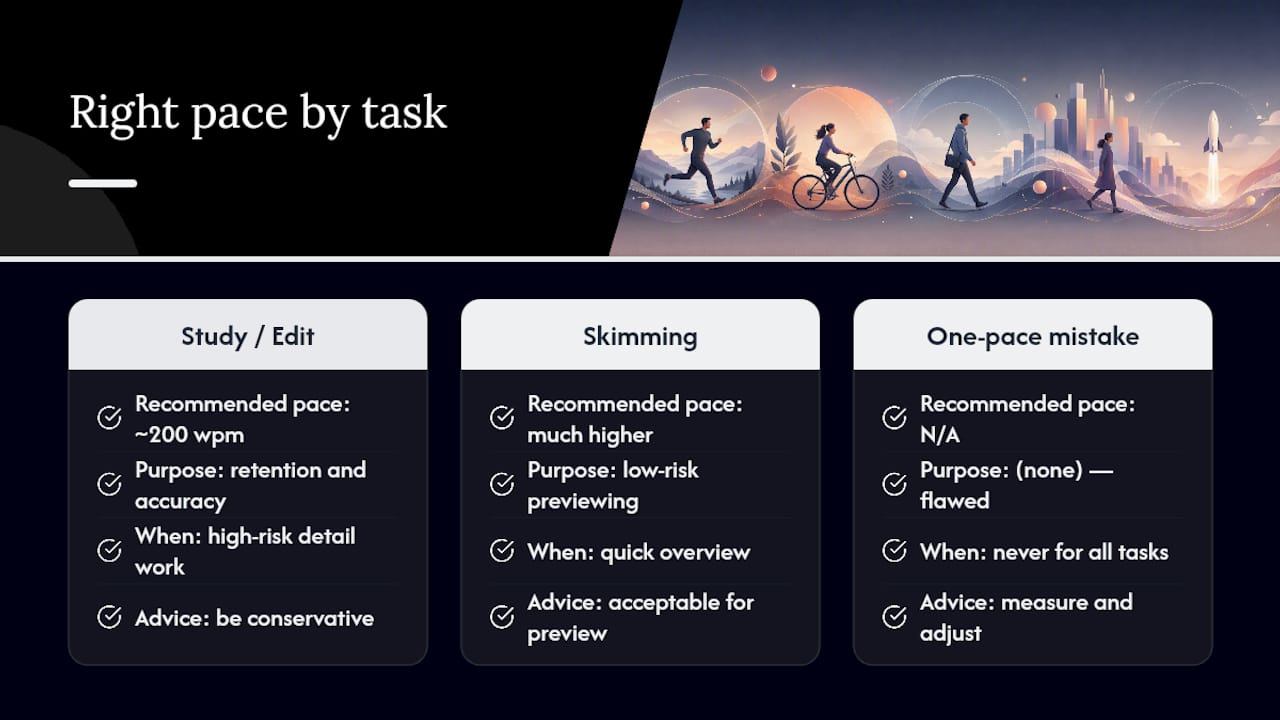
For studying or editing, I'd default to something conservative, closer to 200 wpm than 300, because retention and accuracy matter more than finishing early; practical time-management guidance can help optimize this approach (How to get better grades in college?). For low-risk previewing, skimming at a much higher rate is perfectly reasonable. The mistake is applying one pace to every situation. Measure your actual speed, notice where comprehension starts slipping, and adjust from there instead of chasing a single magic number.
— Steve
Measure Your Reading Speed in Minutes
A reading speed test can give you a concrete number instead of a guess, with your WPM and a percentile ranking delivered right after a short comprehension check, no account required.

Knowing your actual pace turns vague plans like "I'll finish this by Friday" into real estimates you can trust. It also opens the door to understanding your broader cognitive profile: reading speed connects to attention, processing speed, and working memory, all of which show up in Testuno's IQ test with detailed percentile benchmarking. If you're curious how your reading pace fits into the bigger picture of how your mind works, testing your skills more broadly can be a natural next step.
Sources
- How many words do we read per minute? A review and meta-analysis of reading rate
- Eye movements and reading: Review (NCBI / PMC article)
- So Much to Read, So Little Time: How Do We Read, and Can Speed Reading Help?