

If you need personality data that predicts how someone will actually behave, the Big Five wins, and it isn't close. A study covered by Scientific American found Big Five measures roughly twice as accurate as MBTI-style tests at predicting real-life outcomes. MBTI still earns its keep as a conversation starter and identity lens. The sections below cover why the two models diverge, what the evidence says, and how to use each one without misreading your results.
TL;DR:
- The Big Five provides more accurate and stable personality data for predicting real-world outcomes than MBTI-style tests.
- Continuous trait scores in the Big Five capture subtle differences, while MBTI’s binary categories can lead to instability and loss of information.
- The Big Five has broad research support and predicts emotional wellbeing better, especially when traits like Neuroticism are relevant.
- MBTI is better suited for low-stakes, informal contexts like team bonding or personal self-reflection, not for high-stakes decisions.
- Using a validated, trait-based assessment like Testuno's Big Five test improves accuracy and allows benchmarking against other test takers.
Table of Contents
- Big Five vs MBTI: The Core Structural Differences
- What the Research Evidence Says About Predictive Validity
- Choosing the Right Model for Your Goal
- How to Interpret Your Results Without Overreading Them
- Where Testuno Fits Into an Evidence-Based Approach
- The Historical Roots of Both Models
- Comparing the Psychological Theories Underneath Each Model
- Where Each Model Draws Its Fiercest Criticism
- Big Five Traits and MBTI Types in Practice
- Practical Guidance: Which Test Should You Actually Take?
- A Balanced Take on Accuracy vs. Identity
- Get Your Own Big Five Results, Benchmarked and Downloadable
- Sources
Big Five vs MBTI: The Core Structural Differences
The two models don't just ask different questions. They measure personality on entirely different mathematical structures, and that choice explains almost everything else about their accuracy gap.
The Big Five, often called the OCEAN model, scores you on five continuous traits: Openness, Conscientiousness, Extraversion, Agreeableness, and Neuroticism. Nobody is simply "extraverted" or "not extraverted." You land somewhere on a spectrum, usually reported as a percentile against a comparison group. MBTI does the opposite. It sorts people into one of two poles on four separate dichotomies (Extraversion/Introversion, Sensing/Intuition, Thinking/Feeling, Judging/Perceiving), then combines those four letters into one of 16 fixed types.
That distinction, dimensional versus categorical, is the whole ballgame:
- Continuous scales preserve information. Someone who scores 51% on extraversion and someone who scores 98% get treated as meaningfully different by the Big Five and identically "Extraverted" by MBTI.
- Forcing people into binary boxes near the midpoint creates instability. A person sitting close to the E/I line can flip categories on a retest simply due to measurement noise, even though their underlying trait level barely moved.
- MBTI's four axes map only loosely onto Big Five traits. E/I roughly tracks Extraversion, N/S loosely echoes Openness, and T/F inversely resembles Agreeableness. J/P partially overlaps with Conscientiousness. Analysis of tools like 16Personalities shows this correspondence is real but incomplete, leaving gaps in coverage rather than a clean one-to-one match.
- MBTI has no dimension for Neuroticism (emotional stability) at all. That single omission removes one of psychology's most predictive traits from the model entirely.
The origins differ too. The Big Five emerged from decades of lexical and statistical analysis, essentially letting language and factor analysis reveal which trait clusters actually exist in how people describe personality. MBTI was built from Carl Jung's typological theory, then operationalized by Katharine Cook Briggs and Isabel Briggs Myers without the same empirical vetting.
What the Research Evidence Says About Predictive Validity
The clearest head-to-head comparison comes from the study Scientific American reported on, which tested how well each model predicted a wide set of real-world outcomes.
Big Five personality scores were about twice as accurate as MBTI-style dichotomous scores at predicting life outcomes, according to that Scientific American analysis. The researchers pointed to two specific design flaws behind MBTI's weaker showing: it omits Neuroticism, and it forces continuous traits into binary categories, throwing away the finer-grained information a percentile score preserves.
That's not the only data point worth knowing. A 2019 Journal of Personality study compared the Big Five against HEXACO, a six-factor model that adds an Honesty-Humility dimension. The meta-analytic results showed real conceptual overlap between the two frameworks, but also meaningful gaps. HEXACO captures behavior tied to manipulation, fairness, and sincerity that the standard Big Five doesn't explicitly measure. A broader 2021 meta-analysis spanning 152 samples reached a similar conclusion: how you operationalize a trait model changes what it actually covers and how independent its dimensions are from each other.
- Big Five has strong general predictive validity and broad research support, but lacks a dedicated dimension for morality-specific behaviors.
- HEXACO adds an Honesty-Humility dimension, which provides added value when morally relevant behavior is of interest.
- MBTI-style tools exhibit weaker predictive validity due to missing neuroticism measurement and unstable categorical boundaries.
An experience-sampling study with 669 participants found the Big Five typically explained more variance in day-to-day emotional wellbeing than HEXACO did, though both models added some unique predictive value. The takeaway isn't that one model wins everywhere. It's that the Big Five is the stronger default, and HEXACO is worth considering specifically when honesty, fairness, or ethical behavior are the outcomes in question.
Choosing the Right Model for Your Goal
Match the tool to the stakes. The higher the stakes of the decision, the more you should lean on dimensional data over typology.
- Research and formal assessment. Use the Big Five. Its trait scores hold up across studies and populations, and reviews of structural personality models warn that shorter, less rigorous instruments underestimate predictive validity, so a well-validated long-form or mid-length Big Five test beats a quick quiz.
- Hiring and selection decisions. Lean Big Five, and lean cautiously. Conscientiousness and Emotional Stability correlate with job performance across many roles. MBTI type should never gate a hiring decision, a point echoed directly by clinical guidance comparing the two models.
- Leadership development and coaching. Big Five for the diagnostic groundwork, MBTI language layered on top if a team already uses it as shared vocabulary.
- Career exploration. Trait data tells you what environments suit your temperament; resources like NueCareer's guide to personality-based career planning build on that same trait logic.
- Icebreakers, team retreats, low-stakes self-reflection. MBTI is genuinely fine here. Nobody's promotion depends on whether they're an INFJ.
Pro Tip: Use the Big Five to make decisions and MBTI to talk about them. Trait scores tell you what's actually true about someone's tendencies; type labels give a team an easy shared shorthand to discuss it afterward.
How to Interpret Your Results Without Overreading Them
Retest stability is where the two models diverge sharply, and it matters more than most people realize. Big Five percentile scores tend to stay close together across retakes, drifting a little but rarely reversing. MBTI type can flip entirely between attempts when someone's raw score sits near a dichotomy's midpoint, even though their underlying trait level barely shifted.
If two tests disagree, trust the continuous score over the category, and treat any single result as one data point rather than a verdict.
- Don't use MBTI type as a hiring or promotion gate.
- Don't treat one test, of any kind, as a permanent label for who you are.
- Do combine self-report with observer ratings (a manager, partner, or close friend) when the decision actually matters.
- Do retake trait-based tests periodically. Personality shifts modestly over years, especially Conscientiousness and Emotional Stability.
Where Testuno Fits Into an Evidence-Based Approach
Testuno's Big Five personality test reports continuous scores across all five traits rather than forcing you into a type, and pairs each score with a percentile benchmark against other test takers. That structure matches what the research above recommends: dimensional data, not binary categories.
- Full assessments of this kind typically complete in about 15 minutes without requiring sign-up.
- Results commonly include percentile benchmarking against a broader test-taking population.
- Reports may be downloadable for later reference or side-by-side comparison over time.
- Testuno also offers a 16-personality type test for readers who want the MBTI-style experience alongside their trait data.
Running both gives you the predictive backbone of the Big Five and the shared vocabulary MBTI-style typing provides for team conversations.
The Historical Roots of Both Models
MBTI traces back to Carl Jung's early-20th-century theories on psychological types, which Katharine Cook Briggs and her daughter Isabel Briggs Myers adapted into a practical questionnaire during the 1940s. Their goal was accessible: help people understand differences in how others process information and make decisions, particularly in wartime and workplace contexts. It was never built through the kind of empirical validation modern psychometrics demands, and it hasn't fundamentally changed since.
The Big Five took a slower, more empirical path. Researchers in the 1930s through 1960s, including Gordon Allport and Raymond Cattell, started by cataloging the thousands of adjectives English speakers use to describe personality. Later statisticians ran factor analysis on those trait ratings, repeatedly finding the same five clusters emerge regardless of the sample or the specific adjective list used. By the 1980s and 1990s, researchers including Lewis Goldberg and later Costa and McCrae had consolidated this lexical and statistical work into the OCEAN framework used today.
The contrast matters: one model started with a theory and built a test to match it. The other started with data and let the structure emerge. That difference in method is a big part of why one holds up better under statistical scrutiny.
Comparing the Psychological Theories Underneath Each Model
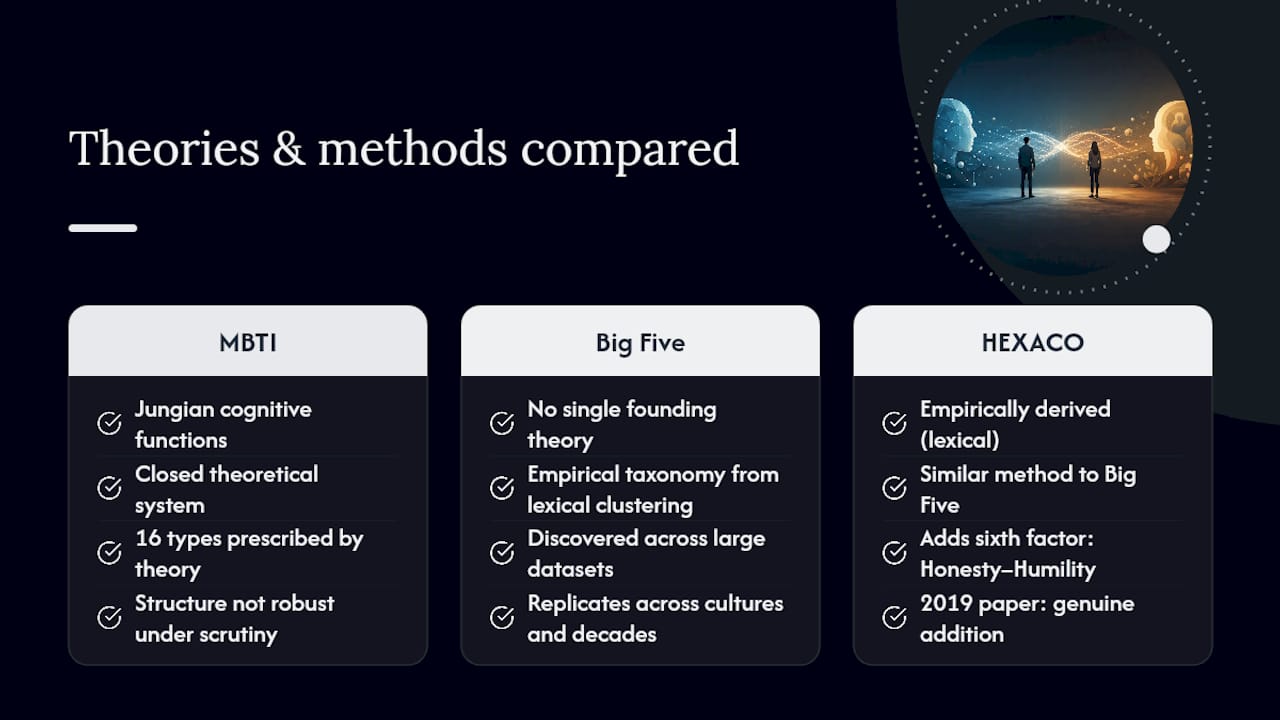
MBTI rests on Jungian typology, specifically Jung's idea of cognitive functions: how people take in information (Sensing vs. Intuition) and how they make decisions (Thinking vs. Feeling), layered with attitudes (Introversion vs. Extraversion) and a later addition of Judging vs. Perceiving. It's a closed theoretical system. The 16 types exist because the theory says they should, not because statistical analysis of real behavior data produced exactly 16 clusters.
The Big Five has no single founding theory in that sense. It's what psychologists call an empirical taxonomy, a structure discovered by asking which trait words cluster together across huge datasets, rather than derived from a philosophical model of the mind. That's part of why it keeps replicating across cultures, languages, and decades of research, while MBTI's four-dichotomy structure hasn't held up the same way under similar scrutiny.
HEXACO sits between the two in spirit but closer to the Big Five in method. It's also empirically derived, using the same lexical approach, but analyses across multiple languages turned up a sixth consistent factor, Honesty-Humility, that standard Big Five instruments don't isolate. The 2019 Journal of Personality comparison frames this as a genuine addition rather than a redundant relabeling of existing traits.
Where Each Model Draws Its Fiercest Criticism
MBTI's most persistent critique isn't just about reliability, it's about the entire premise of sorting continuous human variation into 16 boxes. Critics argue the binary framing invites a kind of astrology-style confirmation bias: once you're told you're an "INFP," you start noticing behavior that confirms it and dismissing behavior that doesn't. The test's commercial history adds another wrinkle. It's owned and licensed by a private company, and the certification process for practitioners has drawn criticism for prioritizing revenue over rigorous validation.
The Big Five draws different criticism. Some psychologists argue five factors oversimplify personality by collapsing traits like impulsivity and organization into one Conscientiousness score, which is part of why facet-level and aspect-level breakdowns exist for researchers wanting more granular predictions. Others point out the model was built almost entirely on Western, English-speaking samples for decades, raising fair questions about how well it generalizes to every culture and language. It also lacks a moral or ethical dimension, the gap HEXACO's Honesty-Humility factor was specifically designed to fill.
Neither critique is fatal, but they're worth knowing. The Big Five's flaws are about completeness. MBTI's flaws go closer to the foundation.
Big Five Traits and MBTI Types in Practice
Picture two coworkers preparing for the same product launch. One scores in the 90th percentile for Conscientiousness and the 20th for Agreeableness. Expect someone organized, deadline-driven, and comfortable pushing back hard in meetings, regardless of what MBTI letters they'd pick. The other scores high on Openness and Extraversion but low on Emotional Stability: someone who generates ideas freely, talks them through out loud, and gets visibly rattled when a deadline slips.
Now run those same two people through MBTI. The first might land as ISTJ, the classic "Logistician," often described as dependable and detail-oriented. The second might land as ENFP, the "Campaigner," often described as enthusiastic and idea-driven. The type labels aren't wrong exactly, they capture something real, but they flatten the picture. ISTJ tells you nothing about where that person actually sits on Agreeableness, and two different ISTJs could have wildly different Neuroticism scores that shape how they handle pressure.
That's the practical difference in a nutshell. Big Five gives you a profile with five independent dials. MBTI gives you a single label built from four fused decisions, memorable and easy to share at a team offsite, but far less precise when you need to predict how someone will actually perform under stress.

Practical Guidance: Which Test Should You Actually Take?
Start with the decision you're trying to make, not the test that sounds more fun. If you're making a hiring call, screening for a high-stakes role, or doing anything resembling clinical or research work, the Big Five is the appropriate tool, full stop. If you're kicking off a team retreat or just curious about your own patterns for personal reflection, MBTI-style typing is a perfectly reasonable, low-stakes option.
A useful middle path: take the Big Five first to get an accurate trait baseline, then use MBTI-style typing afterward purely as shared language for talking about those traits with colleagues or friends who already think in MBTI terms. That order matters. Anchoring on a fixed type first, then trying to reinterpret Big Five results through that lens, tends to produce confirmation bias rather than insight.
One more distinction worth internalizing: don't confuse a quick free quiz with a validated instrument, on either side of this comparison. Short-form measures of any personality model tend to sacrifice reliability for speed, and research on structural personality models specifically warns that abbreviated scales underestimate how predictive a trait actually is. If a decision matters, take the longer, well-validated version of whichever test you choose.
A Balanced Take on Accuracy vs. Identity
Personality tools serve two different human needs, and pretending otherwise is where most debates on this topic go wrong. People want accurate prediction, and they want language for talking about who they are. The Big Five earns the nod for prediction. MBTI earns its popularity honestly, through simplicity and a framing that feels affirming rather than clinical, a pattern the Scientific American piece also notes.
Use trait data when a real decision rides on the outcome. Use type language when you're just trying to connect with someone. Retest occasionally, and hold every result a little loosely.
— Steve
Get Your Own Big Five Results, Benchmarked and Downloadable
If everything above made you curious where you actually land on Openness, Conscientiousness, or Neuroticism instead of which four letters you got assigned, that's exactly the gap Testuno's Big Five test was built to close.

Testuno's Big Five personality test gives you continuous scores across all five traits, benchmarked against other test takers as a percentile rather than dropped into a fixed category. The full assessment may run about 15 minutes, may not need sign-up to start, and can produce a downloadable report you can revisit or compare against a future retake. If you'd rather browse the full range of assessments first, including the 16-personality type test for the MBTI-style side of this comparison, start from the Testuno homepage and pick the test that matches what you're actually trying to learn about yourself.
Sources
- Personality Tests Aren’t All the Same. Some Work Better Than Others | Scientific American
- Journal of Personality (2019) — comparison between HEXACO and Big Five
- Meta-analysis on comparisons of personality models (2021)
- Comparison of Big Five and HEXACO in prediction of emotional wellbeing (2023)