

Brain training apps reliably make you better at the specific game you're playing, but that skill rarely spreads to broader thinking ability. The strongest, best-controlled trials find practice effects on trained tasks and little to no far transfer to everyday cognition. A modest exception exists for some older adults and people with mild cognitive impairment, where sessions can produce small, task-specific gains. Use apps for engagement and targeted skill practice, but lean on exercise, learning, and social connection for durable brain health.
TL;DR:
- Most brain training apps improve performance only on the trained task, with little to no evidence of transfer to real-world cognition for healthy individuals.
- Gains in processing speed and working memory are common, but improvements in reasoning, reasoning, and everyday memory are weak or nonexistent.
- Effective training studies typically involve structured sessions three to five times weekly over several weeks, not casual or brief play.
- Alternative strategies like aerobic exercise, learning new skills, and social engagement have stronger, more consistent evidence for supporting long-term brain health.
- Tracking performance with independent tests is essential to determine whether genuine cognitive improvements occur, rather than relying on in-app scores.
Table of Contents
- Brain Training Apps Effectiveness: What the Clinical Evidence Shows
- What's the Difference Between Practice Effects and Transfer?
- Who Actually Benefits From Brain Training Apps?
- How to Evaluate Any Brain Training App's Claims
- Evidence-Based Alternatives That Support Cognition
- How Testuno Helps You Track Cognitive Changes Honestly
- How Do Popular Brain Training Apps Compare?
- Do Brain Training Apps Improve Daily Life or Job Performance?
- Are the Results Partly a Placebo Effect?
- Are Brain Training Apps Worth the Cost Compared to Alternatives?
- My Take: Use the Apps, but Don't Confuse Them With a Cognitive Upgrade
- Measure Your Own Baseline Before You Train
- Sources
- FAQ
Brain Training Apps Effectiveness: What the Clinical Evidence Shows
The clinical picture is more sobering than app store marketing suggests. A randomized controlled trial of 128 young adults tested a popular commercial cognitive training program against an active control group for 10 weeks. The result: no training-specific effects on neural activity, decision-making, or cognitive performance beyond what the control group experienced. Participants got better at the training tasks. That improvement didn't touch the brain systems researchers measured, and it didn't show up on independent cognitive tests.
A separate randomized study in healthy older adults found a similar pattern. The three-month intervention improved performance on trained tasks but produced no measurable transfer to untrained cognitive outcome measures. Participants got faster and more accurate at the game. Their scores on standardized tests of memory, reasoning, and attention stayed flat.
Where the evidence is strongest and weakest:
- Processing speed and specific trained working-memory tasks show the most consistent small gains in the published literature.
- Reasoning, fluid intelligence, and everyday memory (names, appointments, misplaced keys) show weak or null results across well-controlled trials.
- Studies lacking an active control group tend to report larger, less trustworthy effects.
The active-control problem: When a study compares brain training to doing nothing, the training group almost always "wins." When the comparison group also plays an engaging game, novelty and expectation are matched, and the apparent brain-training advantage often shrinks toward zero.
Systematic reviews back this up. A meta-analysis of computerized cognitive training in older adults found small, inconsistent benefits concentrated in a handful of domains, with publication bias and inconsistent study design muddying the overall picture. Harvard Health's review of the research reaches a similar conclusion: the games can be genuinely fun, but the case that they maintain or improve general brain health is thin once you demand rigorous controls.
What's the Difference Between Practice Effects and Transfer?
A practice effect is getting better at the exact task you repeat. Play a matching-pairs game 50 times and your score climbs, the same way your typing speed climbs after a month of daily practice. A transfer effect is different: it's improvement on a task you never trained, which is the outcome that would actually mean "smarter" or "sharper" in daily life.
Researchers split transfer into two flavors. Near transfer means improvement on a task closely related to the one you trained, say, a different working-memory game using similar mechanics. Far transfer means improvement on something conceptually distant, like remembering a new coworker's name or following a complicated recipe. Most of the marketing language around brain training apps quietly relies on far-transfer promises while the actual data support only near transfer, and often not even that.
The literature is fairly blunt about this gap. Reviews distinguishing practice from transfer effects find near transfer shows up far more often than far transfer, and some large datasets show gains confined entirely to the trained task itself.
- A rising game score tells you practice worked.
- Remembering your new neighbor's name three weeks later tells you transfer happened.
- Only the second one is what most people actually want from "brain training."
Pro Tip: Track your progress with an independent, standardized test rather than relying on your in-app score. If a memory app says you've "improved 40%," that number describes your performance on its own game, not your memory in general.
Who Actually Benefits From Brain Training Apps?
The evidence isn't uniformly bleak. Some groups show small, real gains; others show essentially nothing.
- Older adults: Results are mixed. Some randomized trials show modest, task-specific improvement; the older-adult trial cited above found gains stayed confined to the trained task with no transfer.
- People with mild cognitive impairment (MCI): Mayo Clinic notes apps may produce mild-to-moderate benefits for this group, but they don't prevent or slow dementia.
- Healthy young adults: Well-controlled trials, including the 128-person study above, tend to find null or negligible effects. Your brain likely doesn't need the drill.
- When to see a clinician: If you're noticing real memory lapses affecting daily function, that's a conversation for a doctor, not an app subscription.
How to Evaluate Any Brain Training App's Claims
Marketing copy and peer review rarely agree. Before trusting a claim, run it through this checklist:
- Check for independent RCTs with active controls. A study funded or run by the app maker, without an active control group, is the weakest tier of evidence.
- Look for transfer to functional outcomes, not just improved in-app scores. A claim that only cites "improved level 12 accuracy" is describing a practice effect, not a cognitive upgrade.
- Note the dose used in studies that found effects. Most positive findings involve structured sessions, often three to five times weekly for eight to twelve weeks, not occasional casual play.
- Check for disclosed conflicts of interest and open methodology. Well-designed trials match participant expectation and engagement between groups precisely because failing to do so inflates results.
Even the best-supported claims in this space describe small effect sizes concentrated in narrow domains, which is a very different story than "get smarter" headlines imply.
Evidence-Based Alternatives That Support Cognition
If the goal is durable brain health rather than a better game score, the research points elsewhere first.
- Aerobic and resistance exercise have a stronger evidence base for supporting cognitive function over time than repetitive app-based drills, according to commentary from UCLA researchers on lifestyle and brain health.
- Learning a genuinely new, complex skill engages more brain systems at once than a training app does. Active recall techniques used in language learning and the documented cognitive benefits of picking up a second language both illustrate why complex, novel learning tends to outperform repetitive tasks.
- Social engagement consistently correlates with better cognitive outcomes in aging research.
- Combine, don't replace. Use an app for a specific skill or for motivation to stay mentally active, but treat exercise, learning, and social contact as the foundation, not the afterthought.
How Testuno Helps You Track Cognitive Changes Honestly
If you want to know whether a training habit is actually working for you, personally, the honest approach is measurement, not marketing copy. Testuno offers interactive assessments across cognitive domains, including a flagship IQ test with percentile benchmarking, so you can capture a real baseline before you start any training routine.
- The platform's working-memory test and visual memory assessments let you track task-specific gains over weeks, the same way researchers measure near transfer in a lab.
- Retesting periodically, rather than trusting an in-app score, is the closest a casual user can get to the standardized-battery approach researchers recommend for separating real transfer from practice effects.
- These assessments are built for insight and self-tracking, not clinical diagnosis. If you have genuine concerns about memory or cognitive decline, talk to a doctor.
Pro Tip: Test yourself, train for four to eight weeks, then retest with the same instrument. If your gains show up only on the exact game you practiced and nowhere else, that's a practice effect, not a cognitive breakthrough, and it's useful information either way.
How Do Popular Brain Training Apps Compare?
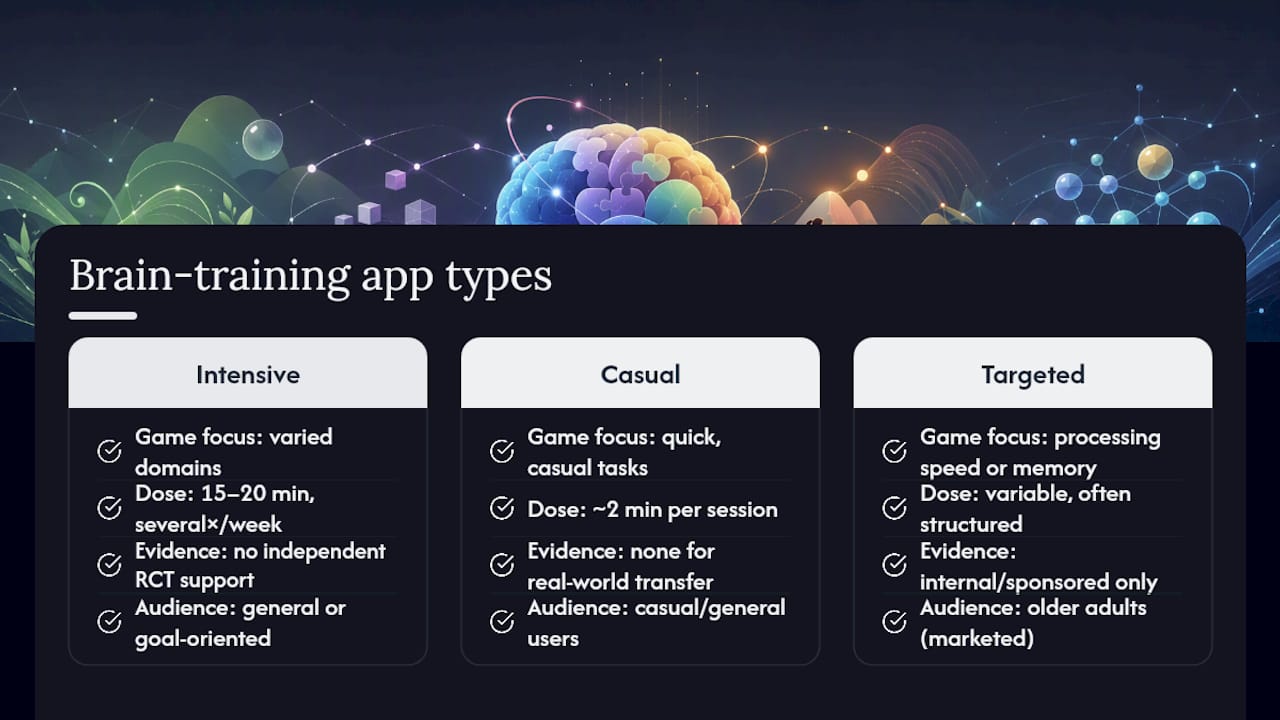
Most commercial brain training platforms follow a similar formula: a suite of short games targeting memory, attention, processing speed, and problem solving, wrapped in a personalized "training program" and a progress dashboard. The differences are mostly in game variety, adaptive difficulty, and how aggressively the marketing leans on cognitive-improvement language.
Some programs emphasize processing-speed drills built around visual tracking tasks. Others lean toward puzzle-style reasoning games or memory-matching formats. A handful market themselves specifically toward older adults and cite internal or sponsored research; others target general "brain fitness" without much distinction between age groups or goals. None of the major commercial platforms has produced independent, active-controlled trial evidence showing broad transfer to real-world cognitive function, and the null results from the 128-person RCT involved exactly this style of adaptive, personalized commercial training.
What actually varies meaningfully between apps is dose and structure, not branding. A program that pushes 15 to 20 minutes of varied, progressively harder tasks several times a week is a different proposition than one you open for two minutes of casual play. If you're comparing options, ask what specific cognitive domain each game targets and whether the claimed benefit is about the trained task or something broader. That question exposes more than any feature list.
Do Brain Training Apps Improve Daily Life or Job Performance?
This is where the evidence gets thin fast. Most published studies measure outcomes in a lab: reaction time on a screen, accuracy on a memory grid, scores on a standardized cognitive battery. Very few track whether users actually remember appointments better, make fewer mistakes at work, or drive more safely.
The closest proxy researchers have is transfer to untrained cognitive tests, and as covered earlier, that transfer is frequently absent even when in-app scores climb. If an app improved your job performance, you'd expect it to show up on independent measures of attention, working memory, or executive function. The older-adult trial that found strong practice gains but no transfer is a fair stand-in for what happens outside the lab too: you get better at the game, and your day-to-day functioning likely stays roughly where it started.
That doesn't mean the time is wasted. Regular mental engagement, even without measurable transfer, can support mood and motivation, and for some users the habit of daily practice is valuable on its own terms. Just don't expect a training app to translate into a sharper presentation at work or fewer forgotten errands. The honest claim is engagement and modest task-specific skill, not a measurable edge in your career or daily routine.
Are the Results Partly a Placebo Effect?
A fair amount of what users report as "feeling sharper" after weeks of brain training probably comes down to expectation. You paid for an app, you're told it improves your brain, you practice diligently, and you notice a subjective sense of improvement. That's a real psychological experience. It's just not the same thing as a measured cognitive gain.
This is exactly why active-control trial design matters so much. When researchers match the control group's engagement and novelty to the training group's, the "brain training worked" narrative frequently collapses, because both groups report feeling more mentally engaged, yet only sometimes does either group show measurable cognitive change. The expectation of improvement, not the specific game mechanics, appears to drive a meaningful share of self-reported benefit.
None of this means user perception is worthless. Feeling more mentally engaged, more confident, or more motivated has real value, even if it isn't a cognitive upgrade in the clinical sense. The problem is when that subjective sense of sharpness gets marketed, or personally interpreted, as proof the app rewired your brain. Separating "I feel better" from "I tested better on an independent measure" is the single most useful mental habit a skeptical user can adopt here.
Are Brain Training Apps Worth the Cost Compared to Alternatives?
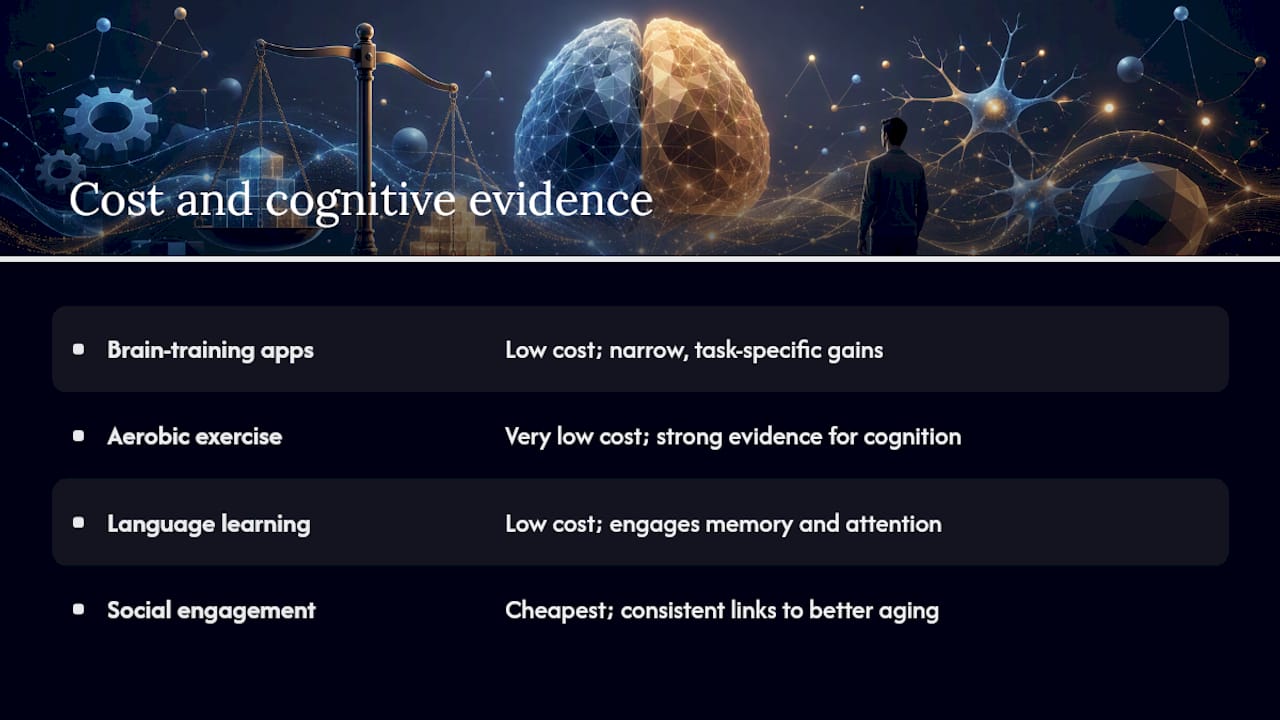
Most brain training subscriptions run somewhere in the range of a modest monthly fee, cheap enough that the financial risk of trying one is low. The cognitive return on that spending, based on the trial evidence above, is narrow: task-specific practice gains, occasional modest benefit for older adults or people with MCI, and little else.
Compare that to the alternatives with stronger evidence behind them. Aerobic exercise costs nothing beyond a pair of shoes and time, and the research base supporting it for cognitive health is considerably deeper than the app literature. Learning a language is free with the right resources and engages memory, attention, and executive function simultaneously rather than one narrow skill at a time. Social engagement, arguably the cheapest intervention of all, correlates consistently with better cognitive aging outcomes.
The realistic verdict: brain training apps are low-cost and low-risk, but also low-yield if your goal is broad cognitive improvement. They're reasonably cost-effective for what they actually deliver, engagement and narrow skill practice, and poorly cost-effective if you're buying them expecting a measurable boost in memory, reasoning, or daily function. Spend the subscription money if you enjoy the games. Spend your limited time budget on exercise and new skills if the goal is your long-term cognitive trajectory.
My Take: Use the Apps, but Don't Confuse Them With a Cognitive Upgrade
Treat brain training apps the way you'd treat a crossword habit: enjoyable, mentally engaging, and worth doing if you like it, but not a substitute for the interventions with real evidence behind them. If you use one, set a specific goal, like sharper focus during a defined task, and measure it independently rather than trusting the in-app score.
Prioritize aerobic exercise, learning something genuinely new, and staying socially connected first. If you notice real memory problems rather than everyday forgetfulness, see a clinician instead of downloading another app.
— Steve
Measure Your Own Baseline Before You Train
Everything in this article points to one practical problem: most people never actually measure whether their brain training routine is working, they just trust the in-app score. Testuno gives you an independent way to check. Its cognitive profile assessment covers memory, processing speed, attention, and reasoning in one sitting, with no sign-up required and results in about 15 minutes.

Take the assessment before you start any training habit, log your percentile results, then retest after six to eight weeks of consistent practice. If your scores move on the independent test and not just inside the training app, you've found genuine transfer. If they don't, you've saved yourself months of false confidence. Start with a full IQ test to get your baseline benchmark, or try the focused working memory test if that's the specific skill you're training.
Sources
- No Effect of Commercial Cognitive Training on Brain Activity, Choice Behavior, or Cognitive Performance
- Practice makes perfect, but to what end? Computerised brain training has limited cognitive benefits in healthy ageing
- Can brain training smartphone apps and computer games really help you stay sharp? - Harvard Health
- Q&A: Do brain-training apps work? - Mayo Clinic
FAQ
Which is better, BrainHQ or Lumosity?
Independent, active-controlled trial evidence doesn't clearly favor either platform for broad cognitive improvement; both show the same practice-effect pattern seen across the category, with gains concentrated on trained tasks rather than general cognition.
What is the best food for memory?
No single food acts as a memory cure, but diets rich in vegetables, fish, and unsaturated fats are consistently linked to better cognitive aging outcomes in the broader health literature, alongside exercise and sleep.
What is the best free brain training app?
Free versions of major brain training apps typically offer the same core game mechanics as paid tiers, just with fewer games and less personalization; the cognitive evidence for either tier remains limited to practice effects rather than proven free-tier superiority.
What is the best brain training app in 2026?
No commercial brain training app has independent, active-controlled trial evidence of broad cognitive transfer, so "best" mostly comes down to which games you'll actually stick with. For tracking whether your chosen app is producing real change, pairing it with an independent baseline test, such as Testuno's cognitive profile assessment, gives you an honest answer instead of a marketing one.