
Self-efficacy is a task-specific "can-do" belief that predicts performance more reliably than general confidence does. Confidence is a broad, dispositional sense of assurance that floats across situations, while self-efficacy is narrow, tied to one skill, one context, one moment of action. If you want someone to actually finish the task, you build the specific belief, not the general mood.
TL;DR:
- Building task-specific self-efficacy through mastery experiences can rapidly improve performance, often within just a week of deliberate effort.
- Self-efficacy is highly domain-specific, and interventions must target the exact skill or task to be effective, unlike general confidence or self-esteem.
- Accurate measurement of self-efficacy involves task-anchored, numerical questions that predict real performance better than broad confidence ratings.
- Avoid generic affirmations; instead, focus on concrete mastery, specific feedback, and realistic task attempts to foster genuine belief in the skill.
- Using domain-focused assessments and structured mastery sequences increases the likelihood of lasting improvements and better performance outcomes.
Table of Contents
- Confidence vs Self-Efficacy: How Psychologists Define the Terms
- What Separates Self-Efficacy From Confidence in Practice
- What the Research Says: Core Studies and Meta-Analyses
- A 7-Day Program to Build Domain-Specific Efficacy
- How to Measure Confidence and Self-Efficacy Accurately
- Common Misconceptions Worth Correcting
- Why Targeting the Right Belief Changes Outcomes
- Track Your Domain-Specific Strengths With Testuno
- Sources
Confidence vs Self-Efficacy: How Psychologists Define the Terms
Psychologist Albert Bandura defined self-efficacy as a person's belief in their capacity to execute a specific behavior needed to produce a specific outcome. Not "I'm a capable person" but "I can give this presentation to this audience on this Thursday." That precision is the entire point. Bandura's framework treats belief as something built through experience, not something you're born with or talk yourself into.
General confidence, by contrast, sits closer to what researchers call a disposition. It's the sense of "I generally handle things well," and it overlaps with self-esteem, which is a broader evaluation of your own worth as a person, unconnected to any particular skill. Self-esteem asks "Am I good?" Self-efficacy asks "Can I do this specific thing?" A review of the status attainment literature found these constructs distinct but correlated: self-efficacy tracks with motivated, goal-directed behavior, while self-esteem tracks more with mood and affect.
Two quick examples show why the distinction matters:
- A person can feel confident in social settings generally, yet have low self-efficacy specifically for public speaking to a hostile audience.
- An athlete can have rock-solid self-efficacy for free throws under practice conditions, but that belief can collapse in the last two seconds of a tied game, a different task context entirely.
Conflating the two terms costs you accuracy. If you measure someone's general confidence and try to predict whether they'll finish a specific project, you're measuring the wrong thing. PsychCentral's overview of self-efficacy makes the same point in plainer language: self-efficacy is trainable and specific, general confidence is diffuse and much harder to move with any single intervention.
What Separates Self-Efficacy From Confidence in Practice
Four axes separate these constructs, and each one has consequences for how you'd actually intervene.
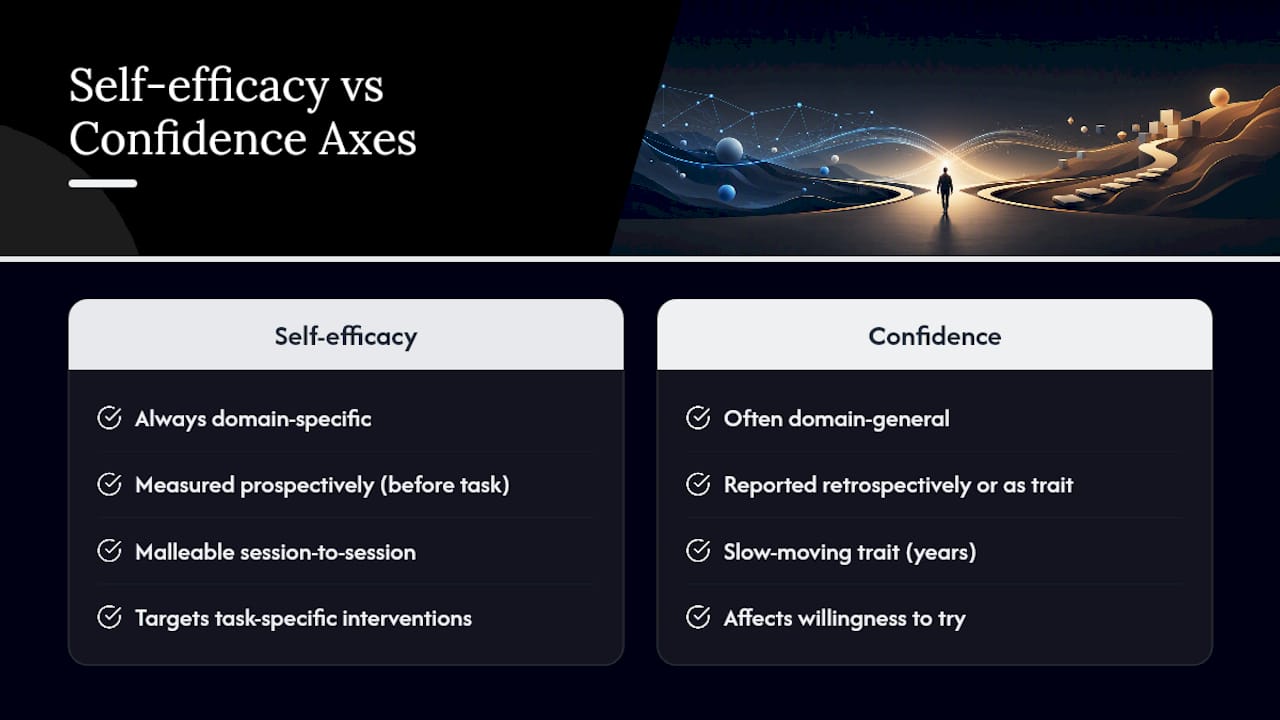
Specificity is the biggest divide. Self-efficacy is always anchored to a domain: efficacy for solving quadratic equations, efficacy for negotiating a raise, efficacy for running a 10K. Confidence often floats above all of that, unattached to any single task. That's useful for how a person feels walking into a room, but it says almost nothing about whether they'll close the deal.

Timing matters more than people expect. Self-efficacy is typically measured prospectively, right before a person attempts a task, functioning almost like a prediction. Confidence tends to get reported retrospectively or as a general trait, disconnected from any one performance window.
Stability differs too. General confidence behaves like a slow-moving trait, shaped over years by upbringing, culture, and repeated feedback. Self-efficacy is far more malleable session to session. A single well-designed mastery experience can shift someone's efficacy for a narrow task in a single afternoon, something general confidence almost never does that fast.
Predictive power is where the evidence gets concrete.
A large-sample study of 7,167 students by Morony and colleagues found that confidence measures predicted math accuracy strongly, but the effect depended heavily on how closely the confidence item matched the actual task. Task-aligned, situational measures explained variance that generic confidence ratings missed entirely.
That finding lines up with a cross-cultural study on achievement outcomes, which found domain-specific self-beliefs related differently to anxiety and performance than broader self-concept measures did. The tighter the match between belief and task, the better the prediction. Loosen that match, and you're basically reading tea leaves.
None of this makes general confidence useless. It shapes how willing someone is to even attempt new domains in the first place. But once someone is inside a specific task, it's the task-specific belief that decides whether they push through the hard part or quit.
What the Research Says: Core Studies and Meta-Analyses
Bandura's original theoretical work laid the foundation that nearly every later study builds on: efficacy beliefs regulate effort, persistence, and the choices people make about which challenges to even attempt. That framework has held up remarkably well across four decades of applied research, from classrooms to hospital wards.
The Morony et al. large-sample analysis remains one of the clearest demonstrations of the specificity effect at scale. With over 7,000 students, the sample size rules out the "small study fluke" objection that dogs a lot of confidence research. The situational, task-aligned measures consistently outpredicted general self-report confidence.
Other review work extends the pattern well beyond academics:
- Workplace studies link higher domain-specific efficacy to better goal attainment and lower burnout among employees facing skill-specific demands.
- Health behavior research ties efficacy for a narrow action (sticking to a medication schedule, for instance) to actual adherence rates, while general optimism about health shows a much weaker connection.
- The international achievement study found that anxiety interacts with self-concept and self-efficacy differently, meaning an anxious student with high task-specific efficacy can still outperform a calm student who lacks it.
The transfer question is the one people get wrong most often. High self-efficacy for chess doesn't transfer to self-efficacy for public speaking, even though both might feel like "confidence" from the inside. Bandura's own framing treats efficacy as built and rebuilt domain by domain, which is why a chess champion can freeze up during a work presentation. The belief simply never got constructed for that specific arena.
A 7-Day Program to Build Domain-Specific Efficacy
A week is enough time to see a measurable shift in task-specific belief, if the structure targets the right source at the right moment.
- Day 1: Pick one narrow domain. Not "become more confident," but "run a 5K without stopping" or "lead one team meeting without notes." Specificity is the whole engine.
- Days 2 to 4: Sequence three winnable mastery reps. Each task should sit slightly above your current baseline but be completable in one to three attempts. Reward finishing the rep, not how polished it looked.
- Day 5: Add a vicarious session. Watch or talk to someone one or two steps ahead of you, not an expert three tiers above, and ask specifically what their early attempts looked like.
- Day 6: Get one piece of specific feedback. Ask a credible person to name one concrete thing you did well and one thing to adjust next time. Skip the generic "great job."
- Day 7: Rehearse the real task once, using the arousal reappraisal script. Label the nervous sensation, reattribute it, run a 30 second physical routine (a few deep breaths, a shoulder roll, whatever resets you), then go.
Pro Tip: Keep a one-line log after each rep: what you attempted, what happened, and a number from 1 to 10 for how doable it felt. That log is your mastery evidence trail, and rereading it before the real attempt does more for belief than any pep talk.
How to Measure Confidence and Self-Efficacy Accurately
A good self-efficacy item is boring on purpose: "How confident are you that you can solve 8 out of 10 algebra problems like this one in the next 10 minutes?" That's a task-anchored, numerically scaled question, and it's a completely different animal from "How confident are you in general?"
Brief scales work fine for a single decision point, like whether someone is ready to attempt a task today. Longer, multi-item scales earn their length when you're tracking a program over weeks and need to catch drift across sub-skills.
A simple decision rule cuts through most of the confusion:
- If someone consistently avoids or abandons a specific task, that's a self-efficacy problem. Build mastery sequences for that exact domain.
- If someone reports pervasive low mood or self-worth across many unrelated situations, that's closer to a self-esteem or general confidence issue, and it needs a different kind of support entirely.
- If you're not sure which one you're dealing with, track behavior for a week before intervening. Avoidance patterns tell you more than a mood check-in does.
Short, no-friction assessments matter here because they close the feedback loop fast. A quick check-in that takes two minutes, rather than a 45-minute inventory, lets you catch whether belief is actually tracking with behavior before you've sunk weeks into the wrong fix.
Common Misconceptions Worth Correcting
Generic affirmations rarely change task performance because they skip the mastery step entirely. Telling yourself "I am confident" changes nothing if your brain has no actual evidence to back the claim. Overconfidence paired with genuinely low efficacy is its own hazard. It leads people to skip preparation they actually need. And treating every low-performance moment as an "arousal problem" ignores that the real gap is often domain specificity: the belief was never built for that exact task in the first place. One-size-fits-all confidence plans fail for the same reason a single shoe size fails a store full of different feet.
Why Targeting the Right Belief Changes Outcomes
I've seen the mastery-sequencing approach change outcomes faster than any pep talk, and it usually plays out the same way: someone stuck on a specific skill stops avoiding it the moment the task gets broken into a rep they can actually win. The takeaway is simple. Stop trying to feel confident in general. Pick the domain, build the evidence, and test the program for a week before judging whether it works.
— Steve
Track Your Domain-Specific Strengths With Testuno
Knowing the theory only gets you halfway. The next step is finding out exactly where your task-specific belief is strong and where it's thin, and that requires actual measurement, not another mood check. Testuno's self-assessment tools give you that without the friction: no sign-up, roughly 15 minutes, and instant results you can act on the same day.

Start with the confidence and personality archetype assessments to see how your general disposition compares with your task-level results, then run a cognitive profile test to spot which specific domains, memory, processing speed, problem solving, are worth targeting first with a mastery sequence. If you just want a fast baseline before committing to a full program, the quick IQ test gives you a benchmark in a few minutes flat. Run one now and use the result as day one of your own efficacy log.
Sources
Bandura identified four sources that build or erode self-efficacy, and they don't carry equal weight. Here's how they rank and what each one looks like in practice, drawn from a review on the sources of self-efficacy.
- Confidence: The best non-cognitive predictor of academic achievement (Morony et al., 2013)
- Self-esteem and self-efficacy in the status attainment process (PMC review)
- Predicting achievement: Confidence vs self-efficacy, anxiety, and self-concept (International Journal of Educational Research)
Pro Tip: Before your next high-stakes task, name the physical sensation out loud ("my hands are shaking") and reframe it in one sentence: "That's my body getting ready, not falling apart." It sounds small, but the reattribution step is what actually changes what the sensation means to you in the moment.
Mastery experiences deserve the outsized attention here. A mechanistic review of mastery experiences describes them as functioning almost like biological evidence, direct proof to the nervous system that a skill sits within reach. That's a different kind of persuasion than a pep talk. It's a receipt.