

Creativity tests measure some combination of idea generation, creative personality traits, or a track record of creative achievement, depending on which one you take. None of them capture creativity in full. They're most useful as a formative snapshot, not a verdict, and the score only means something once you know which slice of creativity it was built to measure.
TL;DR:
- Creativity test scores are highly dependent on the targeted aspect of creativity, such as process, person, or product, which influences their interpretation.
- Divergent thinking tasks measure idea fluency and originality but do not predict actual creative achievement or world-changing creativity.
- Scores from self-report inventories tend to be skewed because most people report few accomplishments, requiring statistical adjustments for accurate comparisons.
- Combining multiple test types and domain-specific assessments provides a more complete understanding of an individual's creative abilities.
- Creativity scores are best used for formative development and self-awareness rather than as definitive rankings for hiring or admissions purposes.
Table of Contents
- Creativity Tests Explained: The Process, Person, and Product Problem
- How Creativity Tests Work: Divergent Thinking, RAT, and Self-Report Scales
- Why Creativity Test Scores Can Mislead You: Reliability, Validity, and Skew
- How to Interpret a Creativity Test Score
- Best Practices for Using Creativity Tests
- Where Creativity Testing Came From
- Creativity Tests vs. Intelligence Tests: What's Actually Different
- Cultural and Demographic Factors That Skew Creativity Scores
- What Administering and Scoring a Creativity Test Actually Looks Like
- What a Creativity Score Should and Shouldn't Change About How You See Yourself
- Try Testuno's Creativity Test for Fast, Benchmarked Feedback
- Sources
Creativity Tests Explained: The Process, Person, and Product Problem
Every creativity test picks one target, and that choice quietly decides what the score can and can't tell you. Researchers usually split the construct into four angles: process (how someone generates ideas), person (traits associated with creative people), product (the quality of what gets made), and press (the environment that encourages or kills creative output). Most commercial and classroom tests only touch the first three.
This is also where the little-c versus Big-C distinction matters. Little-c creativity covers everyday problem solving: a teacher improvising a lesson, a parent fixing a broken zipper with a paperclip. Big-C creativity is the eminent, world-changing kind, the stuff biographies get written about. A review of creativity measurement approaches makes the point that these sit on the same spectrum but require very different measurement tools, and no single instrument currently spans both ends well.
That has practical consequences:
- A divergent thinking test captures process, and it's usually tuned for little-c fluency, not genius-level output.
- A self-report achievement scale captures person and product history, and it skews heavily toward people who've already had public creative success.
- A judged product (a poem, a design, a solution) captures actual output, but judgments vary by rater and by domain.
Know which one you're looking at before you trust the number.
How Creativity Tests Work: Divergent Thinking, RAT, and Self-Report Scales
Most creativity tests fall into four families, and each one asks the test taker to do something completely different.
- Divergent thinking tasks. The classic example is the Alternative Uses task: name as many uses as possible for a brick. Scorers rate responses on fluency (how many ideas), originality (how unusual), flexibility (how many categories of ideas), and sometimes elaboration (how developed each idea is). The Torrance Tests of Creative Thinking (TTCT) built an entire testing tradition around this format, with separate figural and verbal batteries that schools still use for pre and post evaluation of creative thinking programs.
- The Remote Associates Test (RAT). Instead of generating many ideas, test takers find the single word that links three seemingly unrelated words (for example, "cottage," "swiss," "cake" links to "cheese"). This measures convergent insight more than open-ended fluency, which is why RAT scores don't always correlate cleanly with divergent thinking scores.
- Self-report and achievement inventories. The Creative Achievement Questionnaire (CAQ), the Biographical Inventory of Creative Behaviors (BICB), and the Creative Domains Questionnaire (CDQ) ask people to report actual creative accomplishments and behaviors across domains like writing, music, or invention. A 2026 systematic review found that self-report questionnaires were the most frequently used creativity instruments in the literature, accounting for 24 separate scales, largely because they scale remotely and score automatically.
- Consensual Assessment Technique. Here, expert judges rate actual products (stories, drawings, inventions) against each other without a fixed rubric. It's slower and more subjective, but it grades the real thing instead of a proxy for it.
A newer, fifth category is emerging: automated and AI-based scoring that applies natural language processing to open-ended responses, targeting novelty, fluency, and elaboration directly from text. These tools are promising for scale but still struggle to judge value and feasibility the way a human expert would.
Why Creativity Test Scores Can Mislead You: Reliability, Validity, and Skew
A test can be perfectly reliable and still tell you something useless, so it helps to separate two questions before trusting any score: does it measure consistently (reliability), and does it measure the right thing (validity)?
Big-C achievement measures like the CAQ run into a specific statistical problem: most people report zero or near-zero creative achievements, and a small number report a lot. That skew makes raw averages misleading, which is why psychometric evaluations of self-report scales increasingly rely on score transformations and item response theory (IRT) to make comparisons meaningful across a skewed population rather than a normal one.
Large-scale testing runs into a different tension. When the OECD scored open-ended creative thinking responses for PISA 2022, it had to prioritize scalable, cross-country comparable coding over fine-grained ranking of the most creative responses. That's a reasonable trade-off for comparing education systems, but it means PISA-style scores aren't built to distinguish the merely creative from the exceptional.
Even human judges aren't a clean gold standard: appropriateness, originality, and value together explain only about 66% of holistic creativity ratings, leaving a real chunk of subjective judgment in the mix.
- Reliability tells you if the score is consistent; validity tells you if it's measuring creativity at all.
- Skewed distributions need statistical correction, not a simple average.
- No single test, whatever its marketing claims, covers the full creativity spectrum.
Pro Tip: If a test reports your result as a raw percentile without mentioning how it handled skewed data, treat that number as a rough estimate, not a precise rank.
How to Interpret a Creativity Test Score
A fluency score from a divergent thinking task and a lifetime achievement score from a self-report inventory are answering two completely different questions, so don't average them together in your head as if they're the same currency.
- Separate process from output. A high divergent thinking score means someone generates a lot of varied ideas quickly. It says nothing about whether they'll finish a creative project or produce something others value.
- Cross-check with a second measure. Pair a process test with either a self-report inventory or an actual work sample. Convergence across methods is a far stronger signal than any single score.
- Weigh domain relevance. Someone can score low on verbal divergent thinking and be a genuinely creative sculptor. Match the test's domain to the question you're actually trying to answer.
- Use it formatively, not as a gatekeeper. A creativity score is good for spotting a starting point, tracking growth, or sparking self-reflection. It's a poor basis for a single hiring or admissions decision.
Treat the number as a conversation starter. Build a learning plan or a portfolio review around it, and revisit the score after deliberate practice rather than treating it as fixed.
Best Practices for Using Creativity Tests
Creativity tests earn their keep when they're used to spot patterns and guide development, not to rank people once and file the result away. Classroom teachers get the most value from pre and post testing around a specific unit or intervention, since that shows growth rather than a static label. Individuals get more out of combining a test with a portfolio review than from any single number.
- Favor formative use: a review of creative thinking assessment in K-12 settings warns that high-stakes, summative testing can actually suppress creative behavior by pushing instruction toward rigid, drillable answers.
- Standardize administration conditions (time limits, prompts, instructions) so scores are comparable across test-takers.
- Use more than one task type, since a single divergent thinking exercise or a single self-report scale each miss part of the picture.
- Account for cultural and linguistic background before comparing scores across groups, since prompts and scoring rubrics carry cultural assumptions.
A hiring manager evaluating a design candidate, for instance, gets more signal from a short divergent thinking exercise plus a portfolio review than from either alone.
Where Creativity Testing Came From
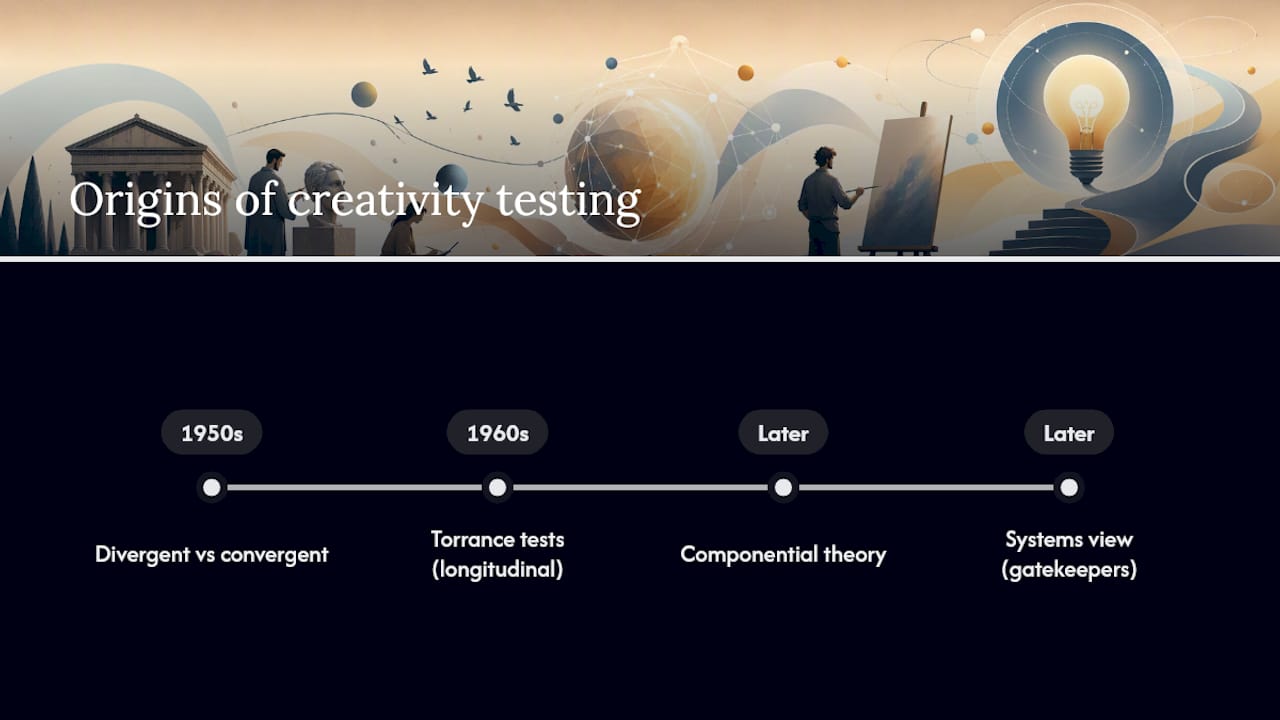
Modern creativity testing traces back to J.P. Guilford's 1950s work distinguishing divergent thinking (generating many possible answers) from convergent thinking (finding the one correct answer). Guilford argued that standard intelligence tests, built almost entirely around convergent problems, were structurally blind to creative ability. That argument reshaped psychological testing.
E. Paul Torrance built on Guilford's framework in the 1960s to create the Torrance Tests of Creative Thinking, still the most widely cited standardized creativity measure today. Torrance's contribution wasn't just a new test. He pushed for longitudinal validation, tracking test-takers for decades to see whether childhood scores predicted adult creative achievement, an unusually patient research design for its era.
Later theorists added the pieces Guilford and Torrance didn't fully address. Teresa Amabile's componential theory brought in social and environmental context, arguing that creativity depends as much on motivation and setting as on raw cognitive ability. Mihaly Csikszentmihalyi's systems view pushed further, arguing that creativity only becomes "real" when a domain's gatekeepers, critics, teachers, and institutions recognize a product as creative. That's the theoretical root of the "press" dimension mentioned earlier, and it's part of why a single test score never fully settles the question of how creative someone is.
Creativity Tests vs. Intelligence Tests: What's Actually Different
Creativity and intelligence overlap, but they aren't the same construct, and conflating them is one of the most common misreadings of test results. Intelligence tests are built around convergent tasks with a single correct answer: matrix reasoning, vocabulary, working memory. Creativity tests, especially divergent thinking tasks, reward generating many valid answers rather than finding the one right one.
Research generally supports a "threshold theory": a baseline level of intelligence is associated with higher creative output, but above that threshold, more intelligence doesn't reliably predict more creativity. A brilliant problem solver and a highly original thinker are related but distinct profiles, and plenty of people score high on one and average on the other.
This is exactly why pairing an abstract reasoning style task with a divergent thinking exercise gives a more complete cognitive picture than either alone. One tells you how well someone converges on a correct solution under constraints; the other tells you how freely they generate alternatives when there isn't a single right answer. Employers and educators who treat a high IQ score as a proxy for creative potential are making a measurement error, not a reasonable shortcut.
Cultural and Demographic Factors That Skew Creativity Scores
Creativity tests are far from culturally neutral, and that shows up most visibly in language-based tasks. A verbal divergent thinking test administered in someone's second language tends to produce lower fluency scores, not because the person generates fewer ideas, but because translation and word retrieval slow them down. Figural or nonverbal tasks reduce this problem but don't eliminate it, since even image-based prompts carry cultural assumptions about what counts as a "sensible" or "silly" use for an object.
Educational background matters just as much. Students trained in environments that reward a single correct answer often underperform on divergent thinking tasks relative to students from more open-ended, project-based classrooms, even when underlying creative potential is similar. That's an artifact of practice and comfort with ambiguity, not raw ability.
Age and domain familiarity add another layer. Older adults and domain experts often show higher originality scores in their specific field but lower fluency on generic tasks unrelated to their expertise, a pattern researchers link to accumulated schema and knowledge rather than declining creative capacity. Any comparison across age groups or cultural backgrounds needs to account for these confounds before treating score differences as real differences in creative ability.
What Administering and Scoring a Creativity Test Actually Looks Like
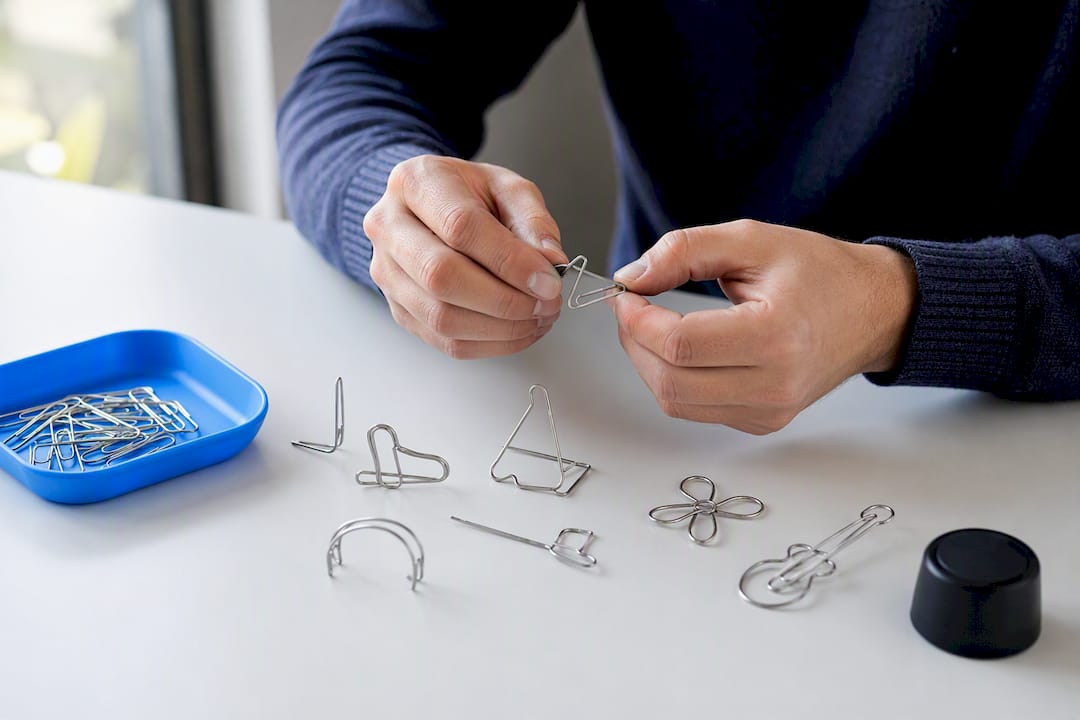
Take the Alternative Uses task, one of the most common divergent thinking exercises. A test taker gets a common object, say a paperclip, and two minutes to list as many uses as possible. Scorers then count total responses for fluency, tally distinct idea categories for flexibility, and compare each response against a normative database to flag statistically rare answers as high in originality.
The Remote Associates Test works differently in administration. Test takers see three words (say, "night," "wrist," "stop") and must find the one word that connects all three ("watch"). There's no partial credit; each item is scored right or wrong, and total correct answers become the score, which makes RAT fast to administer and simple to grade compared with open-ended tasks.
Self-report scales like the CAQ take a completely different administration format: a questionnaire, often 5 to 10 minutes long, asking respondents to check off actual accomplishments across ten domains (writing, music, visual arts, dance, and others), from "I have never done this" to "my work has been recognized in a national publication." Because most people report few achievements, scorers apply transformations rather than raw sums to keep the skewed distribution from distorting comparisons.
Product-based Consensual Assessment Technique looks the most like real-world evaluation: multiple independent judges rate the same set of creative products (poems, collages, business pitches) on originality and quality, and their ratings get averaged. Reviewers evaluating student application essays use a version of this same logic, weighing originality against execution rather than checking boxes on a rubric.
What a Creativity Score Should and Shouldn't Change About How You See Yourself
The most useful thing a creativity test ever gave anyone wasn't a number. It was a specific observation, like noticing you generate a lot of ideas fast but rarely develop any of them past the first draft. That's a pattern you can act on. A single composite score, by contrast, tells you almost nothing actionable on its own.
My advice: treat any test result as one data point next to your actual creative output, whatever that looks like for you, a portfolio, a body of work, a habit of solving problems sideways. Scores and practice-based evidence correct each other's blind spots.
If you want a quick, low-stakes way to see where your own idea generation and flexibility stand, a short interactive creativity test is a reasonable place to start, precisely because it's fast enough to not feel like a verdict.
— Steve
Try Testuno's Creativity Test for Fast, Benchmarked Feedback
Reading about divergent thinking and self-report scales is one thing. Seeing where you actually land is another, and that's the gap Testuno's creativity test is built to close. It runs in a short amount of time, requires no sign-up, and gives you an instant result benchmarked against percentile data.

Use it the way this article recommends: as one input, not the whole answer. Pair your creativity result with a broader cognitive profile if you want to see how idea generation stacks up against reasoning and problem-solving skills, or download your report and set it next to an actual portfolio or work sample for a fuller picture. Curious how your creative thinking compares to your logical reasoning? Start with the creativity test now and see your percentile in minutes.
Sources
- Quantifying creativity: can measures span the spectrum?
- Measuring student success skills: A review of the literature on creative thinking
- Assessing creativity with self-report scales: review and empirical evaluation
- Assessing creativity with self-report scales: A review