

A confidence test estimates how much you trust your own abilities in specific situations, from public speaking to handling criticism, using a set of scored questions you can finish in about 5 to 15 minutes. It won't diagnose anything, but it will show you where your self-efficacy is strong and where it's shaky. The practical next step is simple: take one, then pick one or two situations the results flag and start practicing there.
TL;DR:
- Most online confidence tests measure self-efficacy in specific situations, not overall self-esteem, and are best used to identify narrow skill gaps.
- Results should be interpreted as a map of strengths and weaknesses, focusing on improving the lowest dimension through targeted practice rather than chasing a high overall score.
- Timing and honest, instinctive answers are crucial, as test accuracy depends on when and how you take it, ideally in a neutral state.
- Since these tests lack clinical validation, their primary value lies in tracking change over time rather than making diagnoses or definitive judgments.
- Retaking the test in four to six weeks helps determine if practice efforts are moving the score, especially in the weakest areas, rather than relying on initial results alone.
Table of Contents
- What Does a Confidence Test Actually Measure?
- What Does a Typical Confidence Test Look Like?
- How to Take a Confidence Test and Read Your Results
- How Reliable Is a Confidence Test, Really?
- Why Testuno Built a Confidence Assessment This Way
- The Problem With Treating Confidence Scores as Labels
- Take a Confidence Test on Testuno
- Sources
- FAQ
What Does a Confidence Test Actually Measure?
A confidence test measures something narrower and more useful than most people assume. It's tracking self-efficacy, your belief that you can perform a specific task, not your overall sense of worth as a person. That second thing is self-esteem, and the two are genuinely distinct even though people use the words interchangeably. You can feel fully confident giving a presentation and still struggle with self-esteem in your personal relationships. The two don't move together.
Psychologist Albert Bandura built the framework most confidence tests borrow from. His research identifies four sources that build perceived capability: mastery experiences (you did it before and succeeded), vicarious experiences (you watched someone similar succeed), social persuasion (someone credible told you that you could do it), and physiological states (your body reads calm rather than panic). Good confidence tests are, in effect, sampling how strong these sources are for you right now.
Most tests break confidence into a handful of measurable dimensions:
- Decision-making under uncertainty
- Verbal and social expression
- Coping with failure or rejection
- Comfort with risk and unfamiliar situations
Knowing which of these is weakest matters more than any single overall score.
What Does a Typical Confidence Test Look Like?
Online confidence tests tend to follow a predictable shape, and knowing the format ahead of time keeps you from second-guessing every answer. Expect a mix of binary yes/no items, five-point Likert agreement scales ("I speak up in meetings even when I disagree"), and short scenario choices where you pick how you'd realistically react.
Sample items you'll commonly see:
- "I can walk into a room of strangers and start a conversation."
- "When I make a mistake at work, I recover quickly and keep going."
- "I ask for what I want, even if the answer might be no."
- "I trust my judgment when facing a decision with no clear right answer."
- "Public speaking makes me anxious even when I'm well prepared."
- "I avoid situations where I might be criticized."
Pro Tip: Answer based on how you actually behave most of the time, not how you wish you'd behave in your best moment. Overthinking a single item skews your score more than answering fast and honest ever will.
How to Take a Confidence Test and Read Your Results
Timing matters more than people expect. Take the test when you're not rushed, not mid-argument, and not fresh off a big win or a rough failure, since either extreme will skew your answers toward a mood rather than a pattern. Answer instinctively. If you're stuck rereading a question three times, you're overanalyzing rather than reporting.
Most self confidence assessment tools report your results as a total score sorted into bands:
- Low band: You tend to avoid situations that expose you to judgment or failure, and you second-guess decisions frequently.
- Moderate band: You're confident in familiar territory but hesitate when stakes rise or the setting is unfamiliar.
- High band: You act decisively across most situations and recover quickly from setbacks.
Some platforms add percentile context, showing where your score sits against other test takers, which can be more useful than the raw band alone.
The band matters less than what you do with it; for example, targeted practice like online piano lessons can help build confidence through mastery experience. Once you see where you land, pick one or two specific situations tied to your weakest dimension, whether that's speaking up in meetings or handling a difficult conversation, and design a small, low-stakes way to practice it this week. Retest in four to six weeks. Movement in your score tells you the practice is working; no movement tells you to change the target.
How Reliable Is a Confidence Test, Really?
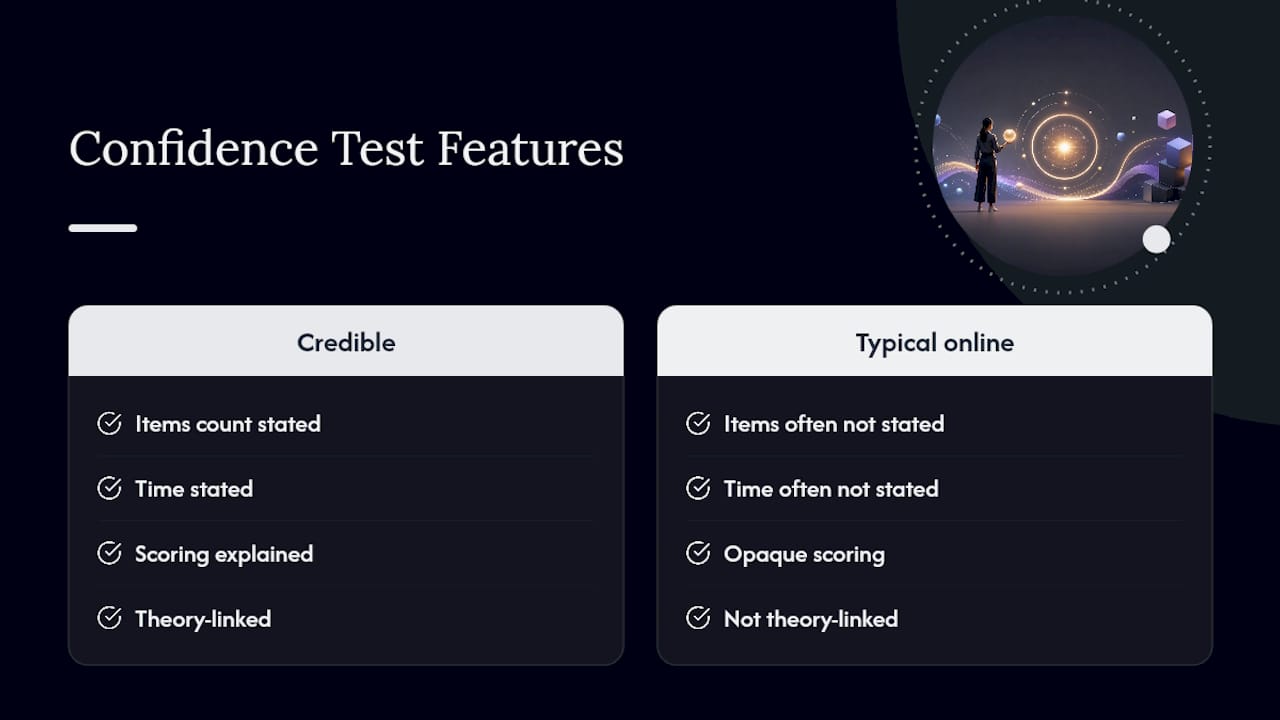
A credible confidence evaluation questionnaire tells you upfront how many items it has, how long it takes, and how scoring works, and it ties its structure back to established theory rather than presenting scores as mysterious verdicts. If a test can't explain any of that, treat the result as a rough gut check rather than a measurement.
Here's the honest limitation: most online confidence quizzes are built for self-reflection and tracking change over time, not for clinical diagnosis. They lack the norming samples and psychometric validation (reliability coefficients, factor analysis) that a formal clinical instrument requires. That doesn't make them useless. It makes them a different tool for a different job, closer to a fitness tracker than an MRI.
The research-backed move is to treat your score as a map, not a verdict. Confidence responds to repeated exposure and graduated practice in a way self-esteem doesn't, since self-esteem tends to shift more slowly and often needs a different kind of work entirely. If your test flags low confidence in one narrow area but your self-worth otherwise feels steady, that's actually a good sign: you have a specific, fixable target instead of a vague, sprawling one.
Why Testuno Built a Confidence Assessment This Way
Testing self-belief accurately means asking questions that map to real behavior, not abstract feelings, and scoring them against a framework people can actually act on. Testuno's platform runs a wide catalog of self-assessments, from intelligence and cognitive skills to personality and relationship insights, all built around the same principle: fast, structured feedback without a signup wall.
A self confidence evaluation on an online platform following this logic takes roughly 15 minutes, requires no account creation, and returns results immediately so users can act on them the same day rather than waiting on an email. That immediacy is the whole point. A confidence level quiz that sits in your inbox for a week doesn't help you plan this week's practice.
The Problem With Treating Confidence Scores as Labels
Most people take a confidence test the way they take a personality quiz: they read the label, nod, and move on. That's the wrong instinct, and it wastes the one thing self-efficacy research actually gives you, a map of where mastery experience is missing.
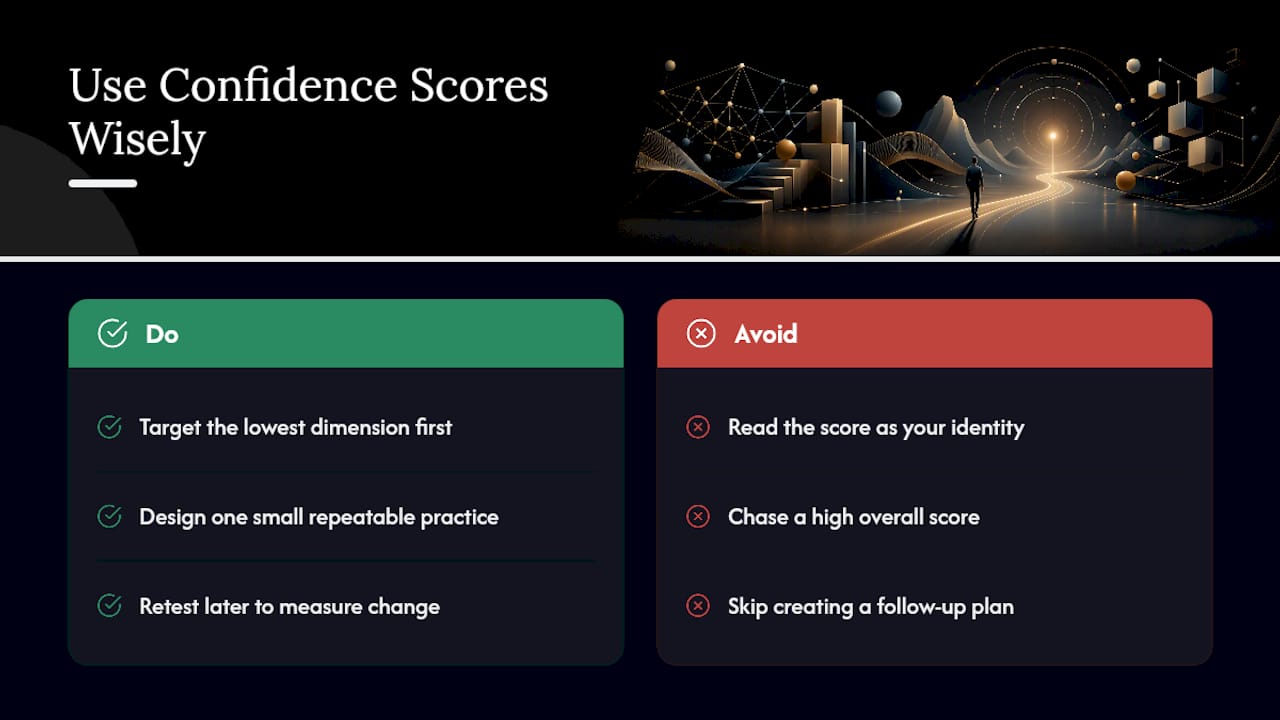
The conventional advice around confidence, "just believe in yourself," "fake it till you make it," skips the mechanism entirely. Bandura's own research is clear that belief follows evidence, not the other way around. You don't build confidence by affirming it. You build it by stacking small wins in a specific situation until your brain updates its prediction about what you can handle. A test score without a follow-up plan is just data sitting idle.
What I'd prioritize first: don't chase a high overall score. Chase the lowest dimension on your report and design one small, repeatable practice around it. Someone scoring low on "expression" doesn't need a pep talk; they need three low-stakes conversations this week where they say the thing they'd normally swallow. Retesting later isn't about vanity metrics. It's the only honest way to know whether the practice is actually moving the number, or whether you picked the wrong target.
— Steve
Take a Confidence Test on Testuno
Testuno gives you a structured way to measure something most people only guess at: how your self-belief actually breaks down across different situations, not just a single vague number. The confidence test takes about 15 minutes, needs no signup, and hands you a scored, downloadable report the moment you finish, so there's no waiting on an email or creating a login just to see where you stand.

Start with the confidence assessment, then come back in four to six weeks and retake it to see whether your practice targets are moving the needle. If you want a fuller picture of how confidence sits alongside your broader traits, Testuno's personality assessments and cognitive profile tools pair well with it. One note worth repeating: this is a self-reflection tool, not a clinical instrument. If low confidence is tangled up with deeper anxiety or self-worth concerns, a licensed professional is the right next step, not another quiz.
Sources
Self-efficacy research points to four main sources: mastery experiences, watching others succeed, encouragement from credible people, and how calm or anxious your body feels in the moment. Bandura's self-efficacy framework treats mastery experience, actually succeeding at something yourself, as the strongest of the four.
- Are self-confidence and self-esteem the same thing? — Psychology Today
- Self-efficacy and human agency — American Psychological Association (APA)
- How to build self-confidence — MindTools
- Self-esteem vs self-confidence: why the difference matters — Counselling Directory
FAQ
How Can I Test My Confidence Level?
Take a structured confidence test that scores you across specific dimensions like decision-making, expression, and coping with failure, rather than relying on a single overall impression. Most online versions, including Testuno's confidence test, take about 15 minutes and give you an immediate breakdown by category.
What Are Common Signs of Self-Confidence?
Confident people tend to speak up even when they might be wrong, recover quickly from mistakes instead of dwelling on them, and make decisions without needing constant outside validation. They also tolerate the discomfort of unfamiliar situations rather than avoiding them outright, which distinguishes confidence from self-esteem as a more situation-specific trait.
How Do I Know if I Have Low Confidence?
Low confidence usually shows up as avoiding situations where you might be judged, second-guessing decisions after you've already made them, and hesitating to ask for what you want. A confidence test can pinpoint whether this shows up in one specific area, like public speaking, or across most situations, which changes what kind of practice actually helps.