
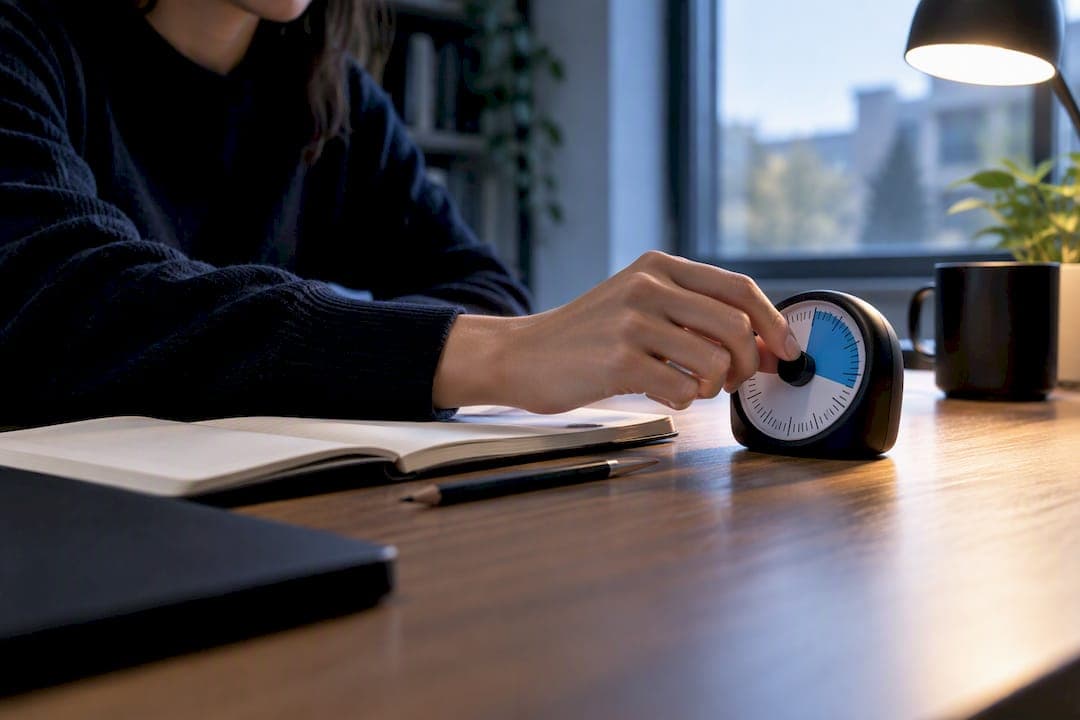
The techniques with the most evidence behind them are structured work intervals like the Pomodoro method, short aerobic movement breaks, consistent sleep timing, brief mindfulness practice, and hard limits on notifications. Start this week with two days of 25-minute focus blocks separated by a 10-minute walk, plus a fixed wind-down before bed. Test your baseline attention now, run the stack for two weeks, then retest to see what actually moved.
TL;DR:
- Focusing on two to three proven techniques, such as structured work intervals, movement breaks, and consistent sleep, yields faster improvements within two weeks.
- Testing attention and working memory before and after the intervention helps determine which habit actually improves your focus.
- Eliminating distractions like notifications and stacking different task types reduces mental drag and enhances ongoing concentration.
- A two-minute reset, involving box breathing and quick movement, can restore focus during the day without leaving your desk.
- Retesting every two to four weeks provides a clearer picture of progress, guiding adjustments rather than relying on subjective feelings.
Table of Contents
- Focus and Concentration Techniques Ranked by Impact
- How to Build a Daily Routine That Stacks These Techniques
- Fast Resets When Your Focus Slips Mid-Task
- How to Measure Whether Your Focus Is Actually Improving
- Common Causes of Poor Concentration and Targeted Fixes
- Managing Mental Fatigue Before It Becomes Burnout
- Why Goal Setting Keeps You Concentrated Longer
- Technology and Apps: Helpful Tool or Bigger Distraction?
- Beating Procrastination and Staying Motivated
- A Two-Week Experiment Worth Running
- Track What's Actually Improving With Testuno
- Sources
- FAQ
Focus and Concentration Techniques Ranked by Impact
Not every technique on this list deserves equal time. Some rewire how your brain handles attention over weeks; others buy you five extra usable minutes right now. Here's the order that gets you the most out of the least effort, starting with the one that changes behavior fastest.
1. Time-blocking and the Pomodoro method
The classic version is 25 minutes of focused work followed by a 5-minute break, and it works because it solves the hardest part of any task: starting it. Harvard Health notes that structured intervals and scheduled breaks help maintain attention and reduce the chance that focus wanes mid-task. If 25 minutes feels too short once you're in flow, try 50 minutes on, 10 off. Professionals juggling meetings tend to do better with the shorter cycle since it's easier to protect a 25-minute slot on a packed calendar; students working through dense reading often prefer the 50/10 split because it matches how long it takes to actually get into a chapter.
2. Mindfulness and breath-based practice
You don't need a 30-minute meditation habit to see a benefit. Five minutes of breath-counting, or a short body scan before a study block, is enough to start. Reviews of mindfulness-based interventions report measurable gains in attention and cognitive organization, and systematic reviews and meta-analyses tie the effect to real changes in how the brain sustains attention over time, not just a temporary calm feeling. Standardized programs like MBSR tend to produce more consistent results than a random meditation app session, though research on mindfulness and lifestyle outcomes suggests the gap narrows when practice is paired with other behavior changes, which is exactly what this stack is built to do.
3. Sleep hygiene, treated as a focus tool, not just rest
This is the one people underrate the most. A daily-diary study of employees found that waking slightly earlier or sleeping fewer minutes than usual was linked to increased scores on a cognitive interference scale the next workday. That's not a dramatic sleep deprivation scenario. That's a slightly early alarm. The fix is boring but effective: a consistent wake time seven days a week, and a wind-down anchor (same lights-off routine, no screens for the last 20 minutes) that doesn't move even on weekends.
4. Light aerobic exercise before or between focus blocks
A session of light aerobic activity lasting around half an hour improves response times in multitasking and raises cortical excitability in healthy adults, according to a study on exercise and executive function. You don't need a gym session. A brisk 10 to 30 minute walk or a bike ride delivers a real, measurable attention boost, and it's one of the most accessible interventions available to anyone who can't or doesn't want to do vigorous exercise. Meta-analyses of single exercise bouts do find that moderate intensity tends to produce more consistent executive-function gains than light intensity, so if a brisk walk isn't cutting it, push the pace.
5. Distraction control: notifications, environment, sound
Phone notifications are the single most common attention leak, and the fix isn't willpower, it's friction. Put the phone in another room during focus blocks, or use airplane mode. Close every browser tab that isn't part of the current task. On sound: some people concentrate better with white noise or instrumental music masking background chatter, others need dead silence. Test both for a week each rather than assuming you know which one works for you.
6. Nutrition and hydration basics
Attention crashes are often blood-sugar crashes wearing a productivity costume. Skip the sugar-heavy breakfast, keep water within reach, and treat caffeine as a tool with a schedule, not a reflex. A coffee at 7 a.m. and another right before a 2 p.m. slump is a smarter use of caffeine than sipping it continuously all day, which just pushes the crash later without preventing it.
7. Active recall and deliberate practice
Passive reading feels like work but rarely builds focus stamina. Active recall, quizzing yourself, summarizing from memory, teaching the material out loud, trains your brain to hold information under attention pressure. Guides like James Clear's synthesis on focus point to practice-based strategies, combined with scheduled breaks, as the mechanism behind gradually longer focused sessions.
8. Task design: don't stack similar tasks
Switching between similar tasks, like answering three different emails on three different topics, causes more mental drag than switching between very different tasks, according to research on task similarity and switch costs. Batch similar work into one uninterrupted block instead of interleaving it throughout the day.
Pro Tip: Pair your hardest task with your best energy window, not your longest open calendar slot. A 25-minute block at 9 a.m. often beats a 90-minute block at 3 p.m.
How to Build a Daily Routine That Stacks These Techniques
Randomly trying five techniques on the same day is a recipe for none of them sticking. Sequencing matters as much as the techniques themselves.
Morning setup (first 30–60 minutes):
- Wake at the same time daily, even on weekends.
- Get 10 minutes of light movement, a walk works fine, before opening email.
- Pick one or two priority tasks for the day. No more.
Student template:
- 50-minute focus block on the toughest subject first, 10-minute break.
- Short walk or stretch at the midpoint of the study session.
- 5-minute breath-counting practice before the second study block.
- Evening review using active recall instead of re-reading notes.
Knowledge worker template:
- 25-minute Pomodoro blocks stacked in pairs, with a 10-minute walk after the second block instead of after every single one.
- Deep work scheduled in the first two hours of the day, meetings batched into the afternoon.
- Mindfulness practice slotted right before the first focus block, not during a slump, since it works better as a primer than a rescue.
Schedule exercise and mindfulness so they bookend focus blocks rather than interrupting one midstream. A walk before a hard task primes attention; a walk in the middle of a task you're just getting into can break momentum you don't want to lose.
Weekly check, every Sunday: log how many focus blocks you actually completed, your average sleep time across the week, and one simple performance number, pages read, tasks closed, whatever fits your work. Compare week to week, not day to day, since daily numbers are too noisy to mean much.
Pro Tip: If a technique isn't showing up in your weekly numbers after two weeks, drop it and try the next one on the list instead of stacking a sixth habit on top of five that aren't working yet.

Fast Resets When Your Focus Slips Mid-Task
Some days the plan falls apart by 10 a.m. anyway. These take under two minutes and don't require leaving your desk.
- Box breathing. Inhale for four counts, hold for four, exhale for four, hold for four. Repeat four times. This clears the low-grade mental static that builds up after 45 minutes of sustained work.
- Sixty seconds of movement. March in place, climb a flight of stairs, or just stand and stretch. Blood flow shifts, alertness follows within a minute or two.
- The notification purge. Phone face down in a drawer, browser tabs closed, Slack on snooze for 20 minutes. This one-step removes more distraction than any app setting ever will.
- Micro-task re-anchor. Don't try to jump back into the whole project. Pick the next two to five minute subtask, send one email, fix one paragraph, and let momentum rebuild from there.
How to Measure Whether Your Focus Is Actually Improving
Guessing whether you're sharper this month than last is unreliable. A baseline number fixes that.
Run a quick self-test before you start any new routine: a reaction-time check, a short working-memory task, or a timed reading-comprehension passage. Testuno's concentration test and working memory test both take a few minutes and give an immediate score, useful as a starting point rather than a diagnosis.
Retest every two to four weeks, not daily. Short repeatable cycles, baseline, two-week intervention, retest, make it easier to spot a real signal instead of chasing day-to-day noise that has nothing to do with your habits.
- A jump in working memory scores but flat reaction time suggests your sleep and mindfulness changes are paying off more than your movement breaks.
- Faster reaction time with no change in sustained reading comprehension points toward exercise helping alertness but not endurance.
- No change in either after four weeks means it's time to swap a technique, not add another one.
A structured cognitive profile breaks results into subdomains, so you're not guessing which specific skill responded to which habit. That distinction, working memory versus processing speed versus sustained attention, is what tells you where to double down next.
Common Causes of Poor Concentration and Targeted Fixes
Persistent focus problems usually trace back to one of four culprits, and the fix depends on which one you're dealing with.
- Sleep debt hiding as laziness. If you're waking up tired despite eight hours logged, check consistency, not just total hours. A fixed wake time for a week often reveals more than a sleep-tracking app ever will.
- Stacking similar tasks. Answering ten similar emails back to back feels efficient but generates more mental drag than doing one email, one report, then one call, because switching between similar tasks raises maintenance difficulty more than switching between different ones, per research on task switching.
- Chronic multitasking habits. People who multitask heavily often get worse, not better, at filtering distractions, since the brain adapts to spreading attention thin rather than holding it steady. Research on multitasking and attention filtering points to structured single-task practice as the way back.
- Undiagnosed medical or mental health factors. If focus problems persist for weeks despite sleep, movement, and distraction fixes, that's a signal worth raising with a doctor rather than another productivity hack. Persistent attention issues can have causes, from thyroid function to anxiety disorders, that no amount of time-blocking will fix.
- Environmental and social pressure. An open office with constant interruptions or a manager who expects instant replies needs a boundary script, not just a better desk setup: "I'm heads down until 11, I'll reply after that" said out loud once tends to work better than hoping people notice your closed door.
Managing Mental Fatigue Before It Becomes Burnout
Mental fatigue and burnout aren't the same thing, but fatigue that goes unmanaged for weeks is how burnout starts. The clearest early sign is that tasks which used to take 20 minutes now take 40, not because they got harder, but because your attention keeps sliding off them.
The fix isn't more focus blocks. It's fewer, with real recovery between them. Cap deep work at three to four focused blocks a day rather than trying to chain eight Pomodoros back to back. Recovery has to include something genuinely restorative, a walk outside, not scrolling a phone, since screen-based breaks tend to keep the same attention systems engaged instead of letting them reset.
Watch for the gap between busy and productive. Fatigue often shows up as doing more low-value tasks (email, small edits) while avoiding the one task that actually needs sustained attention. That avoidance pattern, more than raw hours worked, is usually the better predictor of burnout risk. If you notice it lasting more than a week or two, that's the point to cut commitments rather than push through with more caffeine or longer hours.

Why Goal Setting Keeps You Concentrated Longer
Vague goals produce vague attention. "Work on the report" gives your brain nothing to lock onto, so it wanders. "Draft the introduction and first data section by 11 a.m." gives it a target, and a target is what sustained attention actually needs to hold on to.
Prioritization matters just as much as the goal itself. Pick one or two priority tasks each morning, not five. Trying to hold five open priorities in mind simultaneously is itself a drain on working memory, the same resource you're trying to protect for actual work. Rank tasks by which one, left undone, would hurt you most tomorrow, then start there while your attention is freshest.
Break bigger goals into blocks that match your focus-interval length. A goal that takes six 25-minute blocks to finish is a goal you can actually schedule; a goal that just says "finish the project" is a goal you'll keep deferring because it never fits neatly into a single sitting.
Technology and Apps: Helpful Tool or Bigger Distraction?
Focus apps split into two useful categories: blockers that remove temptation, and trackers that show you patterns you can't see on your own. Website and app blockers that lock out social media during work blocks solve the willpower problem directly, since you can't scroll what you can't open. Time-tracking apps that log how long you actually spent on deep work versus shallow work often reveal a gap people don't expect, many people discover their "focused" day had under two hours of real uninterrupted work.
The risk is turning the tracking itself into a distraction, checking your focus-tracking app every 20 minutes defeats the purpose. Set it, forget it during the block, and review it once at the end of the day. A structured attention and cognitive test taken every couple of weeks tells you more about actual improvement than a daily app streak ever will, since streaks measure consistency, not capability.
Beating Procrastination and Staying Motivated
Procrastination is rarely about laziness. It's usually about a task feeling too big, too vague, or too unpleasant to start, and starting is the actual barrier, not finishing.
The two-minute rule handles this directly: commit to just two minutes of the dreaded task. Open the document. Write one sentence. Momentum built in those two minutes carries further than people expect, and if it doesn't, you've only lost two minutes. For longer-term motivation, tie tasks to a visible small reward, not a huge one, finishing a block earns a coffee break, not a shopping spree, since oversized rewards create their own procrastination loop while you wait for the "big" payoff to feel worth it.
Building a study or work habit that survives past week one usually takes a structured runway. A guide on building study habits backed by science walks through 25-minute interval scaffolding over a 30 to 90 day window, useful if the two-week experiment below leaves you wanting a longer plan.
A Two-Week Experiment Worth Running
Testing beats guessing every time here. Pick two techniques from this list, not five, log them daily for two weeks, and retest your baseline at the end. Expect modest, not dramatic, changes in that window; short repeatable cycles are built to catch real signal, not overnight transformation.
Run a baseline check before you start anything. Choose your two techniques (a walk before your hardest block and a fixed wake time tends to be a strong starting pair). Log completion daily, even a single line in a note app works. Retest at day 14 and compare against your own baseline, not against anyone else's results. Expect small adjustments along the way. If a technique isn't fitting your schedule by day 10, swap it rather than forcing it through the full two weeks.
— Steve
Track What's Actually Improving With Testuno
Behavior changes work faster when you can see which one is moving the needle, and that's where a structured check-in beats a gut feeling. There are online tools that measure specific cognitive skills targeted by these techniques, such as attention, working memory, and reaction speed, through interactive self-assessments that take about 15 minutes with no sign-up required.

Take a working memory test before you start your two-week stack, then again at the end, to see whether sleep and mindfulness moved the number more than exercise did. If you're curious about your broader cognitive profile beyond attention alone, the Quick IQ Estimate adds context with real-time benchmarking and percentile rankings, so you know not just whether you improved, but how that stacks up. Run your first check now at Testuno and give your two-week experiment an actual number to test against.
Sources
- Bidirectional associations of sleep with cognitive interference in employees' work days (CDC/study)
- Mindfulness-based interventions: systematic reviews and meta-analyses (PMC10640625)
- Pay attention to concentration (Harvard Health)
FAQ
What are the most effective ways to improve concentration?
The strongest evidence supports structured work intervals like the Pomodoro method, short aerobic exercise, consistent sleep timing, brief mindfulness practice, and strict control of notifications and environment distractions. Combining two or three of these, rather than relying on just one, tends to produce faster and more noticeable gains within a couple of weeks.
How do I rewire my brain to focus better?
Sustained attention improves through repeated practice under mild challenge, which is why active recall, scheduled breaks, and consistent sleep matter more than any single trick. Mindfulness-based interventions show measurable changes in attention and cognitive organization after weeks of consistent practice, not a single session.
How do people with ADHD improve focus?
People with attention-deficit challenges often benefit from the same structural tools everyone else does, short work intervals, movement breaks, and firm distraction limits, but usually need shorter intervals and more frequent breaks than the standard 25/5 split. Anyone managing ADHD symptoms alongside significant focus struggles should treat these techniques as a complement to, not a replacement for, professional guidance.
How can I increase focus in two minutes?
Box breathing (four counts in, hold, four out, hold, repeated four times) clears mental static fast, and pairing it with 60 seconds of movement, like marching in place or a quick stair climb, adds an alertness boost on top. Follow both with a notification purge and picking one small next subtask to rebuild momentum immediately.
How often should I retest my focus and concentration?
Retesting every two to four weeks strikes the right balance between catching real change and avoiding noise from day-to-day fluctuation. A quick concentration test at the start and end of that window gives you a concrete number to compare instead of relying on how sharp you feel.