

This page gives you a categorized, difficulty-graded bank of general knowledge topics, from history and geography to science and current affairs, each split into easy, medium, and hard questions with answers ready to copy into a quiz. Pick a category, choose a difficulty, decide how many questions per round, and you're set for a pub quiz, a classroom test, or a five-minute self-check. Testuno and the Cornell five-day study plan both back the same principle behind this list: organized categories beat random memorization.
TL;DR:
- Questions should be selected across categories and difficulty levels based on the audience's familiarity, using mostly easy and medium tiers for casual quizzes and more hard questions for competitive settings.
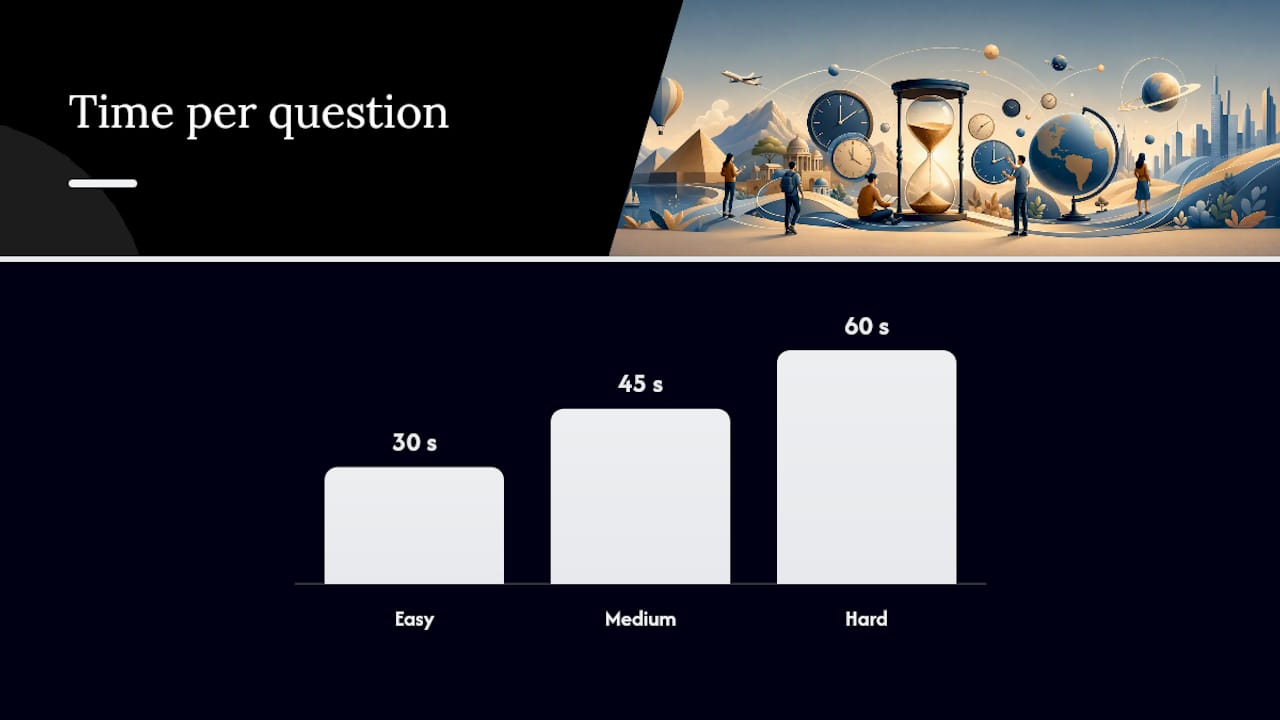
- Timing should be adjusted so that easy questions are answered in 30 seconds, medium in 45 seconds, and hard questions up to 60 seconds, with scoring scaled accordingly.
- Regularly review and update questions to prevent factual drift and staleness, focusing on geography and current affairs categories that change most rapidly.
- Use multiple sources to verify answers, especially superlatives and recent records, and flag questions with outdated or regional-specific answers before play.
- Incorporate short, timed assessments like Testuno's quick IQ tests to identify personal strengths and weaknesses, guiding targeted study efforts.
Table of Contents
- How to Build a Quiz from These General Knowledge Topics
- The Core Question Bank: General Knowledge Topics by Category and Difficulty
- How to Study General Knowledge Topics Without Wasting Time
- How Testuno Helps You Baseline Before You Study
- How to Check If a Trivia Question and Answer Are Actually Correct
- Keeping Your General Knowledge Content Current and Error-Free
- Adjusting General Knowledge Quizzes for Different Audiences
- When to Run a Fun Quiz vs. When to Study for Real
- Turn Practice Into a Measurable Score with Testuno
- Sources
- FAQ
How to Build a Quiz from These General Knowledge Topics
A good quiz round is not a random pile of trivia. It's a mix calibrated to who's playing and how long you have. Three variables control everything: category spread, difficulty curve, and time per question.
Category mixing. For a mixed adult crowd, pull two questions each from four or five categories rather than ten questions from one. A pub quiz round works well as: 2 history, 2 geography, 2 science, 2 entertainment, 2 sports. A classroom test leans harder on the subject being taught, with one or two "wildcard" general knowledge questions to keep energy up. A rapid-fire round for kids or teens skips hard science and math in favor of entertainment, sports, and easy geography.
Choosing a question format. Different formats fit different settings:
- Multiple choice (MCQ) works best for large groups or written tests because it's fast to grade and reduces "no answer" dead air.
- Short answer suits smaller groups or trivia nights where you want players to actually recall the fact, not guess from four options.
- True/false is the fastest format for warmups or tiebreakers, though guessing accuracy runs at 50 percent, so weight it lightly in scoring.
- Picture or audio rounds (album covers, flags, landmarks) work well for entertainment and geography categories and boost engagement in remote or hybrid settings.
Timing and scoring. Give 30 seconds per easy question, 45 for medium, and up to 60 for hard questions that require calculation or multistep reasoning. Standard scoring is 1 point per easy question, 2 for medium, 3 for hard, with a bonus point for the first correct written answer in a tiebreaker. For math or logic questions, consider partial credit if players show work.
Suggested round structure:
- Warmup: 5 easy questions across mixed categories to loosen up the room.
- Main round one: 10 questions, easy to medium, one category focus (e.g., geography).
- Main round two: 10 questions, medium to hard, different category focus.
- Picture or audio round: 5 questions, entertainment or geography.
- Tiebreaker: 1 to 3 hard questions, closest-without-going-over for numeric answers.
For remote play over video call, share questions on screen rather than reading them aloud twice, use a shared spreadsheet or a free quiz tool for live leaderboards, and mute all but the current answerer to cut cross talk.
Pro Tip: Keep a "bench" of 10 to 15 extra questions per session at the same difficulty spread. Ties happen more often than hosts expect, and having backups ready beats scrambling mid-game.
The Core Question Bank: General Knowledge Topics by Category and Difficulty
This bank covers ten categories that mirror how major knowledge overviews, including Wikipedia's own subject taxonomy, organize broad subject areas: general knowledge (miscellaneous), history, geography, science and nature, math, entertainment, sports, arts and literature, technology, and current affairs. Each category is split into easy, medium, and hard tiers. For a casual social quiz, draw mostly from easy and medium tiers (roughly 60/30/10 easy/medium/hard). For a competitive or academic setting, flip that to 30/40/30.
General Knowledge (Miscellaneous)
Easy
- What is the capital of Japan? — Tokyo
- How many days are in a leap year? — 366
- What color do you get by mixing blue and yellow? — Green
Medium
- What is the smallest country in the world by land area? — Vatican City
- Which language has the most native speakers worldwide? — Mandarin Chinese
- What does "GDP" stand for? — Gross Domestic Product
Hard
- What is the only mammal capable of true flight? — Bat
- Which country has the most time zones? — France (12, due to overseas territories)
- What is the term for a word that reads the same forward and backward? — Palindrome
History
Easy
- Who was the first president of the United States? — George Washington
- In what year did World War II end? — 1945
- Which ancient civilization built the pyramids of Giza? — The Egyptians
Medium
- What year did the Berlin Wall fall? — 1989
- Who was the queen of England during the defeat of the Spanish Armada? — Elizabeth I
- Which empire was ruled by Genghis Khan? — The Mongol Empire
Hard
- What treaty ended World War I? — The Treaty of Versailles
- Which dynasty ruled China immediately before the Republic era began in 1912? — The Qing Dynasty
- What was the name of the 1929 economic collapse that triggered the Great Depression? — The Wall Street Crash (Stock Market Crash of 1929)
Geography
Easy
- What is the longest river in the world? — The Nile (by most measurements)
- Which continent is the Sahara Desert located on? — Africa
- What is the largest ocean on Earth? — The Pacific Ocean
Medium
- Which country has the most natural lakes? — Canada
- What is the capital of Australia? — Canberra (not Sydney)
- Which mountain range separates Europe from Asia? — The Ural Mountains
Hard
- Which African country was formerly known as Abyssinia? — Ethiopia
- What is the driest nonpolar desert on Earth? — The Atacama Desert in Chile
- Which two countries share the longest international border in the world? — Canada and the United States
Science and Nature
Easy
- What planet is known as the Red Planet? — Mars
- How many bones are in the adult human body? — 206
- What gas do plants absorb from the air for photosynthesis? — Carbon dioxide
Medium
- What is the chemical symbol for gold? — Au
- How many chambers does the human heart have? — Four
- Which blood type is considered the universal donor for red blood cell transfusions? — O negative, according to the American Red Cross
Hard
- What is the name of the process by which cells divide to produce identical copies? — Mitosis
- Which element has the atomic number 1? — Hydrogen
- What is the term for an organism that can produce its own food through photosynthesis? — Autotroph
Math
Easy
- What is 12 multiplied by 8? — 96
- How many sides does a hexagon have? — Six
- What is half of 150? — 75
Medium
- What is the value of pi rounded to two decimal places? — 3.14
- What is the square root of 144? — 12
- If a triangle has angles of 90 and 45 degrees, what is the third angle? — 45 degrees
Hard
- What is the sum of the interior angles of a pentagon? — 540 degrees
- What is 7 factorial (7!)? — 5,040
- Solve: if x + 5 = 2x - 3, what is x? — 8
Entertainment (Movies, Music, TV)
Easy
- Which movie features the song "Let It Go"? — Frozen
- Who played Iron Man in the Marvel Cinematic Universe? — Robert Downey Jr.
- What instrument has 88 keys? — The piano
Medium
- Which band released the album "Abbey Road"? — The Beatles
- Who directed the movie "Jaws"? — Steven Spielberg
- Which TV show is set in the fictional town of Springfield? — The Simpsons
Hard
- Who composed the score for "Star Wars"? — John Williams
- Which actor has won the most Academy Awards for acting? — Katharine Hepburn (four wins)
- What was the first feature-length animated movie ever released? — Snow White and the Seven Dwarfs (1937)
Sports
Easy
- How many players are on a soccer team on the field at once? — 11
- In which sport would you perform a slam dunk? — Basketball
- How often are the Summer Olympics held? — Every four years
Medium
- Which country has won the most FIFA World Cups? — Brazil (five titles)
- What is the maximum score possible in ten-pin bowling? — 300
- In tennis, what is a score of zero called? — Love
Hard
- Which country hosted the first modern Olympic Games in 1896? — Greece
- Who holds the record for most career home runs in Major League Baseball? — Barry Bonds
- What is the only sport to have been played on the Moon? — Golf
Arts and Literature
Easy
- Who wrote "Romeo and Juliet"? — William Shakespeare
- What is the art of folding paper into shapes called? — Origami
- Who painted the Mona Lisa? — Leonardo da Vinci
Medium
- Which novel begins with the line "Call me Ishmael"? — Moby Dick
- Who wrote "1984" and "Animal Farm"? — George Orwell
- What art movement is Salvador Dalí most associated with? — Surrealism
Hard
- Who wrote the epic poem "The Odyssey"? — Homer
- Which author wrote under the pen name "George Eliot"? — Mary Ann Evans
- What is the term for a fourteen-line poem, often associated with Shakespeare? — A sonnet
Technology
Easy
- What does "www" stand for? — World Wide Web
- What company created the iPhone? — Apple
- What does "AI" stand for? — Artificial Intelligence
Medium
- Who is credited as a co-founder of Microsoft alongside Bill Gates? — Paul Allen
- What does "HTML" stand for? — HyperText Markup Language
- What was the first widely used web browser? — Mosaic (or Netscape, depending on the source)
Hard
- What year was the first iPhone released? — 2007
- What does "URL" stand for? — Uniform Resource Locator
- Which programming language is named after a British comedy group? — Python (named for Monty Python)
Current Affairs
Current affairs questions age fast, so treat this category differently: write your own questions weekly rather than relying on a fixed list. Structure them the same way as the other categories, though, sorted by difficulty:
- Easy: name a country's current head of state, a recent major sporting champion, or a well-covered global event from the past month.
- Medium: ask about recent policy changes, election results, or notable economic shifts covered in mainstream news.
- Hard: ask about specific figures, dates, or details from ongoing international stories, similar to how research organizations like Chatham House break down international affairs into topical subareas for deeper study.
Recommended selection by audience: for a casual house party, pull 3 to 4 easy questions per category. For a trivia night with regulars, go 3 easy, 4 medium, 3 hard per category. For an academic or competitive setting, weight toward 2 easy, 4 medium, 4 hard.
How to Study General Knowledge Topics Without Wasting Time
Random memorization is inefficient. Cramming a list of unrelated facts the night before a quiz produces short-term recall and almost no lasting knowledge. The Cornell five-day study plan recommends breaking material into planned, categorized sessions instead of one long review, specifically because it surfaces knowledge gaps early enough to fix them.
Four techniques make the biggest difference for broad-topic recall:
- Spaced repetition: review the same category again after a day, then a week, then a month, rather than reviewing it once and moving on.
- Retrieval practice: test yourself with questions instead of rereading notes; forcing recall strengthens memory more than passive review.
- Chunking: group related facts (all the world capitals in one region, all the elements in one row of the periodic table) instead of studying them as isolated items.
- Interleaving: mix categories within a single study session (a bit of history, then geography, then science) rather than mastering one category before touching the next.
A practical weekly plan looks like this: ten minutes a day on quick retrieval drills covering two or three categories, one themed deep dive twice a week (pick a weak category and spend 20 to 30 minutes going deeper), and one full timed quiz at the end of the week using this bank's medium and hard tiers to measure progress. PracticeTestGeeks recommends the same core approach: sample questions used regularly, not occasionally, build the strongest base for exams and screeners.
Keep an error log. Every time you miss a question, write down the category, the correct answer, and one memory hook (a rhyme, an image, a connection to something you already know). Review that log before each week's timed quiz. Within a few weeks, the log itself tells you exactly which categories need more attention, which is far more useful than a vague sense that you're "bad at geography."
Pro Tip: Studying with a partner and quizzing each other out loud activates recall differently than silent review. If you can explain why an answer is correct, not just recite it, you've actually learned it.
How Testuno Helps You Baseline Before You Study
Knowing which categories to prioritize saves you time. Short, timed assessments can give you that starting point before you dive into a study plan built from this page.
- Timed subtests with instant benchmarking. Testuno's assessments, including its quick IQ test, run in minutes and compare your performance against percentile rankings, so you see where you stand without waiting for scored feedback days later.
- No sign-up required. You can run a subtest immediately and get results on the spot, which makes it practical to use as a quick diagnostic before committing to a study block.
- Downloadable reports. Detailed breakdowns may be available for readers who want a record to track improvement over time.
The practical tie-in is simple: take a short subtest to see where your reasoning or recall runs weaker, then come back to the category lists on this page and pick the two or three that match. If a subtest flags slower processing speed or weaker logical reasoning, spend more of your weekly study time on the math and science tiers above rather than spreading effort evenly across all ten categories.
This article was compiled with editorial input from Steve, drawing on established study-science guidance and testing frameworks. Where relevant, specific examples or case notes from Testuno's user data may be added to strengthen future updates.
How to Check If a Trivia Question and Answer Are Actually Correct
Every quiz host eventually gets the moment where someone insists the "correct" answer is wrong. A few habits cut that risk sharply.
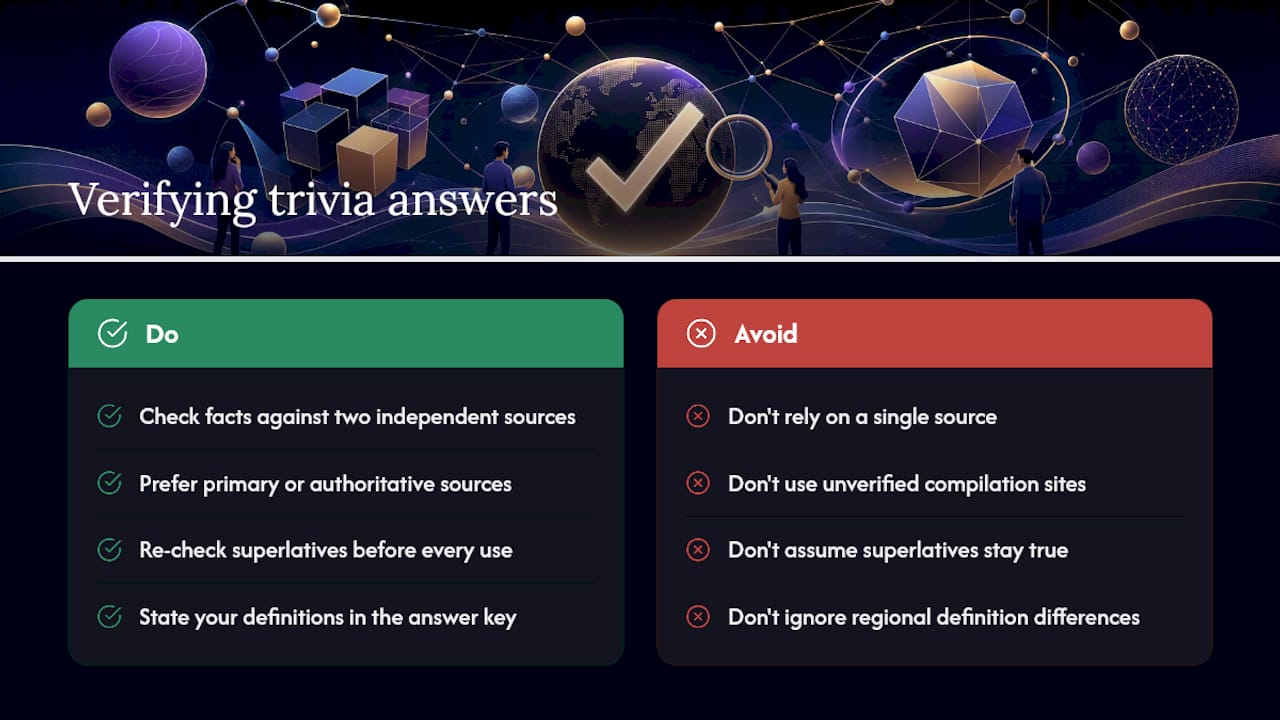
Cross-check any factual claim against at least two independent sources before it goes in a round, especially for statistics, record holders, and "first ever" claims, which get repeated incorrectly online more than almost any other trivia category. Prefer primary or authoritative sources over trivia compilation sites: government data, established encyclopedias, or organizations with subject expertise, like the Red Cross for blood-type facts, carry more weight than a random listicle.
Watch for questions with outdated answers. "Current tallest building," "most Olympic medals," and "largest population" are all facts that change, sometimes within a single year. Flag any question with a superlative ("most," "largest," "first") for a freshness check before every use, not just when you first wrote it.
Be careful with regional variation. Some "facts" are true only in certain countries or under certain definitions (which river is "longest" depends on measurement method; which language has the "most speakers" depends on whether you count native speakers or total speakers). State the definition you're using in the answer key so nobody can reasonably argue.
Curated lists that undergo periodic review, like MojQuiz's fact-checked trivia set, are useful models because they get re-verified on a schedule rather than treated as permanently correct once published.
Keeping Your General Knowledge Content Current and Error-Free
A trivia bank is not a one-time project. Set a recurring review, quarterly works well for most hosts, to check every category for two things: factual drift and staleness.
Factual drift happens when a once-correct answer becomes wrong because the underlying reality changed. Capital cities get moved, records get broken, company names change hands. Geography and current affairs categories need the most frequent attention here, since political boundaries and leadership shift faster than most people expect.
Staleness is different: the answer is still technically correct, but the question has been asked so many times it no longer surprises anyone. Rotate at least 20 percent of your questions each quarter, even in categories where nothing has changed, just to keep repeat players engaged.
Build a simple version-control habit. Keep a master document with a "last verified" date on each question. When you update or replace a question, note why (fact changed, record broken, question overused). This takes minutes but saves you from the embarrassment of using an answer that was correct three years ago and isn't anymore.
For current affairs specifically, treat the category as disposable content. Write it fresh each time rather than reusing old current-affairs questions, since those age out fastest and are most likely to actively mislead if left in rotation.
Adjusting General Knowledge Quizzes for Different Audiences
The same category list plays very differently depending on who's answering. Age and cultural background both change what counts as "easy."
For kids and younger teens, lean heavily on entertainment, sports, and easy science, and go light on history dates, math, and abstract concepts. Questions about movies, animals, and simple geography (continents, famous landmarks) land well; questions requiring multi-step reasoning or memorized dates frustrate this age group fast.
For older teens and young adults, technology, current entertainment, and pop culture references score highest for engagement, while classic literature and pre-1990s history often need to be pitched as "easy" rather than assumed knowledge.
For older adults, history and classic arts and literature categories tend to perform better than technology or current pop culture, simply because of what was culturally dominant during their formative years. Avoid assuming a "medium" technology question for a 25-year-old is equally medium for a 70-year-old.
Cultural background changes difficulty even within the same nominal category. A geography question that's "easy" for someone raised in Europe (naming EU capitals) may be genuinely hard for someone raised elsewhere, and vice versa for questions about, say, ASEAN nations or Pacific Island geography. When hosting a culturally mixed group, favor globally taught facts (major world capitals, widely distributed movies and music, universal science) over region-specific knowledge, or explicitly build in one "home region" round per represented culture so nobody feels excluded for an entire session. Building basic cultural fluency into your question design, understanding what's considered common knowledge across different backgrounds, is itself a skill worth developing, and resources on cross-cultural training cover this in more depth for anyone hosting internationally mixed groups regularly.
When to Run a Fun Quiz vs. When to Study for Real
Broad general knowledge quizzes and focused study serve different goals, and treating them as interchangeable is where most hosts and self-learners go wrong.
A wide-ranging quiz, ten categories, one question each, is built for engagement. It works at parties, in classrooms as a Friday wrap-up, or as an icebreaker for mixed groups who don't share a common specialty. Nobody's expected to know everything, and the fun comes from the spread, not the depth. Using it to measure someone's actual competence in any one subject is a mistake; one geography question tells you almost nothing about someone's overall geography knowledge.
Focused, single-category practice is a different tool entirely. If you're prepping for a civil service exam, a pub quiz league with subject rounds, or you just know your science knowledge has gone soft, drilling one category repeatedly with increasing difficulty is what actually moves the needle. This is also where a structured diagnostic, like a Testuno subtest focused on reasoning or working memory, earns its place: it tells you specifically where to focus, rather than leaving you guessing.
The two approaches aren't rivals. Run a broad quiz monthly to keep things fun and catch blind spots you didn't know you had, and layer in weekly focused practice on whatever category that broad quiz just exposed as weak.
— Steve
Turn Practice Into a Measurable Score with Testuno
This page hands you the question bank. Testuno gives you the number to go with it. Where a quiz tells you which categories felt shaky, a timed Testuno assessment tells you exactly where your reasoning, memory, or processing speed actually stand against a percentile benchmark, with no sign-up needed and results in about 15 minutes.

Start with the quick IQ test if you want a fast baseline before committing to a study plan, or take the full IQ test for a detailed six-subtest breakdown you can download and revisit as you improve. If your weak spot looks more specific, logic gaps versus memory versus spatial reasoning, the logical reasoning test or working memory test narrows it down further. Take one now, note where you scored lowest, and go straight to the matching category above for your next study session.
Sources
These sources back the study advice and category framework used throughout this page:
- Cornell Learning: The five-day study plan
- Wikipedia: Contents/Overviews
- PracticeTestGeeks: General Knowledge study guide
- MojQuiz: 100 fact-checked trivia questions
FAQ
What are good general knowledge topics for a quiz?
History, geography, science and nature, math, entertainment, sports, arts and literature, technology, and current affairs cover the widest range of common knowledge and work for nearly any audience.
What are the top 10 general knowledge questions to start a quiz with?
Start with easy-tier questions spread across categories, capital cities, basic science, well-known history dates, and popular entertainment, since a strong warmup round builds confidence before difficulty increases.
How many questions should a general knowledge quiz round have?
Most hosts use 10 questions per main round, with a 5-question warmup and a 1 to 3 question tiebreaker, though smaller groups can run tighter 5-question rounds.
What are examples of general knowledge facts?
Examples include factual items like the capital of Australia (Canberra, not Sydney), the chemical symbol for gold (Au), and the fact that Barry Bonds holds the MLB career home run record, the kind of verifiable, single-answer facts that make strong quiz questions.
How do I know if a trivia question's answer is still accurate?
Cross-check superlative claims ("largest," "first," "most") against a recent, authoritative source before each use, since these categories change over time faster than most quiz writers expect.