

A professionally administered IQ test typically costs between $100 and $2,500, depending on who gives it and what you need the results for. Supervised society admission testing (like Mensa) runs on the low end, university psychology clinics sit in the middle, and a full private evaluation with a licensed psychologist sits at the top.
- Low ($60 to $400): Mensa supervised admission testing or a university psychology clinic. You get a score, sometimes a percentile rank, rarely a detailed clinical report.
- Mid ($400 to $900): Standalone WAIS or WISC testing through a private practice. You get a scored, clinician-interpreted result.
- High ($1,500 to $2,500+): Full psychoeducational or neuropsychological evaluation, including IQ, achievement, and personality measures with a written report suitable for accommodations or legal use.
If you're testing out of curiosity or want to see where you stand, an affordable online option like Testuno's IQ test or a Mensa session covers it. If you need documentation for school accommodations, a workplace request, or a legal matter, you need a licensed psychologist, full stop.
Key Takeaways
IQ test costs range from $60 for supervised Mensa admission to over $2,500 for a full clinical evaluation, and the right choice depends entirely on whether you need an official document or just an answer.
| Point | Details |
|---|---|
| Match cost to purpose | Curiosity needs a quick online test; accommodations or legal cases need a licensed psychologist. |
| Mid-range covers WAIS/WISC only | $400–$900 typically buys standalone testing without a full written report. |
| Behind-the-scenes work drives price | Clinicians often spend 3–8 hours scoring and writing reports beyond the 2–3 hour test session. |
| Ask about savings before booking | University clinics, sliding scales, and insurance coverage for medical necessity can all cut costs. |
| Start with Testuno for a quick estimate | Testuno's IQ test offers a fast, low-cost percentile-based score as a first step, not a replacement for clinical documentation. |
Where to Verify Pricing and Credentials
- American Mensa's testing page lists current supervised admission pricing.
- University of Alabama's psychology clinic shows a real example of reduced-rate university testing.
- Pearson's WAIS product page confirms which instruments licensed clinicians actually use.
- TherapyCostGuide's pricing breakdown helps you sanity-check any quote you receive.
Table of Contents
- What Drives IQ Test Cost: Breaking Down the Price Bands
- Where Can You Get a Legitimate IQ Test?
- What Affects IQ Test Fees, and How to Pay Less
- Choosing the Right Test for Your Goal
- A Faster, Lower-Cost Way to Check Your Score First
- Frequently Asked Questions
- Sources
What Drives IQ Test Cost: Breaking Down the Price Bands
The price tag on any IQ test reflects two things: who's giving it and what paperwork comes out the other end. A $60 Mensa session and a $2,500 neuropsychological battery aren't different versions of the same product. They're different products entirely.
The low band covers supervised, low-overhead testing designed for accessibility rather than clinical documentation. American Mensa's testing page lists chapter testing around $60 and private supervised testing around $99. These sessions are often volunteer-run, which keeps costs down, and they exist to qualify people for society membership, not to produce a diagnostic record. University psychology clinics fall in a similar range, typically $100 to $400, because graduate students under faculty supervision do much of the testing.
The mid band, roughly $400 to $900, buys standalone WAIS (for adults) or WISC (for children) testing through a private practitioner. This is the testing portion cost cited by TherapyCostGuide, and it typically covers 2 to 3 hours of face-to-face testing. What it may not fully cover is the report writing and feedback session, which some practices bill separately.
The high band starts around $1,500 and climbs past $2,500 for comprehensive or forensic-grade evaluations. A full psychological evaluation that combines IQ, academic achievement, and personality testing commonly lands in the $500 to $2,500 range, and some practices charge $1,500 to $2,000 for basic clinical assessments, with complex or forensic cases running $2,000 and up.
| Price band | Typical cost | What's included | Time involved |
|---|---|---|---|
| Low | $60–$400 | Score, sometimes percentile rank | 1–2 hours testing |
| Mid | $400–$900 | Scored WAIS/WISC, brief interpretation | 2–3 hours testing plus scoring |
| High | $1,500–$2,500+ | Full battery, written report, feedback session | 2–3 hours testing plus 3–8 hours behind the scenes |
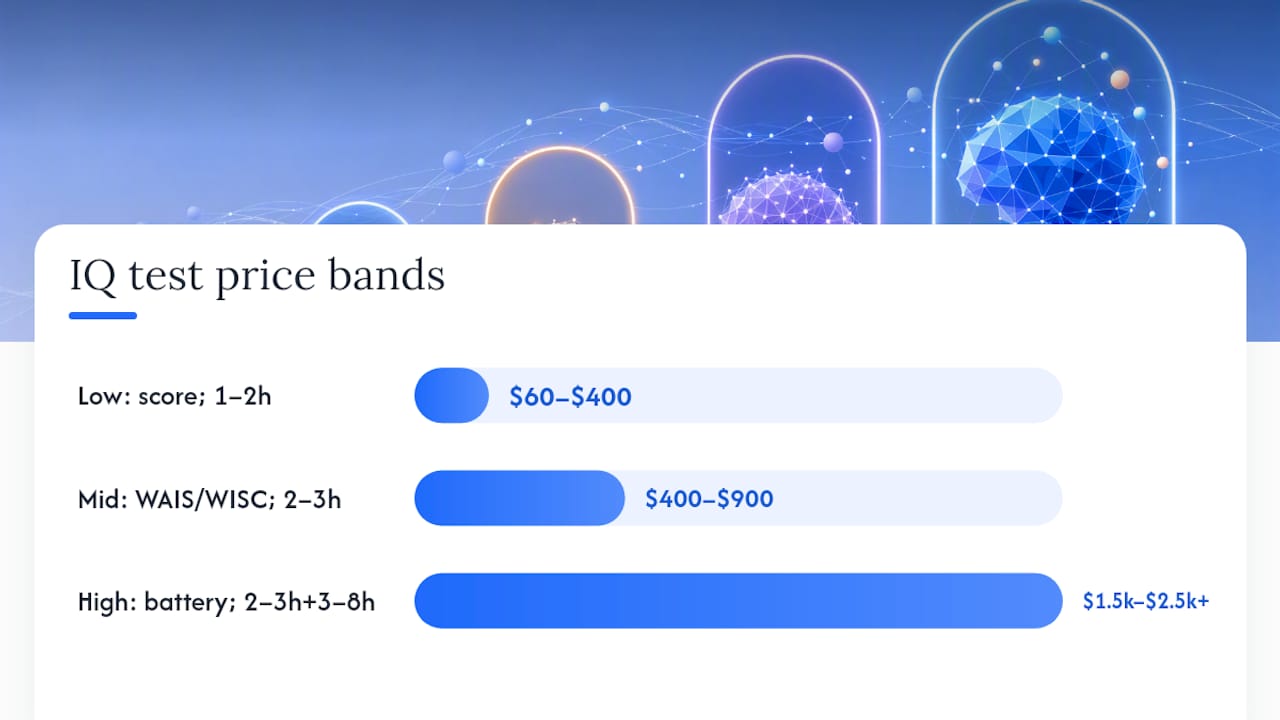
That last column matters more than most people realize. Much of what you're paying for at the higher end isn't the time you spend in the room. It's what happens after you leave.
Where Can You Get a Legitimate IQ Test?
Not every testing option serves the same purpose, and picking the wrong one can waste both time and money.
- Licensed private psychologist: The gold standard for diagnosis, accommodations, or legal documentation. Verify licensure and ask which instrument they use, WAIS or WISC are the standards most clinicians rely on.
- University psychology clinic: Lower-cost testing supervised by licensed faculty, often through a training clinic. Good for adults or students who need a credible report without private-practice pricing.
- Mensa supervised admission: Cheap, fast, and built specifically for society membership. Not designed to produce a clinical report.
- School or educational evaluation: Often free or low-cost through a public school system when a child qualifies for special education assessment. Restricted to educational purposes.
- Publisher-backed professional testing: Any provider administering Stanford–Binet or Wechsler scales should be a licensed professional purchasing materials through publishers like Pearson.
- Legitimate proctored online assessments: Useful for a quick, informational estimate. Testuno's IQ test falls here, fast, low-cost, and useful for benchmarking, but not built to meet documentation standards for accommodations or legal cases.
Casual online quizzes with no proctoring, no standardized scoring, and no named psychologist behind them don't belong on this list at all. If a provider can't tell you which instrument they use or whether they're licensed, that's your answer.
What Affects IQ Test Fees, and How to Pay Less
Most of the cost in professional testing has nothing to do with the hour you spend answering questions. It's the work that happens after.
Scoring, interpreting results against normative data, writing the report, and holding a feedback session can eat up 3 to 8 hours of a clinician's time, often more than the testing session itself. Add licensed test materials, administrative overhead, and regional differences in practitioner rates, and you can see why a big-city forensic evaluation costs more than a small-town clinic visit.
You do have leverage, though:
- Ask university clinics about sliding-scale or reduced-rate testing.
- Check whether your insurance covers testing when it's medically necessary, most plans won't cover curiosity or membership testing, but a documented clinical need is a different story.
- Ask if a school evaluation applies before paying privately.
- Request IQ-only testing instead of a full battery if that's genuinely all you need.
Pro Tip: Ask any provider for an itemized fee estimate that separates contact hours from report and scoring time. It makes comparing quotes far easier and gives you room to negotiate a limited-scope test instead of paying for a full battery you don't need.
Choosing the Right Test for Your Goal
Match the route to the reason you're testing, not the other way around.
- Curiosity or benchmarking: Start with a fast, affordable online option. You'll get a directional score in minutes without committing hundreds of dollars.
- Society membership (Mensa): Book supervised admission testing directly. It's inexpensive and purpose-built for that single outcome.
- School or workplace accommodations: You need a licensed psychologist administering WAIS or WISC, with a written report. Skip anything that doesn't end in a signed clinical document.
- Diagnostic clarity (learning differences, giftedness, cognitive concerns): A university clinic or private psychologist, depending on budget, gives you the depth a curiosity test can't.
The trade-off is consistent across all four: more cost buys more report detail and more credibility in formal settings. Less cost buys speed and a rough estimate.
A Practical Note on Choosing Wisely
If your need is informational, start with a validated, low-cost online assessment before spending hundreds on professional testing you may not need. If you eventually need official documentation, move to a licensed psychologist, and always confirm credentials and ask exactly what the report includes before paying anything.
A Faster, Lower-Cost Way to Check Your Score First
Before you book a $1,500 evaluation, it's worth knowing where you stand. Testuno's IQ test gives you a research-grounded estimate across six subtests in about 15 minutes, with percentile benchmarking so you can see how your score compares to others, no sign-up, no waiting room, no appointment.

It's not a substitute for clinician-administered testing when you need documentation for school accommodations, workplace requests, or legal matters. Think of it as your first, low-stakes step: a way to satisfy your curiosity or get a directional read before deciding whether a full clinical evaluation is worth the cost. If your results leave you wanting a deeper look at specific cognitive areas, Testuno's cognitive profile assessment breaks things down further. Take the test now and see your percentile ranking in about 15 minutes.
Frequently Asked Questions
How much does an IQ test cost on average? Costs range widely depending on the route. Supervised society testing runs $60 to $99, university clinics charge $100 to $400, and private psychologist evaluations run $400 to over $2,500 depending on scope.
Is a free online IQ test legitimate? It can give you a reasonable estimate for personal insight, but it won't meet documentation standards for school accommodations, workplace requests, or legal proceedings.
Does insurance cover IQ testing? Sometimes, when testing is tied to a documented medical or educational need. Insurers typically won't cover testing done purely out of curiosity or for society membership.
What's the difference between Mensa testing and clinical testing? Mensa testing qualifies you for society membership at a low cost. Clinical testing, using instruments like WAIS or WISC, produces a full report suitable for diagnosis, accommodations, or legal use.
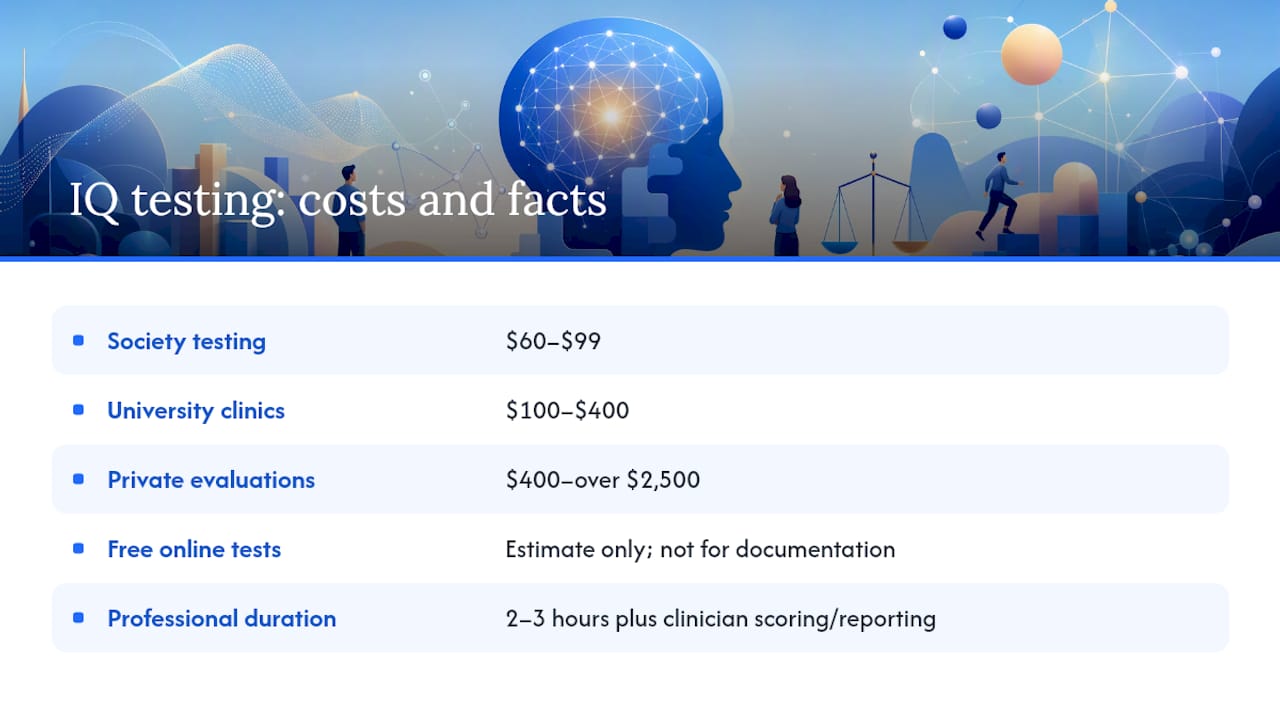
How long does professional IQ testing take? Expect 2 to 3 hours of direct testing, plus several additional hours the clinician spends scoring results and writing your report before your feedback session.
Sources
- Psychological Testing Cost: IQ, Personality, and Achievement Tests — TherapyCostGuide
- Psychologicalassessments
- Take the Mensa Admission Test — American Mensa
- University of Alabama Psychology Clinic — services (adult)
Recommended
- Iq Test Page | TESTUNO
- nonverbal-iq-test | TESTUNO
- quick-iq-test | TESTUNO
- numerical-reasoning-test | TESTUNO
Created with BabyLoveGrowth to get found on Google and AI search