

Emotional intelligence predicts leadership effectiveness and team performance better than IQ does, while IQ remains the stronger predictor of technical skill acquisition and raw problem-solving speed. Neither wins outright. The evidence points to a split by job function, not a universal winner.
Here's what each one actually forecasts:
- IQ predicts: technical problem solving, how fast you learn new material, and performance on tasks with a clear right answer.
- EQ predicts: teamwork, leadership effectiveness, stress management under pressure, and your ability to influence people.
- Next step: take a quick baseline read on where you stand with a quick IQ test, then look at your emotional skills with the same honesty.
Key Takeaways
Career success depends on matching cognitive strengths to technical demands and emotional strengths to leadership and team demands, not maximizing one score alone.
| Point | Details |
|---|---|
| IQ and EQ predict different outcomes | IQ forecasts technical and learning speed; EQ forecasts teamwork, leadership, and stress management. |
| The 80/20 split is a myth | No rigorous research supports a fixed percentage breakdown between EQ and IQ for success. |
| Self-report EQ tests carry bias | Scores can shift substantially under "fake good" conditions in high-stakes settings. |
| EQ can compensate for lower IQ | Organizational research shows EQ matters more for certain job outcomes when cognitive ability is lower. |
| Start with a quick baseline | Testuno's quick IQ test gives a 15-minute benchmark before pursuing deeper, validated assessment. |
Table of Contents
- What Is IQ and What Does It Actually Measure?
- What Is Emotional Intelligence and How Is It Different From Personality?
- How Are IQ and EQ Actually Tested, and Where Do the Tests Fall Short?
- Does IQ or EQ Matter More for Career and Leadership Success?
- Where Do IQ and EQ Matter Most in Real Roles?
- Can You Actually Improve Your IQ and EQ?
- How Should You Assess Your Own IQ and EQ?
- Frequently Asked Questions
- Sources
What Is IQ and What Does It Actually Measure?
IQ measures general cognitive ability, often labeled "g" in psychological research. It's not one skill. It's a composite of several distinct mental abilities that tend to move together in the same person.
The core skills that make up an IQ score include:
- Reasoning: solving novel problems without relying on prior knowledge.
- Working memory: holding and manipulating information in your head.
- Processing speed: how quickly you take in and respond to information.
- Verbal comprehension: understanding and using language.
- Spatial ability: mentally rotating and manipulating shapes or layouts.
Researchers commonly use Raven's Progressive Matrices, a nonverbal test built to strip out cultural and language bias, along with broader General Intelligence Assessments (GIA) that combine multiple subtests. A percentile score tells you how you rank against a reference population, not an absolute ceiling on what you can learn.
What Is Emotional Intelligence and How Is It Different From Personality?

Emotional intelligence is your capacity to recognize, understand, and manage emotions, in yourself and in other people. There are two very different ways psychologists measure it: ability EQ, tested like a cognitive skill with right and wrong answers, and trait EQ, measured through self-report questionnaires about how you see your own emotional habits.
Five domains show up across most EQ models, each with a distinct behavior signature:
- Self-awareness: noticing you're getting defensive before you snap at someone.
- Self-regulation: pausing before sending an angry email.
- Motivation: staying focused on a goal after a setback.
- Empathy: picking up on a coworker's frustration before they say anything.
- Social skills: smoothing over a disagreement in a team meeting.
The three most-cited measures are the MSCEIT (an ability test scored like a puzzle), the EQ-i or Bar-On model (a self-report trait inventory), and the TEIQue (another trait-based questionnaire). That ability-versus-self-report split matters more than most people realize, and it's the subject of the next section.
How Are IQ and EQ Actually Tested, and Where Do the Tests Fall Short?
Not all tests measuring "intelligence" work the same way, and mixing them up leads to bad conclusions. Here's the quick rundown:
- MSCEIT — ability test — measures emotional problem-solving through scored tasks, not opinions.
- EQ-i (Bar-On) — self-report — measures how you rate your own emotional and social functioning.
- TEIQue — self-report — measures trait-level emotional self-perception.
- Raven's Progressive Matrices — ability test — measures fluid, nonverbal reasoning.
- GIA — ability test — measures general cognitive ability across multiple domains.
Self-report EQ inventories carry a real weakness: people can present themselves favorably. Research on the Bar-On EQ-i found scores correlate strongly with established personality traits and can increase substantially when test-takers are motivated to "fake good," according to a review of emotional intelligence measurement. That's a meaningful distortion in any hiring or promotion context.
Pro Tip: Use a short online screener to get a quick baseline, but save validated inventories or professional testing for decisions that actually carry weight, like a hiring pipeline or a leadership promotion.
Does IQ or EQ Matter More for Career and Leadership Success?
IQ predicts technical and academic outcomes more reliably. EQ predicts teamwork, leadership effectiveness, and job satisfaction more reliably. The honest answer is that both matter, just for different parts of the job.
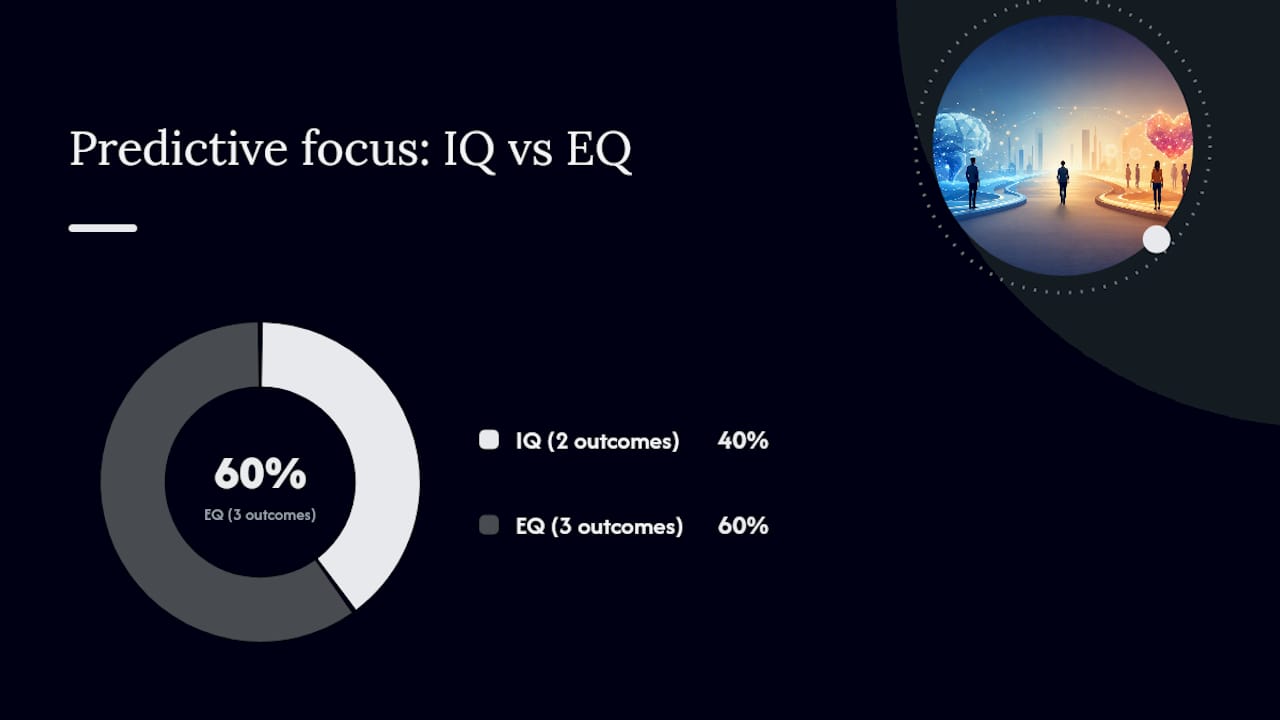
You've probably heard the claim that success is predominately EQ rather than IQ. Drop it. That split isn't empirically grounded, and rigorous reviews of student and workplace outcomes reject it as an oversimplification of a multi-factorial reality.
The research paints a more textured picture:
- A large-sample study found only a very small correlation between trait EQ and a multidimensional intelligence score, meaning the two constructs are largely independent of each other.
- Organizational research on job performance found a compensatory pattern: emotional intelligence tends to matter more for certain performance outcomes, especially citizenship behaviors, when cognitive ability is lower.
- Leadership studies consistently link stronger EQ to better team cohesion and retention, though it rarely substitutes for baseline technical competence.
As a rough rule of thumb: individual contributors in technical roles lean more on IQ, while people managers and client-facing leaders lean more on EQ. Neither operates in isolation.
Where Do IQ and EQ Matter Most in Real Roles?
The two skill sets show up differently depending on what the job actually demands.
IQ carries the most weight in roles built around complex, novel problem solving: engineering, data analysis, research, and any job where you're diagnosing something nobody has seen before. EQ carries the most weight in roles built around people: sales, management, healthcare, customer service, and anywhere collaboration determines whether a project ships on time.
A quick checklist for evaluating a candidate, or yourself, on both fronts:
- Can they solve an unfamiliar problem with limited instructions? (IQ signal)
- Do they stay composed and adjust their approach after receiving critical feedback? (EQ signal)
- Do they pick up on unspoken tension in a group setting? (EQ signal)
- Can they explain their reasoning clearly to someone outside their field? (both)
Pro Tip: Pair a cognitive assessment with a structured behavioral interview or a short work simulation. A score tells you capacity; a simulation tells you how that capacity shows up under real conditions. Career-advice research from sites like Indeed backs this combined approach for practical hiring decisions.
Can You Actually Improve Your IQ and EQ?
Both skill sets respond to deliberate practice, but the gains are incremental, not dramatic. Be skeptical of any program promising a fast, permanent IQ jump.
- Practice targeted reasoning drills. Spaced practice with matrix-style reasoning puzzles builds the pattern-recognition skills IQ tests measure.
- Label your emotions in real time. Naming what you're feeling ("I'm frustrated, not angry") is the foundation of self-regulation.
- Practice perspective-taking deliberately. Before reacting to a colleague, spend ten seconds considering their likely intent.
- Ask for specific feedback and act on it. Vague feedback doesn't move the needle; specific, repeated feedback does.
- Track your own results. Retest periodically rather than assuming a training program worked because it felt productive.
Expect modest, measurable improvement over weeks and months of consistent practice, not overnight transformation. Emotional intelligence in particular improves through structured relationship investment at work, which takes sustained effort, not a weekend workshop.
How Should You Assess Your Own IQ and EQ?
Start simple, then get more precise as the stakes rise.
- Step one: take a quick, low-stakes nonverbal IQ test to get a fast baseline reading on your reasoning ability.
- Step two: move to validated inventories, TEIQue or EQ-i for trait-based emotional self-perception, MSCEIT if you need an ability-based emotional score.
- Step three: for high-stakes decisions, such as clinical evaluation or executive assessment, work with a licensed professional using full-length instruments like Raven's or a comprehensive GIA.
- Always cross-check test scores against behavior: work samples, references, and how someone actually performs under pressure tell you more than any single number.
A quick note from the editor
The evidence keeps surprising people: you can be sharp and still struggle to lead a room, or emotionally sharp and still miss technical nuance. Run a quick baseline test, then commit to improving one specific area instead of chasing a perfect score on both.
Get a Fast, Research-Grounded Read on Where You Stand
Guessing at your cognitive strengths wastes time you could spend actually building them. Testuno's quick IQ test gives you a 15-minute baseline with instant percentile benchmarking, no sign-up required, so you know where your reasoning and problem-solving skills stand before you invest in deeper development.

If you want the fuller picture, Testuno's flagship IQ test runs six research-grounded subtests and delivers a detailed percentile report you can download and keep. Start with the quick screener, see your baseline, then decide if the full report is worth the deeper dive.
Frequently Asked Questions
Is EQ more important than IQ for leadership? EQ tends to predict leadership effectiveness and team cohesion more consistently than IQ, but baseline cognitive ability still matters for strategic decision making. Most effective leaders score reasonably well on both.
Can you have high IQ and low EQ, or the other way around? Yes. Large-sample research found only a very small correlation between trait EQ and IQ, meaning the two are largely independent, so someone can score highly on one and average on the other.
What's the difference between ability EQ tests and self-report EQ tests? Ability tests like the MSCEIT score you on actual emotional problem-solving tasks with right answers. Self-report tests like the EQ-i or TEIQue ask you to rate your own emotional habits, which introduces more room for bias.
How long does it take to improve emotional intelligence? Meaningful improvement usually takes weeks to months of consistent, deliberate practice, such as feedback exercises and perspective-taking drills, not a single workshop or seminar.
Should employers test for IQ, EQ, or both during hiring? Both, depending on the role. Technical positions benefit from cognitive assessment, while people-facing and leadership roles benefit from adding emotional intelligence evaluation and behavioral work samples to the process.
Sources
- Emotional intelligence: What we know and what we don't (Annual Review chapter, 2008)
- Large-sample study on trait EQ and intelligence (Psych, 2023)
- Compensatory model linking EI and cognitive ability to job performance (PMC article)