

The five love languages are words of affirmation, quality time, physical touch, acts of service, and receiving gifts. Dr. Gary Chapman developed the framework as a counseling tool, not a clinical diagnosis, and it works across romantic partners, family, and friends. Below, you'll find real-world examples of each type plus a short self-check to find your primary and secondary languages.
TL;DR:
- Matching your love language to your partner's preferences can significantly increase relationship satisfaction, especially when responding to their specific needs.
- Words of affirmation are most effective when they are specific and genuine, and physical touch requires careful attention to consent and context.
- Acts of service avoid resentment when both partners clearly communicate what help they need, rather than guessing or assuming.
- Love languages are flexible, can change over time, and should be used to foster mutual respect rather than manipulation or control.
- The framework is based on counseling experience and limited research, emphasizing applying it as an intentional tool rather than a strict scientific rule.
Table of Contents
- The Love Languages List at a Glance
- Words of Affirmation: Why Some People Need to Hear It
- Quality Time: Presence Over Presents
- Physical Touch: Context, Consent, and Everyday Closeness
- Acts of Service: When Actions Say "I've Got You"
- Receiving Gifts: It's Never About the Price Tag
- How to Find Your Primary and Secondary Love Languages
- What Love Languages Get Wrong (and How to Avoid It)
- What the Research Actually Shows
- A Practical Take on Making This Stick
- Curious What Your Communication Style Really Is?
- Sources
The Love Languages List at a Glance
Here's the full love languages list before diving into detail on each one:
- Words of affirmation: verbal praise, encouragement, and appreciation.
- Quality time: focused, undistracted attention and shared activities.
- Physical touch: hugs, hand holding, and other appropriate physical closeness.
- Acts of service: doing helpful things that lighten someone's load.
- Receiving gifts: thoughtful items that show someone was on your mind.
These five categories aren't limited to couples. A sibling who lights up at a handwritten card, or a coworker who feels valued when you cover their shift, is showing the same patterns the framework describes for romantic relationships.
Words of Affirmation: Why Some People Need to Hear It
If you light up from a genuine compliment or feel hollow after a fight ends without an apology spoken out loud, words of affirmation might be your language. People with this preference often replay a kind sentence in their head for days, and an unspoken "I love you" doesn't land the same as a spoken one.
Common examples include:
- Texting "I'm proud of how you handled that" after a hard day.
- Leaving a short thank-you note on the counter.
- Naming a specific quality you admire, rather than a generic compliment.
Pro Tip: Pick one specific phrase this week, like naming exactly what someone did well, instead of a vague "good job." Specificity is what makes affirmation feel real instead of automatic.
Quality Time: Presence Over Presents
Quality time means undivided attention, not just shared square footage. Someone with this preference notices immediately when you're scrolling your phone mid conversation, and a canceled plan can sting more than harsh words would.
Practical examples:
- A device-free walk where phones stay in pockets.
- A weekly ritual, like Sunday morning coffee, that never gets skipped.
- Asking follow-up questions instead of waiting for your turn to talk.
Busy schedules don't have to kill this one. Consistent check-ins with real eye contact often do more than occasional long outings. Consistency is more important than duration here.
Physical Touch: Context, Consent, and Everyday Closeness
Physical touch as a love language has nothing to do with intimacy alone. It ranges from a hand on the shoulder during a hard conversation to a hug at the door, and it depends entirely on context and consent. What feels comforting from one person can feel invasive from another, even doing the exact same gesture.
Examples of low-key physical touch:
- A hand squeeze during a stressful moment.
- Sitting close on the couch instead of at opposite ends.
- A brief hug hello or goodbye, especially after time apart.
Pro Tip: Read the room before you reach out. A quick "is a hug okay?" costs nothing and tells you more about someone's comfort than assuming ever will.
Respecting boundaries matters more here than in any other language, since touch that isn't wanted can damage trust fast, regardless of good intentions behind it.
Acts of Service: When Actions Say "I've Got You"
Someone whose primary language is acts of service feels loved when you do the dishes without being asked or handle an errand they were dreading. Grand declarations mean less to them than a full tank of gas on a morning they're running late.
Real examples:
- Making dinner after a long day so they don't have to think about it.
- Picking up a prescription without waiting to be asked twice.
- Handling a dreaded phone call or paperwork task for them.
The catch: acts of service can tip into resentment if the labor stays lopsided. Concrete examples of healthy service exchanges work best when both people name what they actually need help with, rather than one person guessing and quietly keeping score.
Receiving Gifts: It's Never About the Price Tag
Receiving gifts gets misunderstood as materialism, but the real driver is thoughtfulness. A $4 candy bar someone remembered you liked from a passing comment three months ago can mean more than an expensive gift bought last minute.
Low-cost, high-meaning ideas:
- A note tucked into a bag or lunchbox.
- Their favorite snack, picked up "just because."
- A small item tied to an inside joke or shared memory.
Timing matters as much as the object itself. A tiny, unprompted gift on a random Tuesday often lands harder than one expected on a birthday, precisely because nobody was expecting it. For more low-effort ways to express this and other languages daily, Pingher's roundup of small daily gestures offers a useful starting list.
How to Find Your Primary and Secondary Love Languages
You don't need a formal test to get a rough answer, though one can help confirm your instincts. Try this:
- Notice your complaints. What do you find yourself upset about most? Feeling ignored points to quality time; feeling unappreciated points to affirmation.
- Notice what you give. People often express love the way they want to receive it, so pay attention to your default gestures.
- Run a forced-choice test. Ask yourself: would you rather get a heartfelt letter or a home-cooked meal? A hug after a bad day or an hour of uninterrupted conversation? Your gut answers reveal patterns fast.
- Ask your partner directly, using language that invites rather than accuses: "What's something small I could do that would make you feel most loved this week?"
Pro Tip: Ask about a specific recent moment instead of an abstract question. "What made you feel closest to me last week?" gets a sharper answer than "what's your love language?"
What Love Languages Get Wrong (and How to Avoid It)
The framework is a conversation starter, not a diagnostic label, and treating it otherwise creates real problems. A few cautions worth taking seriously:
- It's not a personality test. Nobody is purely one type, and most people carry a primary and a secondary preference that shift depending on the relationship.
- Weaponizing it backfires. "That's not my love language" isn't a valid excuse for refusing basic respect or effort, and using it that way turns a helpful tool into a manipulation tactic.
- Consent still governs everything, especially with physical touch, no matter what someone's stated preference is.
- Preferences evolve. A new parent, a grieving friend, or someone recovering from illness may temporarily need a different language than usual, so periodic check-ins matter more than a one-time label.
LoveIsRespect's guidance on healthy application is direct on this point: the model works when it builds intentionality and mutual respect, and it fails the moment either partner uses it to control the other.
What the Research Actually Shows
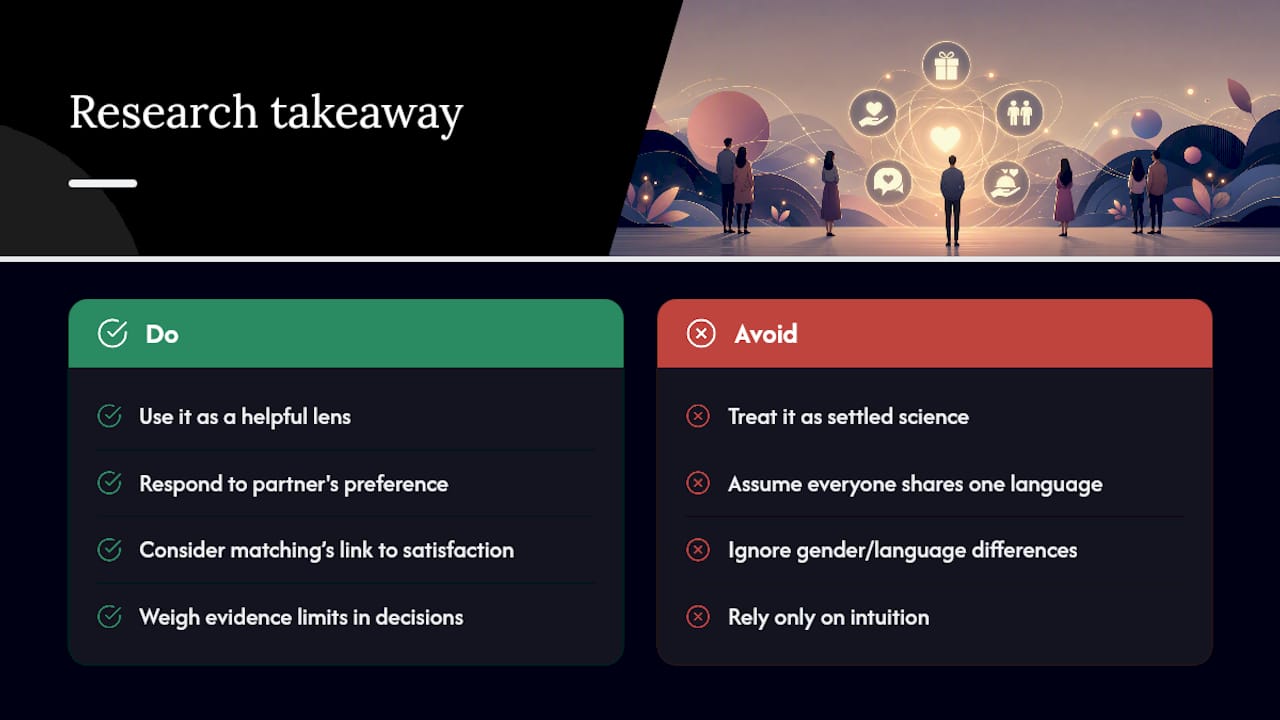
Gary Chapman introduced the five love languages in his 1992 book, built from years of marriage counseling rather than laboratory research. That origin matters. Wikipedia's summary of the model notes it remains popular in counseling settings but lacks the kind of formal validation that would make it a recognized psychological instrument.
That doesn't mean it's baseless. A study of heterosexual couples found that partners who matched more closely on love-language preferences reported higher relationship and sexual satisfaction, though the effect varied by language and by gender.
The clearest takeaway from the research isn't that everyone needs the same language. It's that responding to a partner's actual preference, rather than your own default, correlates with feeling more satisfied in the relationship.
Treat the framework as a useful lens, backed by a coherent but limited body of evidence, not a settled scientific fact.
A Practical Take on Making This Stick
Most people read about love languages once, nod along, and never actually change a habit. The gap isn't in understanding the concept. It's in picking one specific action and repeating it long enough for a partner to notice a pattern, not just a one-off gesture.
Try this experiment: for one week, do a single thing aligned with what you suspect is your partner's or friend's primary language, every single day, without announcing it. Watch whether their reaction shifts. That small test tells you more than any quiz score.
— Steve
Curious What Your Communication Style Really Is?
Guessing at your own patterns only goes so far. Testuno's love style test gives you a structured way to see how you tend to express and receive affection, alongside related options like the relationship communication test for couples who want to compare notes.

It takes about 15 minutes, requires no sign-up, and gives you instant feedback with an optional downloadable report available for purchase. Nobody needs a test to have a meaningful conversation about how they feel loved, but if you'd rather start from a clear baseline than a guess, take the love style test and see where your results land.
Sources
- The 5 Love Languages — Cleveland Clinic
- The Five Love Languages — Family Assist (MSF)
- Responding to partner's love-language preferences boosts satisfaction — ResearchGate (2024)
- Applying the 5 love languages to healthy relationships — LoveIsRespect