

Yes. Creativity can be measured in a way that's genuinely useful, but only if you match the method to your purpose and combine more than one type of measure. Relying on a single test, whether it's a five-minute puzzle or a personality quiz, gives you a slice of the picture, not the whole thing.
Divergent thinking tasks, self-report personality scales, and expert ratings of real output each capture a different facet of creative ability. None of them alone equals a "creativity score" the way a single number can represent reading level. That's precisely why automated scoring tools have become useful: they make it practical to combine methods without turning the process into a research project.
Here's the fastest way to think about your options:
- Want a quick, transparent personal profile? A validated online platform that pairs a task-based creativity exercise with a personality measure, like Testuno's creativity test, gets you a usable snapshot in minutes.
- Screening a classroom or team? Standardized divergent-thinking tasks with published norms work better than informal brainstorming ratings.
- Publishing research? You need documented reliability statistics, normative samples, and ideally more than one measurement family.
Key Takeaways
Creativity is measured most reliably by combining divergent thinking tasks, self-report scales, and product ratings rather than trusting any single instrument.
| Point | Details |
|---|---|
| No single test suffices | Combine process, person, and product measures to cover different facets of creativity. |
| Four components matter | Divergent thinking tests score fluency, flexibility, originality, and elaboration separately. |
| Match test to purpose | Choose domain-general tasks like AUT or DAT for screening, domain-specific ratings for evaluation. |
| Check validation before trusting scores | Ask any platform, automated or human-scored, for reliability data and normative samples. |
| Testuno offers a fast starting point | Its creativity test pairs task-based and personality measures for a combined, transparent profile quickly. |
Table of Contents
- How Do You Define Creativity Before You Try to Measure It?
- What Are the Main Ways to Measure Creativity?
- What Do Divergent Thinking Tests Actually Score?
- How Do Personality and Product Ratings Fit In?
- How Do You Choose and Interpret a Creativity Test?
- What Are the Limits of Creativity Testing?
- Where Do Automated Scoring Tools Fit In Now?
- Which Creativity Tests Should You Actually Try?
- Get a Transparent Creativity Snapshot in Minutes
- Frequently Asked Questions
- Sources
How Do You Define Creativity Before You Try to Measure It?
Most researchers land on a compact working definition: creativity is the production of ideas or outputs that are both novel and useful, sometimes with an added element of surprise. That two-part definition matters because a test that only checks for novelty (can you generate a weird idea?) misses whether the idea actually solves anything.
Psychologists also split creativity into two scales. Big-C creativity refers to eminent, field-changing achievement, the kind that gets a Nobel Prize or reshapes an industry. Little-c creativity covers the everyday problem-solving most of us do: figuring out a workaround at your job, writing a clever birthday card, or repurposing leftovers into a real meal. Research on the creativity spectrum shows that process measures and everyday product ratings tap into little-c, while productivity and eminence indicators are what capture Big-C. No single instrument spans both ends.
There's a third distinction worth knowing: domain-general tests (like listing unusual uses for a brick) claim to measure a broad ideation capacity, while domain-specific assessments require a rater with real expertise in the field being judged, whether that's music composition or software architecture.

Pro Tip: If you're assessing creativity for a job or academic application in a specific field, a domain-general test alone will undersell someone whose creative strength only shows up inside their specialty.
What Are the Main Ways to Measure Creativity?
Researchers typically sort creativity assessment into four families, sometimes called the "four Ps": process, person, product, and press. None of them is complete on its own, which is exactly why a systematic review of measurement approaches recommends combining methods rather than trusting one instrument.
- Process measures (divergent thinking tasks) time how someone generates ideas. Best for: research settings and quick self-screening.
- Person measures (self-report personality scales like the Creative Personality Scale) ask people to rate their own creative tendencies. Best for: large-scale surveys where task administration isn't practical.
- Product measures (expert ratings of actual creative output, like a poem, a prototype, or a business pitch) judge the thing someone actually made. Best for: domain-specific evaluation and portfolio review.
- Press measures look at environmental and organizational factors that either support or choke off creative behavior. Best for: workplace or classroom audits.
Combining even two of these, say a divergent-thinking task plus a self-report scale, catches blind spots that either one misses alone. Someone can score high on fluency but rate themselves as low in creative confidence, and that gap is itself useful information.
What Do Divergent Thinking Tests Actually Score?
Divergent thinking tasks are the workhorse of creativity measurement, and nearly all of them score four components. Understanding these four terms will make every test result you encounter make more sense.
- Fluency: how many distinct ideas you generate.
- Flexibility: how many different categories or approaches those ideas span.
- Originality: how statistically rare or unusual an idea is compared to other respondents.
- Elaboration: how much detail and development you add to each idea.
The three most cited standardized tests approach this differently:
| Test | What it asks you to do | Typical time | Scoring method |
|---|---|---|---|
| Alternate Uses Test (AUT) | Name unusual uses for a common object (a brick, a paperclip) | minutes | Human rating or automated similarity scoring |
| Torrance Tests of Creative Thinking (TTCT) | Complete figural and verbal tasks (drawings, word associations) | 30–90 minutes | Trained human scorers using published norms |
| Divergent Association Task (DAT) | List 10 unrelated words, scored by semantic distance | minutes | Fully algorithmic |
The Divergent Association Task is the newest of the three and the easiest to administer at scale, since a computer calculates the semantic distance between your words with no human rater needed. TTCT remains the most comprehensive but also the slowest to administer and score. The AUT sits in between: fast to give, but its scoring traditionally required trained human judges, which is exactly the bottleneck modern algorithmic scoring is designed to remove.
Pro Tip: Automated scoring systems like CLAUS and the Creativity Assessment Platform can process hundreds of responses in the time a human scorer needs for a handful. Before trusting the output, ask whether the developer has published a validation study comparing algorithmic scores to trained human raters.
How Do Personality and Product Ratings Fit In?
Divergent thinking tasks measure a moment of ideation. They don't tell you whether someone actually finishes creative projects or sees themselves as a creative person. That's where person and product measures come in.
On the person side, the Creative Personality Scale and Big Five openness to experience subscale ask people to rate their own tendencies toward imagination, curiosity, and unconventional thinking. These scales are fast and easy to administer remotely, but research on self-report creativity measures is clear that they capture creative self-concept, not observed creative performance. Someone can believe they're highly creative and score low on an actual task, or the reverse.
On the product side, the Consensual Assessment Technique has trained experts independently rate real creative outputs, poems, designs, business plans, without a rigid rubric, then checks agreement across raters. The Creativity Achievement Questionnaire (CAQ) takes a different approach, asking people to self-report actual creative accomplishments (published work, exhibited art, patents) across ten domains.
Environmental "press" factors round out the picture: a rigid, deadline-driven workplace measurably suppresses idea generation compared to one that tolerates failed experiments. Measuring press matters most when you're diagnosing why creative output dropped, not just whether it exists.
How Do You Choose and Interpret a Creativity Test?
Start by asking what decision the result needs to support:
- Are you screening, diagnosing, tracking growth, or researching? A one-time hiring screen has different requirements than a semester-long classroom growth study.
- Do you need domain-general or domain-specific results? A general ideation score won't predict success in a technical field the way a domain expert's product rating will.
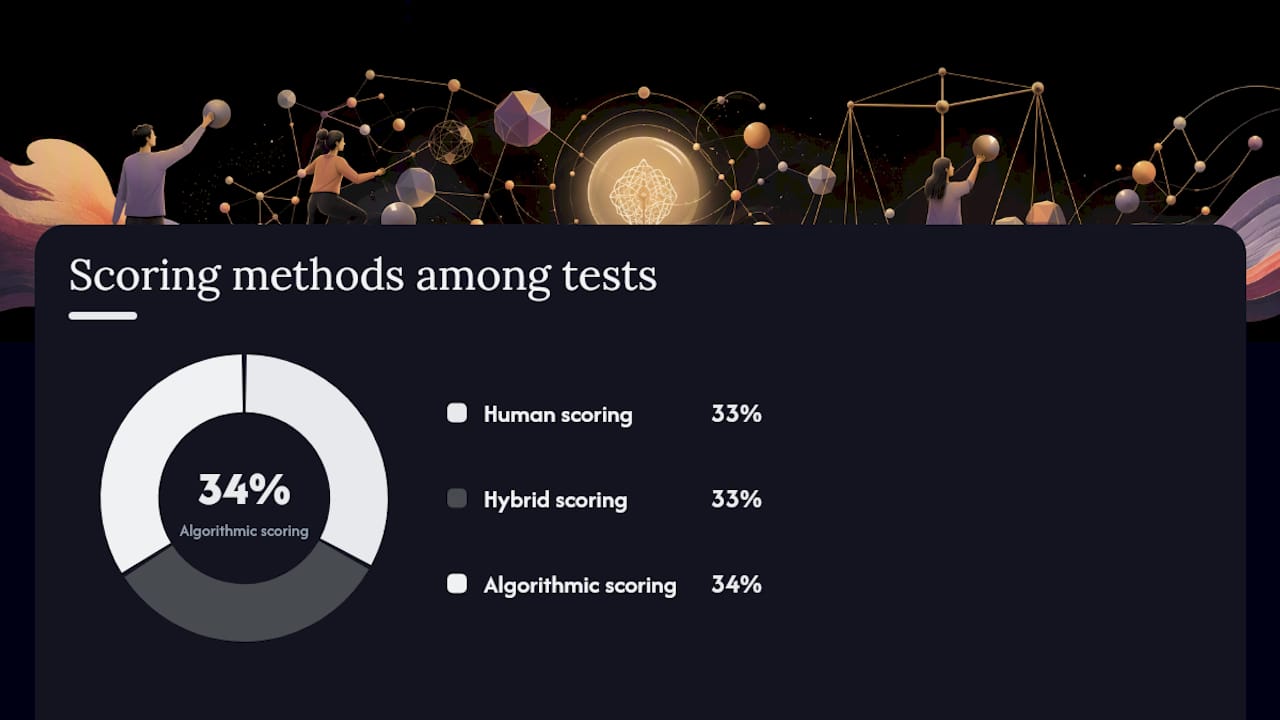
- What scoring method fits your timeline and budget? Algorithmic scoring (DAT, some AUT platforms) is fast and consistent; human scoring (TTCT, Consensual Assessment Technique) is slower but can catch nuance an algorithm misses.
- What reliability and validity data has the test publisher released? Ask specifically for internal consistency figures and a normative sample description, not just a marketing claim of accuracy.
For administration, keep it simple: give the test in a quiet room, read instructions verbatim, stick to published time limits, and offer one practice item so people understand the task before the clock starts.
When you get scores back, watch for these red flags:
- A single test result presented as a final verdict on someone's creative potential.
- No explanation of how the scoring works, human or algorithmic.
- No normative comparison group, so you can't tell if a score is high, average, or low relative to anyone else.
What Are the Limits of Creativity Testing?
There's no equivalent of an IQ score for creativity. That's not a gap in current testing, it's a structural fact: every instrument targets a slice of the construct, and a systematic review of creativity measurement approaches found that many existing instruments carry real conceptual and psychometric shortcomings.
Domain specificity is one persistent problem. Reliability varies by rater training and sample, and originality scoring in particular depends heavily on the norm group you're compared against, since "unusual" is a relative judgment. A response that's rare in one country's TTCT norming sample might be common in another's.
The practical fix is triangulation: run a divergent-thinking task alongside a self-report scale, and add a product rating if you have real output to judge. Report results as a range or profile, not a single confident number.
Where Do Automated Scoring Tools Fit In Now?
Machine learning has changed what's realistic for creativity testing in the past few years. Rather than waiting on trained human raters, automated scoring research groups the computational approaches into three categories: text similarity, text classification, and text mining. Together they can compute seven core creativity dimensions, including novelty, elaboration, and fluency, directly from written responses.
Platforms like the Creativity Assessment Platform (CAP) and scoring systems such as CLAUS were built to reproduce human rating patterns at scale, and Springer's coverage of automated creativity scoring notes that this kind of automation makes standardized assessment far more accessible than it was even a decade ago. The catch: not every automated tool publishes the validation study that proves its scores actually track human judgment.
That's exactly the gap Testuno's approach is built to close for individual users. Rather than a single opaque score, its creativity test pairs a task-based ideation exercise with personality-based measures, giving you a combined profile instead of one isolated number.
- Ask any automated platform for its validation study before trusting the output for anything consequential.
- Request sample norm tables so you know what "average" means for that specific tool.
- If a measure uses human scorers, ask for inter-rater reliability figures, not just a claim of accuracy.
Which Creativity Tests Should You Actually Try?
- Alternate Uses Test: widely available in free online adaptations; best for a quick personal check on fluency and flexibility.
- Torrance Tests of Creative Thinking: licensed and used mostly in schools and formal research; expect 30 to 90 minutes.
- Divergent Association Task: free, online, under five minutes, scored instantly by algorithm.
- Creativity Achievement Questionnaire: free self-report tool for tracking real-world creative accomplishments over time.
- Big Five openness scales: available on many personality platforms, including Testuno's Big Five assessment, as a quick personality-side complement to any task score.
A quick note on combining methods
I've seen enough single-test verdicts treated as gospel to say this plainly: pairing a task-based measure with a transparent, well-normed personality scale beats trusting either one alone, every time.
Get a Transparent Creativity Snapshot in Minutes
You don't need a research lab to get a useful read on your creative profile. Testuno built its creativity test around exactly the combined-methods approach this guide recommends: a task-based ideation exercise paired with personality measures, scored instantly, with no sign-up required.

The test takes roughly 15 minutes and returns instant feedback rather than a delayed report. It sits alongside Testuno's broader cognitive profile, so you can see how your creative ideation compares against reasoning and problem-solving results from the same platform. If you're weighing whether openness to experience or raw ideation fluency better explains your results, Testuno's 16-personality-type test adds another data point without repeating a purchase.
Before using any result for a hiring decision, academic application, or other high-stakes call, review the scoring documentation and norms behind it, whether that's Testuno's or any other platform's. For a quick, transparent starting point today, try the creativity test and see where your ideation profile lands.
Frequently Asked Questions
Can creativity really be measured accurately?
Yes, within limits. Divergent thinking tasks, self-report scales, and expert product ratings each measure a real facet of creativity, but no single test captures the full construct the way an IQ test aims to measure general intelligence.
What is the most common way to measure creativity?
The Alternate Uses Test and similar divergent thinking tasks are the most widely used, scored on fluency, flexibility, originality, and elaboration.
Is the Torrance Test still used today?
Yes, particularly in educational and research settings, though its 30 to 90 minute administration time and human scoring requirement make it slower than newer algorithmic options like the Divergent Association Task.
Are online creativity tests as accurate as academic ones?
It depends on whether the platform publishes validation data and normative samples. A well-documented automated tool can match human scoring reliability; an undocumented one cannot be trusted to the same degree.
Should I combine multiple creativity tests?
Generally, yes. Pairing a task-based measure with a personality scale like Big Five openness gives a more complete profile than either alone, especially for anything beyond casual self-exploration.
Sources
- Quantifying creativity: can measures span the spectrum? - PMC
- Dynamics of automatized measures of creativity: mapping the landscape to quantify creative ideation - Frontiers
- Can We Measure Creativity? - MDPI Blog
- Automated creativity scoring (Springer article)
- Approaches to Measuring Creativity: A Systematic Literature Review
- Creative self-report scales and the CPS - University of Nebraska Omaha digital commons