

Norm-referenced reports show how a student ranks among peers; criterion-referenced reports show whether a student meets a fixed standard. Use criterion-referenced interpretation when you need to know if someone has mastered a skill. Use norm-referenced interpretation when you need to rank, place, or select among candidates. Some tests report both, but mixing the two frames without labeling them clearly is how good data turns into bad decisions.
TL;DR:
- Norm-referenced scores compare a student’s performance to a fixed population, often using percentiles that indicate relative standing rather than mastery.
- Criterion-referenced scores assess whether a student meets an established standard, typically reported as pass/fail, proficiency levels, or percentage correct.
- Percentile ranks only show how many peers a student outperformed, not their actual skill mastery, which can lead to misinterpretation.
- Combining both score types in reports without clear labels can cause confusion, so each should be used only for the decision it supports.
- Using recent, representative norm groups and transparent standards is essential to ensure fair and meaningful assessment results.
Table of Contents
- Norm Referenced vs. Criterion Referenced: The Core Definitions
- What Percentiles, Stanines, and Proficiency Bands Actually Mean
- When Norm-Referencing and Criterion-Referencing Each Earn Their Keep
- Reading Real Score Reports: Two Examples
- Trade-Offs You Can't Ignore in Either Frame
- Can One Test Deliver Both Interpretations?
- A Practitioner's Checklist for Choosing the Right Frame
- What Transparent Reporting Looks Like
- Where These Two Frames Came From
- How Test Design and Item Selection Diverge
- Fairness Questions Neither Frame Solves Alone
- How Each Frame Shapes Motivation and Teaching
- A Straight Answer From Someone Who Reads a Lot of Score Reports
- See Both Sides of Your Own Results With Testuno
- Sources
Norm Referenced vs. Criterion Referenced: The Core Definitions
A norm-referenced interpretation tells you where a person stands relative to a defined norm group, the sample of test takers used to build the comparison scale. For example, a percentile rank indicates the relative standing of a student compared to others in the norm group, without conveying specific mastery of skills. It says she outperformed 82% of the students in the group the test was normed against. The SAT and most commercial IQ tests work this way, which is why score reports lean so heavily on percentiles, stanines, and grade equivalents.
A criterion-referenced interpretation measures performance against a fixed, predefined standard, independent of how anyone else performed. The question isn't "how did you compare?" It's "did you meet the bar?" That bar is usually a cut score or a rubric descriptor, and scores get reported as percentages, pass/fail marks, or proficiency levels. A driver's license exam is criterion-referenced. So is a classroom unit test scored against a syllabus.
Here's the contrast stripped down:
- Purpose: Norm-referenced ranks and sorts; criterion-referenced verifies mastery against a standard.
- Typical scores: Norm-referenced uses percentiles, stanines, grade equivalents; criterion-referenced uses percent-correct, pass/fail, or proficiency bands.
- Reference point: Norm-referenced compares to other people; criterion-referenced compares to a fixed target.
- Common examples: Norm-referenced includes IQ tests and college admissions exams; criterion-referenced includes licensure exams and state standards tests.
What Percentiles, Stanines, and Proficiency Bands Actually Mean
Score reports fail people constantly, not because the math is wrong but because the labels get misread. A percentile rank tells you the percentage of the norm group a student scored above, not the percentage of questions answered correctly. A student at the 60th percentile might have gotten 90% of items right on an easy test or 40% right on a hard one. The percentile only describes relative standing.
Stanines compress percentile ranks into a nine-point scale, and grade equivalents estimate the grade level at which a raw score would be typical. Both get misread constantly. A third grader with a grade equivalent of "6.2" on a reading test hasn't mastered sixth-grade material. It means her raw score matches what an average sixth grader would score on that same third-grade test, a distinction that trips up parents and plenty of teachers.
Criterion frames use different language entirely: percent-correct, proficiency bands like "below basic" or "advanced", and binary pass/fail calls tied to a cut score.
Pro Tip: If a report calls a number a "percentile" but the scale only runs to 100 with no reference group described, ask whether it's actually a percent-correct score mislabeled. This mix-up shows up more often than testing companies would like to admit.
When Norm-Referencing and Criterion-Referencing Each Earn Their Keep
Matching the frame to the decision matters more than picking a "better" methodology, because each one answers a different question.
- Selection and admissions. When you're choosing the top candidates from an applicant pool, norm-referenced scores tell you who outperformed whom. College admissions and gifted-program screening depend on this.
- Benchmarking growth over time. Norm-referenced percentiles let a district compare a student's trajectory against a stable reference population year over year.
- Mastery checks and course completion. Criterion-referenced scoring is essential here. A student either demonstrates the required skill or doesn't; ranking against peers is irrelevant.
- Licensure and certification. Nobody wants their surgeon or electrician certified because they "beat 60% of test takers." Criterion-referenced pass/fail cut scores exist for exactly this reason.
- Classroom formative assessment. Most day-to-day quizzes are criterion-referenced by design, since the goal is checking whether a lesson landed.
- Universal screening. Programs identifying students at risk often blend both, using norm-referenced percentiles for triage and criterion-referenced benchmarks for intervention thresholds.
When reports combine both, label each score explicitly. A report that says "62nd percentile, proficient" without defining the norm group and the standard invites confusion.
Reading Real Score Reports: Two Examples
Take Student A, who scores at the 40th percentile on a norm-referenced math screener. Under a norm-referenced lens, that's a placement signal: she performs below average relative to peers, which might trigger extra support or a different instructional group. But that percentile tells you nothing about whether she's mastered fractions or long division. If the same raw score is interpreted through a criterion lens against grade-level standards, it might indicate mastery of a majority of the target skills, offering different and potentially more actionable information for a teacher.
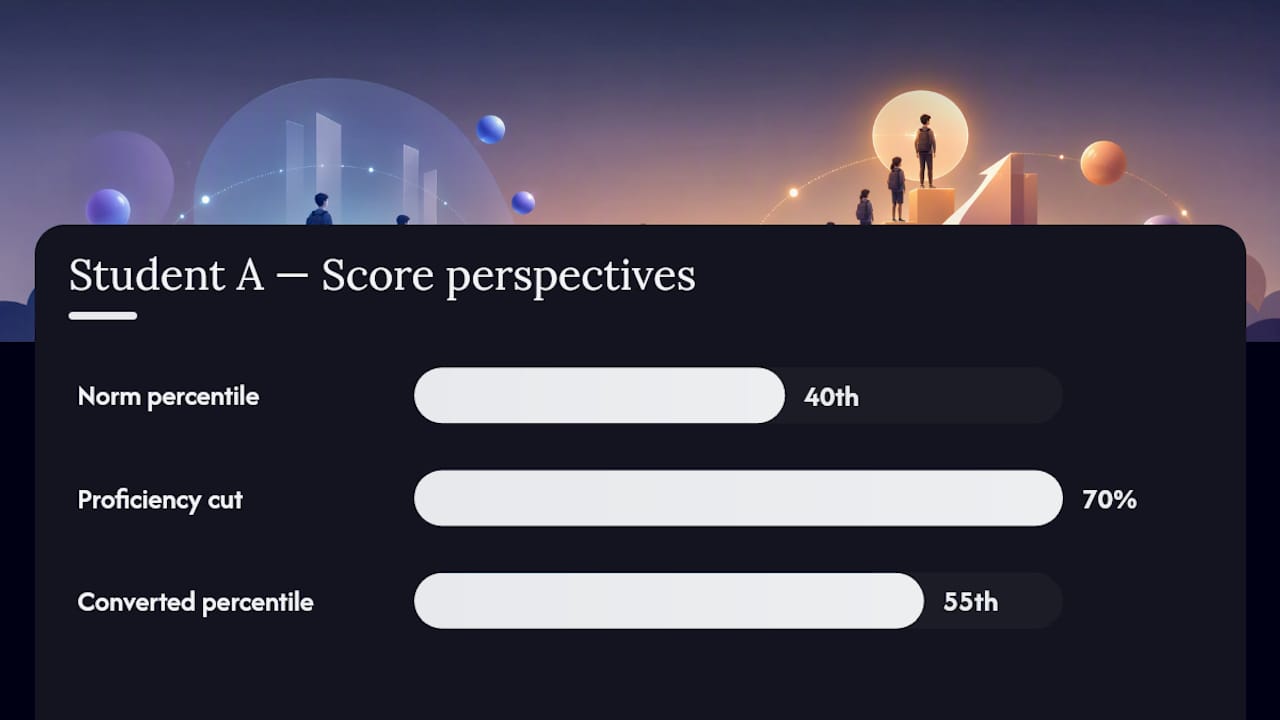
Under a criterion frame, that's likely a passing grade if the cut score for proficiency is 70%. Convert that same raw score into a percentile against a national norm group, though, and it might land at the 55th percentile, solidly average, not exceptional. Neither number is wrong. They answer different questions.
Here's a short checklist for reading any mixed report:
- Identify whether each number is drawn from a norm group or a standard.
- Check the date and composition of the norm group if one is cited.
- Look for the cut score or rubric behind any pass/fail or proficiency label.
- Ask what decision the score is meant to support before acting on it.
Pro Tip: When a report shows both a percentile and a proficiency level for the same test, treat them as two separate conversations. Don't average them or let one override the other in a placement decision.
Trade-Offs You Can't Ignore in Either Frame
Norm-referenced scores lose meaning fast when the norm group goes stale or doesn't match your population. A test normed a decade ago on a different demographic mix can produce percentiles that misrepresent where a student actually stands today, which is why technical manuals caution against using outdated or nonrepresentative norms without disclosure. Norm-referenced scores also say little about what a student can specifically do.
Criterion-referenced scoring carries its own baggage. Setting a defensible cut score is genuinely hard, and rubric quality varies wildly between programs. Inter-rater reliability suffers when scorers interpret descriptors differently, which is why effective criterion-referenced practice depends on published rubrics, moderation, and student familiarization with the standards before the test.
Mitigations exist for both problems:
- Use local norms built from your own population when national norms feel disconnected from your students.
- Publish rubrics and standards descriptors before the assessment, not after.
- Run moderation sessions so multiple scorers calibrate against the same examples.
- Give item-level feedback so a proficiency label doesn't feel like a black box.
Can One Test Deliver Both Interpretations?
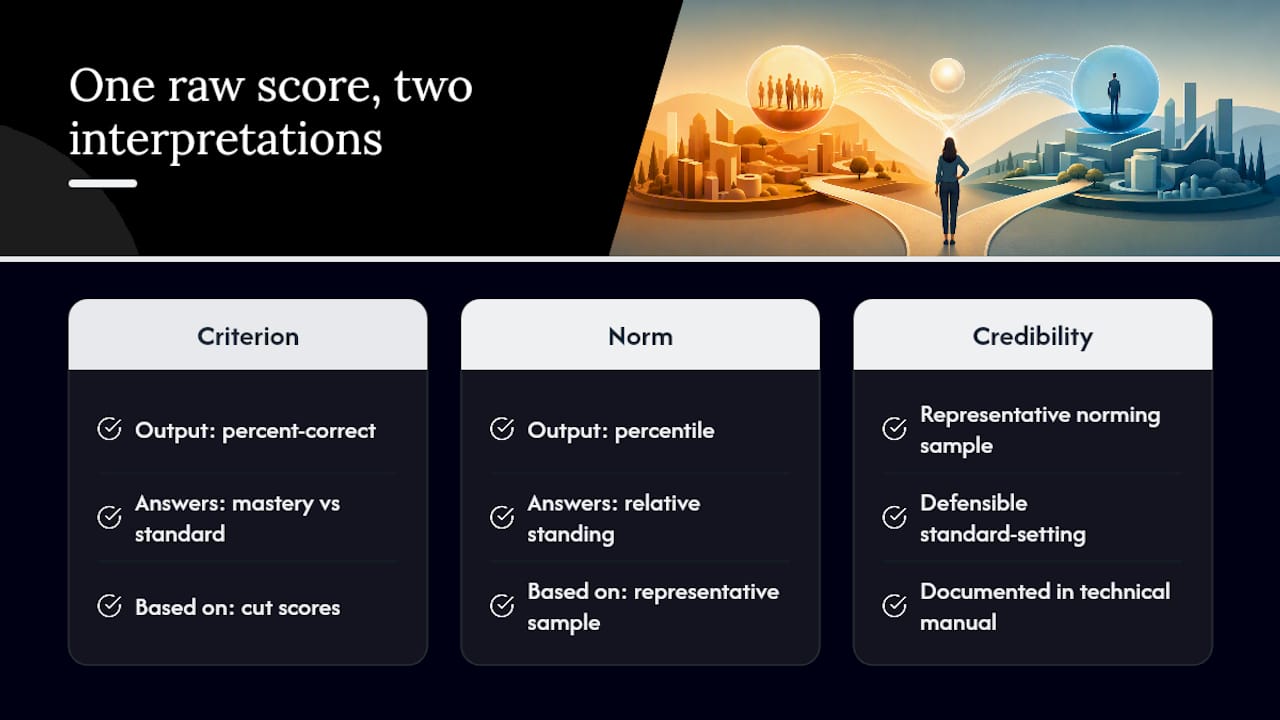
Yes, technically. A raw score can convert into a percent-correct figure for criterion interpretation and a percentile for norm interpretation, since both derive from the same underlying performance data. Doing this credibly requires a representative norming sample and a documented, defensible standard-setting process behind the cut scores, points measurement researchers stress belong in any technical manual worth trusting. Dual reporting gets risky for parents and students when a report shows both numbers without explaining which one answers which question.
A Practitioner's Checklist for Choosing the Right Frame
Before selecting or designing an assessment, work through these questions in order:
- What decision will this score inform? Placement, mastery certification, and program evaluation each point toward a different frame.
- Do you need ranking or evidence of mastery? If you can't answer this clearly, the assessment design will end up muddled.
- Are the norms recent and representative of the population you're testing, or are you relying on a sample from a different era or demographic?
- Was a defensible standard-setting method used to establish any cut scores, and is that method documented anywhere accessible?
- Match the scenario to the frame: a weekly classroom quiz calls for criterion-referenced scoring; a screening tool for a gifted program calls for norm-referenced ranking; an accountability exam usually needs both, clearly labeled.
Experts who study test selection consistently emphasize matching the interpretation to the decision rather than treating "norm-referenced" or "criterion-referenced" as a fixed label stamped on a test forever.
Pro Tip: If you can't name the specific instructional or administrative decision a score will trigger, don't administer the test yet. Figure out the decision first, then pick the frame that serves it.
What Transparent Reporting Looks Like
A trustworthy score report tells you what norm group it used, when that group was tested, and how it was sampled. It defines any rubric descriptors behind proficiency labels and gives item-level feedback, not just a single number. When evaluating a vendor's claims about percentiles or proficiency bands, ask to see the technical manual. If a company can't produce documentation of its norm group or standard-setting process, treat its percentiles skeptically.
Where These Two Frames Came From
Norm-referenced testing traces back to early 20th-century psychometrics, when researchers like Alfred Binet and later Lewis Terman built intelligence scales designed explicitly to rank individuals against a population curve. The entire architecture, the bell curve, standard deviations, percentile ranks, was built for comparison, not for describing mastery of any particular skill.
Criterion-referenced assessment emerged later, largely as a reaction against norm-referencing's limits. Robert Glaser coined the term in 1963, arguing that education needed a way to measure whether learners had achieved specific, defined objectives rather than simply where they landed relative to classmates. This idea took hold as competency-based education and mastery learning gained traction through the 1960s and 1970s, and it accelerated again with the standards movement of the 1990s and 2000s, when states began writing explicit grade-level standards and building tests to measure mastery against them rather than against a national sample.
The theoretical split matters because it shapes everything downstream: item writing, score reporting, even how teachers talk about student progress. A norm-referenced worldview asks "who's ahead?" A criterion-referenced worldview asks "who's ready?" Modern assessment increasingly tries to answer both questions without confusing which is which.
How Test Design and Item Selection Diverge
Item writers build norm-referenced tests to maximize spread. A good norm-referenced item is one that a predictable percentage of test takers get right, ideally around 50%, because items answered correctly by everyone or no one do nothing to differentiate scores. This is why norm-referenced tests often include a range of difficulty levels engineered through pilot testing and item response theory, with items discarded or revised if they don't discriminate well between high and low performers.
Criterion-referenced test design starts from the opposite direction. Item writers begin with a learning objective or standard, then write items that directly measure whether that objective was met. It might mean the objective was well taught, not that the item is defective. Difficulty isn't the design goal; alignment to the standard is.
This difference shows up in test blueprints too. Norm-referenced tests often sample broadly across a domain to produce a stable, generalizable ranking. Criterion-referenced tests map more tightly to a specific curriculum or standard set, sometimes at the cost of broader generalizability. Neither approach is inherently more rigorous. They're built for different jobs, and confusing one design philosophy for the other is a common error when districts adopt an off-the-shelf norm-referenced test and expect it to double as a mastery check.
Fairness Questions Neither Frame Solves Alone
Norm-referenced testing raises equity concerns when the norm group doesn't reflect the population being tested. A norm sample skewed toward one socioeconomic group, language background, or region produces percentiles that can systematically disadvantage students who differ from that sample, a documented weakness in norm-referenced score interpretation generally. Students from under-tested demographics can appear to underperform when the real problem is a mismatched comparison group.
Criterion-referenced testing sidesteps that specific problem by comparing everyone to the same fixed standard rather than to each other. But it introduces its own equity risk: if the standard itself, or the cut score defining "proficient," was set without input from diverse stakeholders, or without piloting across varied student populations, it can encode bias just as easily. A rubric written with one type of classroom in mind may penalize students whose prior instruction looked different.
Fairness in either frame depends less on which one you choose and more on transparency: publishing the norm group's makeup, documenting how a cut score was set, and giving students access to the criteria before they're assessed against them. Both approaches can be fair. Both can also be quietly unfair in ways that only show up when someone checks the fine print.
How Each Frame Shapes Motivation and Teaching
Norm-referenced feedback tends to frame achievement as a competition. Telling a student she's "in the 30th percentile" answers a comparative question, but it can also demotivate students who read that number as a verdict on ability rather than a snapshot relative to one particular group. Teachers working from norm-referenced data often adjust instruction by grouping students for differentiated pacing, since the score signals relative standing rather than specific gaps.
Criterion-referenced feedback tends to support a growth mindset more directly, because it tells a student exactly what she can already do and what she still needs to learn. A report showing "meets 8 of 10 standards" gives a teacher a concrete instructional target: reteach the two unmet standards. This specificity is a major reason mastery-based and competency-based programs lean almost entirely on criterion-referenced reporting; it turns a score into a lesson plan rather than a ranking.
In practice, the healthiest classrooms use criterion-referenced feedback to drive day-to-day instruction and reserve norm-referenced data for broader placement or screening decisions, keeping the two conversations separate so students don't confuse "how am I doing relative to a standard" with "how am I doing relative to my classmates."
A Straight Answer From Someone Who Reads a Lot of Score Reports
Most confusion doesn't come from bad tests. It comes from good tests reported badly. Ask what decision the score needs to support before you look at the number, and demand reports that say plainly which frame you're reading.
— Steve
See Both Sides of Your Own Results With Testuno
Reading about percentiles and proficiency bands is one thing. Seeing your own numbers laid out clearly is another. Testuno's IQ test reports your results with real-time percentile benchmarking against a defined comparison group, so you get a norm-referenced answer to "how do I compare?" without wading through a technical manual to figure out what the number means.

The test runs about 15 minutes, requires no sign-up, and covers multiple subtests spanning different cognitive skills, giving a breakdown of specific strengths rather than one flat score. If you want a faster snapshot, the quick IQ test delivers results in less time. Either way, you can download a full report afterward and see exactly where your performance sits.
Sources
For technical definitions and score types, see the Social Sci LibreTexts overview. For standard-setting guidance, see Michigan Assessment Consortium's primer and the University of Tasmania's criterion-referenced assessment guide.
- 8.2: Norm-Referenced and Criterion-Referenced Assessment Tools - Social Sci LibreTexts
- Criterion Referenced Assessment - Teaching & Learning | University of Tasmania
- Norm-referenced test — Wikipedia