

This page gives you free numerical reasoning practice sets, a full-length timed mock with worked solutions, and a six-week plan built around it. Everything below is designed to run in one sitting: no signup, no fluff, just questions, answers, and a method for turning mistakes into faster, more accurate scoring. Testuno hosts a timed version you can try right after reading, and most people see the biggest gains in the first two weeks simply by fixing how they read the question.
TL;DR:
- Practice the correct question families through targeted drills rather than random problems to improve transferability under timed conditions.
- Log errors by type to identify and drill specific weak points such as misreading tables or misapplying formulas.
- Use full-length timed mock tests to develop pacing and simulate actual test conditions, especially since most tests last 15 to 25 minutes with tight time limits.
- Focus on understanding typical question types like percentage change, ratio splits, table analysis, number series, and weighted averages, as these appear most frequently.
- Regularly review worked solutions to internalize methods, and incorporate daily quick drills to build speed and confidence overall.
Table of Contents
- Free Numerical Reasoning Practice Sets and How to Use Them
- Worked Examples: Sample Numerical Reasoning Questions
- How to Build a 6-Week Numerical Reasoning Practice Plan
- What Do Numerical Reasoning Tests Actually Look Like?
- Testuno: A Practical Place to Run Timed Numerical Reasoning Practice
- How Numerical Reasoning Scores Are Calculated and Interpreted
- Managing Test Anxiety and Time Pressure
- Why Most Advice on This Topic Misses the Point
- Try a Timed Numerical Reasoning Mock Right Now
- Sources
- FAQ
Free Numerical Reasoning Practice Sets and How to Use Them
Practice only works if it matches the shape of the real test. Random questions from a textbook won't cut it, because most numerical reasoning tests reuse the same five question families over and over, and the skill that transfers is recognizing the family fast, not memorizing individual problems.
Break your practice into three tiers:
- Micro-drills (10 to 20 questions): single-skill reps, like percentage change only, done in 5 to 8 minutes.
- Themed drills (percentages, ratios, table reading, number series): mixed difficulty within one family, 10 to 15 minutes, meant to expose weak spots before a mock.
- Full-length timed mocks (15 to 25 questions): the real test experience, one sitting, one timer, no pausing.
Run your mocks the way the actual test will feel: one screen, a strict countdown, and whatever calculator rule the employer's testing publisher uses (SHL, Aon, and Cubiks all handle this differently, so check the specific format when you know the employer). Practice untimed only when you're learning a brand-new question type for the first time. Once you understand the method, timing goes back on immediately.
A simple weekly session template:
- 5-minute number-sense warm-up (rounding, quick percentages, doubling and halving).
- 10-minute themed drill on your weakest family.
- 15-minute full mock, once or twice a week, always reviewed the same day.
Worked Examples: Sample Numerical Reasoning Questions
Reading a worked solution teaches you more than reading ten unsolved questions. Here are five representative examples covering the families that show up most often on real tests.
-
Percentage change. A store's revenue rises from $84,000 to $96,600. What's the percentage increase? The increase is $12,600. Divide by the original figure, $84,000, not the new one: 12,600 ÷ 84,000 = 0.15, or 15%. Pro Tip: The single most common error here is dividing by the wrong number. The base is always the starting value, never the ending one.
-
Ratio question, "parts" method. A company splits a $45,000 bonus pool between three departments in a ratio of 2:3:4. How much does the largest share get? Add the parts: 2+3+4=9. Each part equals $45,000 ÷ 9 = $5,000. The largest share is 4 parts, or $20,000. Pro Tip: Solve for one part first, then multiply. Trying to solve all three shares at once is where most people lose time.
-
Table extraction. A table lists quarterly sales for four regions. The question asks which region had the highest percentage growth from Q1 to Q4, not the highest total sales. Read the question before you touch the table. Locate only the two columns you need (Q1 and Q4 for each region), then calculate the percentage change for each. Pro Tip: Tests often reuse one table for three or four questions. Skimming the whole table first wastes time; find only the cells the current question needs.
-
Number series. What comes next: 4, 9, 19, 39, 79? Each term doubles the previous term and adds 1 (4×2+1=9, 9×2+1=19). The next term is 79×2+1=159. Pro Tip: Test the "double and add" or "difference of differences" rule on the first three terms before committing. A rule that works twice usually holds.
-
Weighted average. A student scores 70 on a test worth 30% of the grade and 90 on a test worth 70% of the grade. Weighted average: (70×0.3)+(90×0.7) = 21+63 = 84.
How to Build a 6-Week Numerical Reasoning Practice Plan
Structured practice consistently beats random practice, and a sequence of untimed review, timed drills, focused practice, and mock tests produces measurable gains over random question-hopping. Here's a plan built around that sequence.
- Week 1: One untimed baseline mock. Log every error by type (misread, wrong formula, calculation slip, unit mistake, ran out of time).
- Weeks 2 through 5: Pick one question family per week based on your error log. Run daily 10-minute themed drills, then two timed mocks weekly, cutting your per-question time target slightly each week.
- Week 6: One final full-length mock under strict test conditions, then targeted polishing on whatever error category still leads your log.
Pro Tip: Training protocols that recommend 10 to 15 questions repeated three times a week for four to six weeks show measurable speed and accuracy gains, which is roughly the cadence this plan follows.
Layer in daily 5 to 15 minute number-sense drills, quick percentage shortcuts, rounding practice, doubling and halving. These compound faster than they seem to in the moment.
Your error log is the real engine here. Categorize every miss as reading, formula, calculation, unit, or time, then drill whichever category dominates. If half your errors are misreads, more arithmetic practice won't fix that. You need table-decomposition drills instead.
What Do Numerical Reasoning Tests Actually Look Like?
Most numerical reasoning tests run 15 to 25 minutes and contain 15 to 25 multiple-choice questions, which works out to roughly 45 to 75 seconds per question. That's tight enough that you can't afford to reread a table three times.
- Match your practice to the employer's testing publisher when you know it; SHL, Aon, and Cubiks vary in calculator policy and question style.
- If you don't know the publisher, practice both with and without an on-screen calculator so neither format catches you off guard.
- Some tests are adaptive, meaning the difficulty shifts based on your answers. You typically can't skip or return to earlier questions, so pacing from question one matters more than it does on a fixed-form test.
Testuno's numerical reasoning test mirrors this format, giving you a realistic sense of pacing before you sit a real assessment.
Testuno: A Practical Place to Run Timed Numerical Reasoning Practice
Testuno runs interactive numerical reasoning tests alongside a broader set of cognitive assessments, all with instant feedback and percentile benchmarking at Testuno. You see where you land against other test takers immediately, not after a wait.
Sessions typically take about 15 minutes and are designed to provide results immediately after completion, allowing easy integration into structured practice plans without setup friction. For daily number-sense reps between mocks, the mental math test works as a fast, low-stakes warm-up.
How Numerical Reasoning Scores Are Calculated and Interpreted
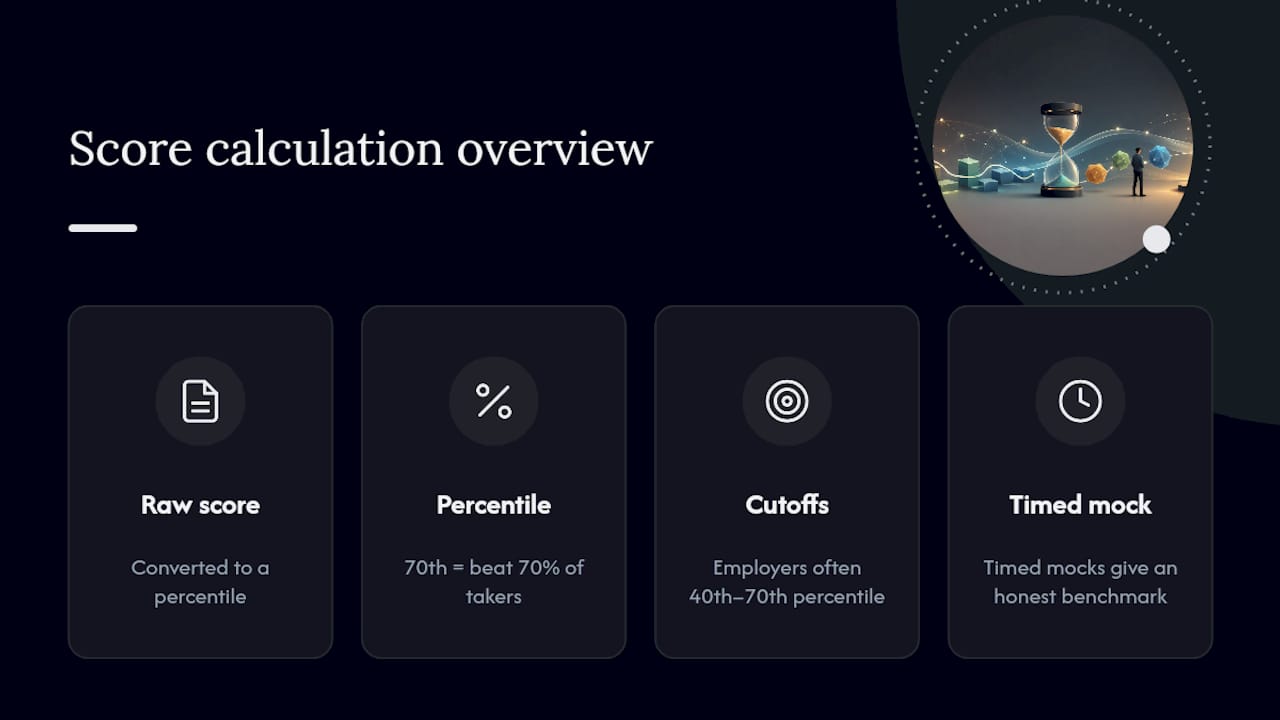
Your raw score, the number of correct answers, gets converted into a percentile that compares your performance against a reference group of other test takers. A score in the 70th percentile means you outperformed 70% of that group, not that you got 70% of questions right. This distinction trips people up constantly.
Employers typically set a percentile cutoff, often somewhere between the 40th and 70th percentile depending on the role, rather than judging your raw number of correct answers in isolation. Some publishers also weight harder questions more heavily, particularly on adaptive tests where the system adjusts difficulty based on your previous answers.
Accuracy and speed both feed the final score, but they don't trade off evenly. Rushing through questions and guessing wildly tanks accuracy fast, while spending too long per item means you never reach the later questions at all, which counts as a miss either way. The practical implication: a mock score isn't just "questions correct out of total." It's your percentile relative to typical test takers, which is exactly why practicing against a timed, benchmarked mock, rather than untimed problem sets alone, gives you a more honest read on where you actually stand before the real test.
Managing Test Anxiety and Time Pressure
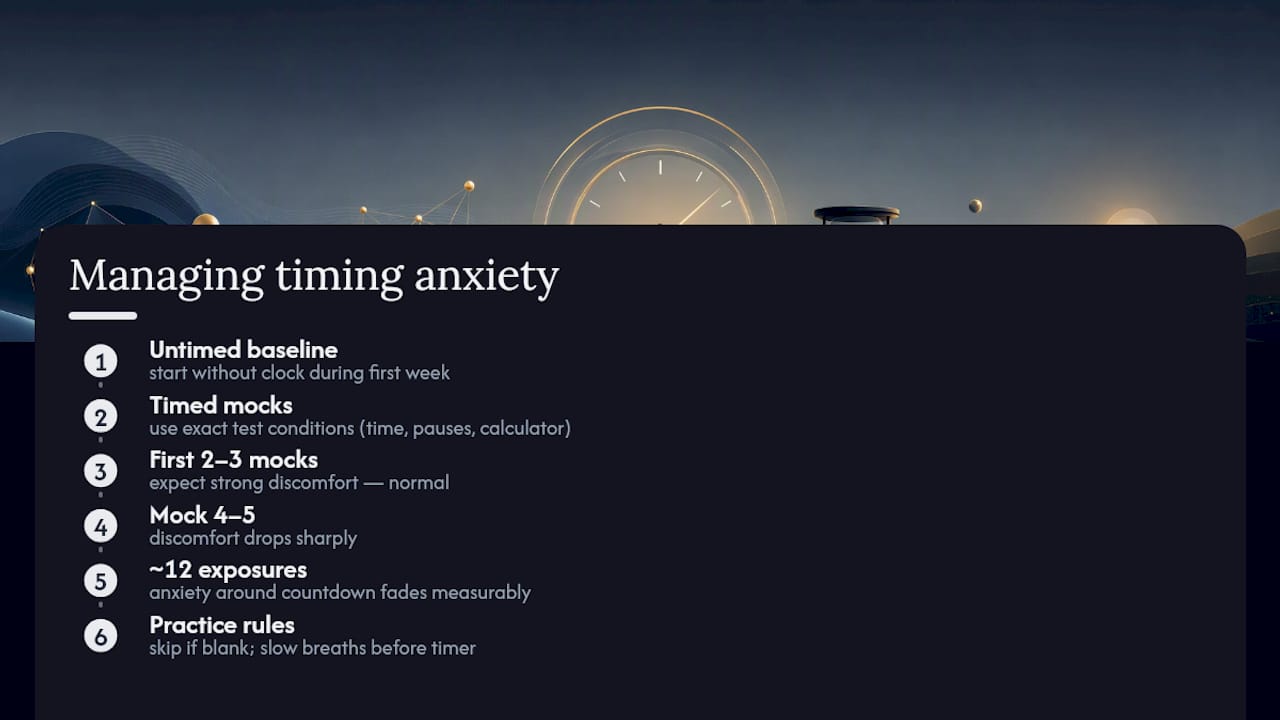
Time pressure is the single biggest factor separating how people perform on a numerical reasoning test versus how they'd perform on the same questions with no clock running. The fix isn't "calm down." It's exposure. Anxiety around a ticking countdown fades measurably once you've sat through it a dozen times.
Run your mocks under the exact conditions you'll face on test day: same time limit, same lack of pauses, same calculator rule. The first two or three timed mocks will feel uncomfortable no matter how well you know the material. That discomfort drops sharply by mock four or five, which is precisely why the six-week plan front-loads an untimed baseline before introducing strict timing.
If you blank on a question, move on immediately rather than staring at it. A skipped question costs you one point; a question you stare at for ninety seconds costs you that question plus whatever you didn't get to at the end. Build this rule into practice now, not on test day, so it becomes automatic. And treat your breathing the same way you treat your formulas: a few slow breaths before starting the timer measurably steadies most people, not because it changes the math, but because it interrupts the spiral that turns one hard question into a wasted three minutes.
Why Most Advice on This Topic Misses the Point
Most numerical reasoning advice treats the problem as a math deficiency. It isn't, usually. The people who struggle most on these tests can do the arithmetic fine untimed. What breaks under pressure is method selection: picking the right approach to a ratio or percentage question fast enough that the clock doesn't win.
That's why an error log matters more than another stack of practice questions. Grinding fifty new percentage problems when your real issue is misreading tables wastes a week. Categorizing your mistakes first, then drilling the actual weak point, is the difference between practice that moves your score and practice that just feels productive.
The other piece conventional guides underweight is exposure to real timing. Untimed practice teaches method. Only timed, benchmarked mocks teach pacing, and pacing is what most people actually fail on. A platform like Testuno's timed test format gives you that pressure without needing to schedule a proctor, which makes it a reasonable first rep before the real thing.
Start with the baseline mock. Log the errors honestly. Then drill the category that's actually costing you points, not the one that feels most familiar to practice.
— Steve
Try a Timed Numerical Reasoning Mock Right Now
The fastest way to know where you stand is to sit one. Testuno's numerical reasoning test runs in about 15 minutes, needs no signup, and gives you instant feedback with a percentile benchmark against other test takers the moment you finish.

Follow the same sequence from the six-week plan: one untimed review mock first to shake off rust, then one timed mock per week while you drill your weakest question family in between. If you want a broader read on your reasoning and processing speed alongside the numerical score, Testuno's cognitive profile pulls several related assessments into one view. Start with a single mock today, log your errors, and book your next one for the same time next week.
Sources
For deeper practice sets, see Practice Aptitude Tests and Assessment-Training's guide. For quick calculation checks during drills, this percentage calculator is a handy utility.
- Free Numerical Reasoning Test: 20 Questions + Answers
- Numerical Reasoning Tests: Practice Guide 2026 | forge
- Numerical Reasoning Practice Questions: Types, Examples and How to Prepare | Assessment-Training Blog
FAQ
How Do I Improve My Numerical Reasoning?
Run a structured practice sequence: untimed baseline, then timed drills by question family, then full mocks, while logging every error by category (reading, formula, calculation, unit, or time) so you drill your actual weak point.
How Should I Practice for Numerical Reasoning Tests?
Combine short themed drills on one question family at a time with at least one full-length timed mock per week, reviewing every worked solution the same day you take it.
What Are Some Examples of Numerical Reasoning Questions?
Common examples include percentage change (using the correct starting value as the base), ratio splits solved with the "parts" method, table or chart extraction questions, weighted averages, and number series with a hidden arithmetic rule.
Are Numerical Reasoning Tests Hard?
They're not conceptually difficult so much as time-pressured. Most people can solve the underlying math untimed; the real challenge is recognizing the question family and applying the right method within roughly 45 to 75 seconds per question.