

Some personality tests measure something real. Most don't. The dividing line isn't marketing or popularity, it's math: Big Five and HEXACO assessments, along with clinical tools like the MMPI, hold up under retesting and predict real outcomes, while MBTI-style typing and viral quizzes tend to fall apart under the same scrutiny.
A reliable test should produce test-retest correlations in the 0.80 to 0.90 range, meaning you'd get a similar score if you took it again next month. MBTI-style tests don't clear that bar consistently. One widely cited meta-analysis found that roughly 35% of people get a different type within four weeks of their first result, even with no real change in their behavior or outlook.
What this means practically:
- Trust continuous trait scores (like Big Five percentiles) over binary type labels
- Expect any legitimate test to describe tendencies, not fixed identities
- Treat a single test result as one data point, not a verdict
Reliable personality tests show test-retest correlations of 0.80–0.90; MBTI-style tests show roughly 35% category change within a month, according to reliability research.
Table of Contents
- What Makes a Personality Test Accurate, Anyway?
- The Tests Backed by Real Research: Big Five, HEXACO, and MMPI
- Why MBTI and Viral Quizzes Keep Failing Under Scrutiny
- A Practical Checklist for Judging Any Online Personality Test
- How Testuno Approaches Accuracy and How to Use Its Reports Responsibly
- Cultural and Demographic Factors Shape What a Score Actually Means
- The Statistical Tools Behind a Trustworthy Personality Score
- Norm-Referenced vs. Criterion-Referenced: Two Different Questions
- What Personality Tests Still Can't Tell You About Real Life
- Situation vs. Disposition: Why the Same Person Tests Differently
- What the Research Actually Tells You to Prioritize
- Get a Personality Report Built on Continuous Scoring
- Sources
What Makes a Personality Test Accurate, Anyway?
"Accuracy" in psychometrics breaks into two separate questions, and conflating them is where most confusion about personality test accuracy starts.
The first question is reliability: does the test give you the same answer twice? Test-retest reliability measures consistency over time, usually by having the same person take a test weeks or months apart and correlating the two sets of scores. Internal consistency, often reported as Cronbach's alpha, checks whether items meant to measure the same trait actually move together within a single sitting. Psychologists generally want alpha values above 0.70, and well-built Big Five instruments regularly report scores near 0.80 to 0.90.
The second question is validity: does the test measure what it claims to measure? This splits further into convergent validity (does it agree with other established measures of the same trait), divergent validity (does it correctly distinguish unrelated traits), and predictive validity (does it forecast something that matters, like job performance, relationship satisfaction, or health behavior). Predictive validity is the one that actually matters to you as a test taker. A test can be perfectly reliable and still tell you nothing useful about your life if it lacks predictive validity.
Here's the intuitive way to read a correlation coefficient: a correlation of 0.50 between a trait score and an outcome means the trait explains a meaningful chunk of the variation, but plenty of other factors, including situation and chance, fill in the rest. No personality measure produces a coefficient of 1.0, and none should claim to.
- Reliability asks: is the measurement stable?
- Validity asks: does the measurement mean anything?
- A test needs both to be worth your time
The Tests Backed by Real Research: Big Five, HEXACO, and MMPI
The Big Five model (openness, conscientiousness, extraversion, agreeableness, neuroticism) has survived decades of attempts to break it. Researchers have replicated its factor structure across dozens of languages and cultures, and it keeps showing up when you run factor analysis on personality data collected almost anywhere. HEXACO, a six-factor variant that separates out an honesty-humility dimension, has earned similar cross-cultural support among researchers who study these models closely.

Both frameworks score continuously rather than sorting people into boxes, which matters more than it sounds. A person can score in the 60th percentile on extraversion and stay there, roughly, on a retest. That stability is the whole point.
The MMPI operates in a different arena entirely. It's a clinical instrument, not a curiosity quiz, running nearly 600 true-false items and built with internal validity scales specifically designed to catch inconsistent or deceptive answering. Clinicians use those scales to flag when someone is faking good, faking bad, or just not paying attention. You won't find that level of built-in fraud detection on a five-minute online quiz, and that's a feature the MMPI has that most consumer tests never bother to build.
Pro Tip: If a test doesn't disclose reliability statistics or sample sizes anywhere, treat that silence as information. Legitimate psychometric tools publish their numbers because the numbers are good.
- Big Five/HEXACO: replicated across cultures, continuous scoring, decades of data
- MMPI: near-600 items, built-in lie detection, professional administration required
- Both stand in sharp contrast to single-session, no-validation online quizzes
Why MBTI and Viral Quizzes Keep Failing Under Scrutiny
The Myers-Briggs Type Indicator has a structural problem baked into its design: it forces continuous traits into either/or categories. You're not "somewhat introverted," you're Introvert or Extrovert, full stop, even if your actual score sits one point from the midline. That single design choice explains a lot of the instability researchers keep finding.
- MBTI ignores neuroticism entirely, one of the most predictive traits in the Big Five for outcomes like job stress and relationship conflict.
- Comparative research has found the Big Five roughly twice as accurate as MBTI-style frameworks for predicting real-world outcomes.
- Dichotomizing continuous data throws away information. A trait score of 51 and a score of 99 both round to the same category, even though they describe very different people.
Then there's the Barnum effect, named after the showman famous for lines that felt personal to everyone. Vague, universally flattering statements ("You have a deep need for others to like you, yet you're also independent") get rated as highly accurate by nearly everyone who reads them, regardless of what test produced them.
The trick isn't in the test. It's in the language. Generic positive statements feel personal because most people want to see themselves that way, and testers exploit that quietly by writing results that could apply to anyone.
Self-report itself carries baked-in limits, too. Your mood on test day, your desire to look good to an imagined evaluator, and plain blind spots about your own behavior all bend your answers. That's why even well-built tests use validity checks, and why cross-referencing with someone who knows you helps.
A Practical Checklist for Judging Any Online Personality Test
You don't need a psychology degree to spot a weak test. You need six questions and about ten minutes.
- Does it publish reliability numbers? Look for test-retest correlations or Cronbach's alpha. No numbers, no trust.
- Does it score you on a spectrum or force you into a type? Continuous scores retain more information and tend to hold up better on retest than binary categories.
- Does it disclose its normative sample? A test validated on 500 college sophomores may not generalize to a 45-year-old manager. Legitimate tools describe who they were tested on.
- Does it include internal validity checks? Even a short online test can include a few items designed to catch random or careless clicking.
- Is there peer-reviewed backing? A model with published, replicated research behind it (Big Five, HEXACO) starts from a stronger position than a proprietary framework invented for a website.
- Does the marketing overpromise? Phrases like "100% accurate" or "reveals your true self" are a red flag, not a selling point. No instrument in psychology claims perfect accuracy honestly.
Beyond the checklist, run your own experiment. Retake the same test in three or four weeks and see how much your scores move. Take a validated Big Five measure and compare it against whatever quiz you just finished. And ask someone who knows you well to rate you on the same traits; self and observer ratings for Big Five factors typically correlate between 0.37 and 0.56, which tells you your self-image and your reputation overlap, but not completely.
Pro Tip: Keep a screenshot of your first result before you retake a test. Memory is unreliable, and you want the real comparison, not the one you think you remember.
How Testuno Approaches Accuracy and How to Use Its Reports Responsibly
Testuno's Big Five personality test reports continuous trait scores with percentile benchmarking rather than sorting you into a fixed type, which lines up directly with the checklist above: spectrum scoring over binary labels. Users also get real-time comparison against other test takers, so a score means something relative, not just a number floating in isolation.
For readers who prefer a type-style summary for quick reference, Testuno's 16-personality type test exists too, but it's worth reading it alongside the trait-based report rather than instead of it. Combining both gives you the readability of a type label and the statistical grounding of continuous scores.
Every report is downloadable, which matters if you're using results for coaching conversations, team-building exercises, or your own longitudinal tracking. Retake the Big Five assessment in a month; if your percentile ranks stay close, that consistency itself is a useful signal about your own self-report reliability, separate from the test's.
- Continuous, percentile-based Big Five scoring for spectrum-level detail
- Optional 16-type report for quick, shareable summaries
- Downloadable reports for retesting, coaching, or comparison over time
Cultural and Demographic Factors Shape What a Score Actually Means
A personality test built and normed on one population doesn't automatically transfer cleanly to another. Language matters more than most people assume. A trait item that translates literally from English into another language can shift in emotional weight, formality, or even social acceptability, which changes how people answer it regardless of their actual disposition.
Age and generational context matter too. Someone who came of age before smartphones may interpret an item about "constant connectivity" completely differently than someone who has never lived without one. Occupational and educational background shift baseline expectations around traits like conscientiousness, since a factory supervisor and a graduate student may both score "organized" but mean different daily behaviors by it.
The Big Five's cross-cultural replication is genuinely one of its strongest selling points among the models discussed here, but replication of structure isn't the same as identical norms. A percentile score of 70 on extraversion means something specific relative to the sample it was calculated against. If that sample skews toward one country, one age bracket, or one education level, your percentile rank is really telling you how you compare to that group, not to humanity broadly.
This is why transparency about norming samples belongs on your evaluation checklist, not as an afterthought. A test that discloses who it was validated on lets you judge whether the comparison is even relevant to you. A test that hides this information is asking you to trust a comparison you can't actually verify.
The Statistical Tools Behind a Trustworthy Personality Score
Two statistical methods do most of the heavy lifting behind any personality test worth taking seriously.
Factor analysis is how researchers figured out that human personality traits cluster into a handful of broad dimensions in the first place. Ask people hundreds of questions about their behavior, run the answers through factor analysis, and patterns emerge: people who describe themselves as talkative also tend to describe themselves as sociable and energetic, forming what we now call extraversion. The Big Five didn't come from theory first; it emerged from data, repeatedly, across independent research teams working with different samples decades apart. That convergence is a large part of why psychologists trust the model.
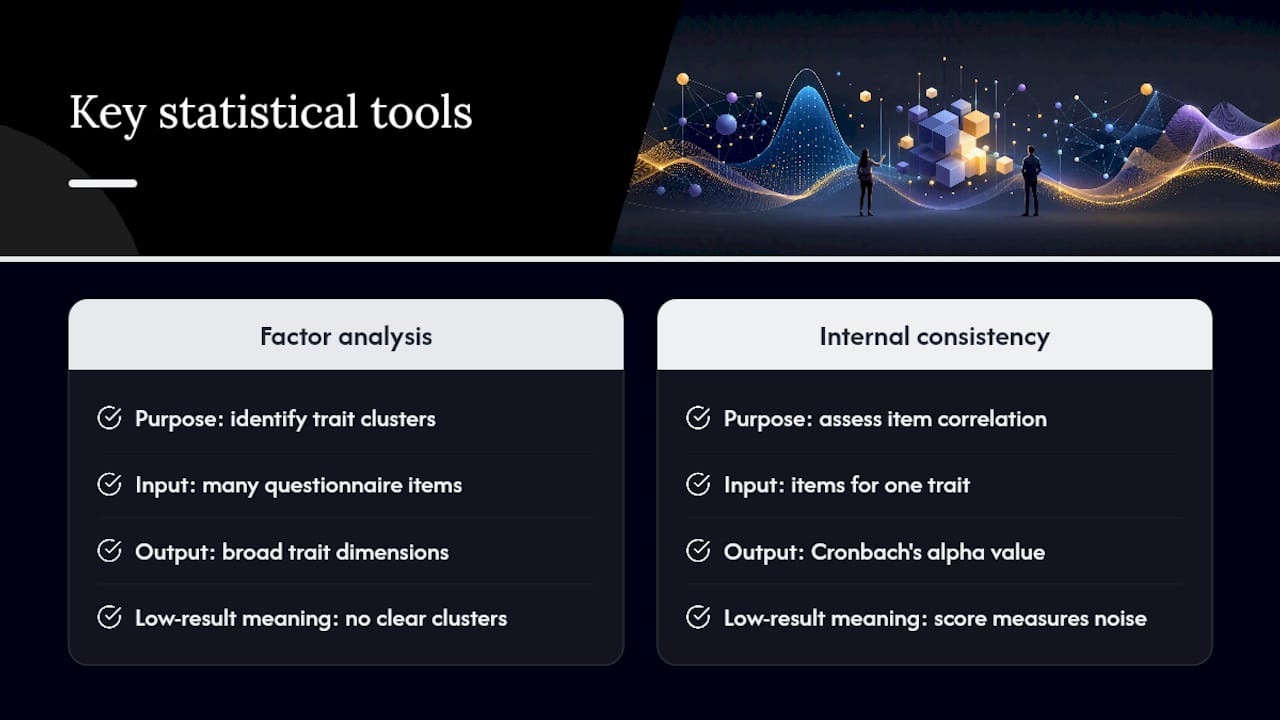
Internal consistency analysis, typically expressed as Cronbach's alpha, checks whether the individual questions meant to measure one trait actually hang together statistically. If a test asks five questions about conscientiousness and people's answers to those five questions don't correlate with each other, the trait score built from them is measuring noise, not conscientiousness.
Beyond these two, researchers use confirmatory factor analysis to test whether a proposed model fits new data, and measurement invariance testing to check whether a test functions the same way across different demographic groups. That last method matters directly for the cultural questions raised above; it's the formal statistical way of checking whether a test means the same thing for a 22-year-old in one country as it does for a 55-year-old somewhere else.
Norm-Referenced vs. Criterion-Referenced: Two Different Questions
Most personality tests you'll encounter online are norm-referenced, meaning your score gets its meaning by comparison to other people who took the same test. A percentile rank is the clearest example: scoring in the 80th percentile on openness tells you that you scored higher than 80% of the comparison sample. It says nothing, by itself, about whether that level of openness is good, bad, or relevant to any particular decision.
Criterion-referenced assessments work differently. They measure you against a fixed standard tied to a specific outcome, not against other people. A driving test is criterion-referenced: you either meet the standard for safe driving or you don't, regardless of how other test takers performed that day.
Personality tests almost never work this way, and that's worth sitting with for a second. There's no fixed "passing score" for conscientiousness because personality isn't a skill with a correct answer. This is exactly why a test that scores you against clear real-world criteria (like a validated risk tolerance measure tied to actual financial decision patterns) sits in a different category from a general trait quiz reporting where you fall on a bell curve.
Knowing which type you're looking at changes how you should read the result. A norm-referenced percentile tells you about your relative standing. It doesn't tell you what to do about it, and tests that blur this line, implying a percentile score carries prescriptive weight, are overselling what the number actually means.
What Personality Tests Still Can't Tell You About Real Life
Even the best-validated personality test is predicting tendencies, not scripting your Tuesday afternoon. Predictive validity coefficients for trait measures against real-world outcomes commonly land in a moderate range, strong enough to matter across large groups, weak enough that any single prediction about you specifically carries real uncertainty.
Part of the gap comes from aggregation. Personality traits predict patterns averaged across many situations and many people, not a specific decision you'll make in a specific meeting next week. A high conscientiousness score predicts that you'll generally follow through on commitments more often than a low scorer will, across dozens of situations over years. It says much less about whether you'll finish one particular report by Friday, because that single outcome depends on workload, sleep, interruptions, and a dozen other variables the personality score never captured.
There's also the ceiling problem: no self-report measure fully escapes the honesty and self-insight of the person answering it. Even instruments with strong validity evidence are working with secondhand information, filtered through your own perception of yourself, which is why experts who study personality assessment generally recommend treating any single test as one input, combined with observed behavior over time, rather than a standalone verdict.
Situation vs. Disposition: Why the Same Person Tests Differently
Personality psychology has argued for decades over how much of behavior comes from stable traits (disposition) versus the immediate environment (situation). The honest answer, backed by a large body of research, is both, and the ratio shifts depending on what you're measuring and when.
A naturally introverted person can behave in an outgoing, energized way at a close friend's wedding and behave in a withdrawn, quiet way during a stressful work deadline the following Monday. Neither behavior is fake. Both are real expressions of the same underlying disposition interacting with very different situational pressures. This is exactly why test-retest reliability matters so much as a checkpoint: if your score shifts wildly depending on what kind of week you happened to have when you took the test, the instrument may be picking up your current mood or context rather than your stable disposition.

Strong personality measures try to write items that pull for cross-situational tendencies ("I usually feel energized around groups of people") rather than single-moment reactions ("I felt energized at the last party I attended"). That phrasing choice sounds small but changes what the test is actually capturing. A well-designed instrument nudges you toward reporting your general pattern; a poorly designed one lets a single recent event color your entire result.
This is also the practical argument for retesting weeks apart. If your trait scores hold steady across different life circumstances, you're likely seeing disposition. If they swing with your calendar, the test may be measuring your week, not you.
No personality test replaces observed behavior over time; the strongest evidence comes from combining a validated, continuous-scoring instrument with retesting and observer input.
| Point | Details |
|---|---|
| Favor continuous scoring | Big Five and HEXACO models avoid the forced categories that make MBTI-style results unstable. |
| Check the reliability numbers | Look for published test-retest correlations near 0.80 to 0.90 before trusting any report. |
| Watch for the Barnum effect | Generic, flattering statements feel accurate to almost everyone regardless of the test behind them. |
| Combine self-report with observer input | Self and observer ratings correlate around 0.37 to 0.56, so a friend's perspective adds real signal. |
| Retest before you fully trust a score | A stable result across weeks suggests disposition; a swinging one suggests mood or context. |
| Testuno offers continuous, benchmarked scoring | Its Big Five assessment reports percentile ranks and downloadable results built for retesting and comparison. |
What the Research Actually Tells You to Prioritize
The conventional advice on personality tests treats accuracy as a binary: a test is either legit or it's a horoscope with better branding. That framing misses the more useful truth. Accuracy sits on a spectrum, and where a given test lands depends on specific, checkable factors: does it score you continuously, does it publish reliability data, does it disclose its norms.
What's overrated in most coverage of this topic is the hunt for a single "best" test. The Big Five isn't magic, it's just the model that has survived the most attempts to disprove it. What's underrated is the retest. Almost nobody takes a personality test twice, yet a second attempt a month later tells you more about whether you can trust your first result than any amount of reading about the test's methodology.
If you take one thing from this, prioritize the habit over the hunt: retake, compare against an observer's view, and read your percentile score as a relative comparison rather than a fixed label. That habit does more for your understanding of yourself than switching tests ever will.
— Steve
Get a Personality Report Built on Continuous Scoring
If everything above makes you want a test that actually shows its work, Testuno's Big Five personality test reports percentile-based trait scores instead of forcing you into one of sixteen boxes. You see where you land on openness, conscientiousness, extraversion, agreeableness, and neuroticism, benchmarked against other test takers in real time, with a downloadable report you can revisit or share with a coach.

No sign-up wall stands between you and your results, and the test itself runs in about fifteen minutes. If you'd rather see a quick, type-style summary alongside your trait scores, Testuno's 16-personality type test gives you that option too, so you get both the shareable label and the statistical backing behind it. Curious how your cognitive profile lines up with your personality results? Testuno's IQ test pairs naturally with a Big Five report for a fuller picture. Start with the Big Five assessment, save your results, and put the retest habit into practice in three or four weeks.
Sources
- Myers-Briggs Type Indicator Score Reliability Across Studies: a Meta-Analytic Reliability Generalization Study
- Minnesota Multiphasic Personality Inventory (MMPI) overview (NCBI Bookshelf)
- Annual review article on personality measurement and self/observer validity (Annual Reviews)
- Personality tests aren't all the same. Some work better than others. (Scientific American)