

The fastest way to prepare for an IQ test is to practice timed versions of the actual item types, then optimize sleep, exercise, and anxiety the day you sit for it. That combination reliably raises your score. What it won't do is meaningfully raise your underlying fluid intelligence in a week or two, so treat any prep plan as sharpening performance, not rewiring ability.
TL;DR:
- Familiarizing yourself with common IQ test formats and practicing targeted drills can significantly reduce test anxiety and improve pacing during the exam.
- Full timed mock tests are the best way to simulate real test conditions, help identify pacing issues, and build confidence before the actual exam.
- Prioritize sleep, light exercise, and stress management on test day, as these factors notably influence fluid reasoning and processing speed.
- Focusing on format exposure and sleep in the final 48 hours yields better results than trying to relearn reasoning tips or content.
- Short-term practice improves performance by reducing anxiety and format unfamiliarity, but does not meaningfully increase underlying fluid intelligence.
Table of Contents
- What an IQ Test Actually Measures
- The Strategies That Actually Move Your Score
- A 4-Week Plan You Can Actually Follow
- Where to Find Materials Worth Your Time
- What Preparation Can Change, and What It Can't
- Run a Timed Mock Before the Real Thing
- Sources
What an IQ Test Actually Measures
Most IQ tests are not one test. They're a bundle of subtests, each targeting a different cognitive skill, and knowing which is which changes how you prepare.
Matrix and abstract reasoning items ask you to spot a pattern in a grid of shapes and pick what completes it. Number series items push the same pattern logic onto digits. Analogies test relational thinking ("shoe is to foot as glove is to ___"). Spatial items measure mental rotation. Vocabulary and general knowledge sections tap crystallized intelligence, the stuff you've learned over years. Working memory and processing-speed subtests measure how fast and accurately you hold and manipulate information under a clock.

Here's the part that matters for planning: vocabulary and format familiarity respond to short-term prep. Fluid reasoning, the ability to solve novel problems you haven't seen before, is far more stable and resistant to quick gains, since practice tends to be test-specific and transfers poorly to unrelated item types.
The Wechsler Adult Intelligence Scale, currently in its fifth edition, and the Stanford-Binet are the two professional batteries most clinical psychologists use, and each weighs these subtests a little differently, which is why the two batteries produce genuinely different profiles for the same person. Culture-fair tests strip out language and rely almost entirely on abstract pattern recognition, which is worth knowing if you're not sure which format you're facing.
The Strategies That Actually Move Your Score
Not every hour of prep pays off equally. Some tactics produce real, repeatable gains. Others are wasted effort dressed up as studying.
Get familiar with the item types first. You don't need to master every subtest, but you do need to have seen a matrix problem, a number series, and a verbal analogy before test day. Closing the unfamiliarity gap is where most of the practical score gain lives — it's not about learning secret tricks, it's about not freezing on a format you've never encountered. Spend focused time on matrix reasoning, abstract reasoning, and numerical reasoning drills specifically, since these show up across nearly every major battery.
Practice under a clock, not just for correctness. Working through problems with no time pressure teaches you the logic but not the pacing. Full timed mock exams build the rhythm you need, and they're the single best predictor of how you'll actually perform when the countdown is real.
Optimize your body the way you'd optimize for an athletic event, because that's essentially what this is. Aim for 7 to 9 hours of sleep, especially the two nights before the test, since sleep loss hits fluid reasoning and processing speed harder than almost any other cognitive task. A 20 to 30 minute walk or light jog the morning of the test, paired with a low-glycemic breakfast, keeps your energy and focus steady for hours afterward. Keep caffeine at your normal level. Test day is the wrong time to quit cold or double your dose.
Handle anxiety on purpose. Spend 5 to 10 minutes on slow, focused breathing before you start. Read every question fully before answering, and if something stalls you, skip it and circle back rather than burning three minutes on one item.
Pro Tip: If you only have 48 hours, skip trying to "cram" harder reasoning content. Spend that time on format exposure and sleep instead — a rested brain looking at a familiar question shape will outperform an exhausted brain trying to relearn logic patterns.
A 4-Week Plan You Can Actually Follow
If you have a month, structure beats intensity. Here's how to spread the work so each week builds on the last.
- Week 1: Meet every format. Do short, untimed drills across matrix reasoning, number series, analogies, spatial rotation, and vocabulary. The goal isn't speed yet. It's making sure nothing on test day is a surprise.
- Week 2: Add the clock. Start timing individual drill sets and build up to 20 to 40 minute timed blocks. Notice where you lose time, whether it's rereading instructions or getting stuck on one stubborn item type.
- Week 3: Run full mocks. Simulate real test conditions, quiet room, phone away, one sitting, no pausing. Review your errors afterward and sort them into categories: careless mistakes, format confusion, or genuine reasoning gaps.
- Week 4: Taper down. Cut practice volume, protect your sleep schedule, and do one final light mock two or three days before the real thing.
A useful daily session, especially in weeks 2 and 3, follows a simple template:
- Five-minute warm-up with easy items to settle in.
- Fifteen to 20 minutes of focused drilling on your weakest item type.
- One timed block simulating a real section.
- Five to 10 minutes reviewing what you missed and why.
Where to Find Materials Worth Your Time
Good practice material shares a few traits, and a lot of what's marketed online doesn't have them. Look for realistic timing that mirrors actual test sections, coverage across all the major item types rather than just one, worked explanations so you understand why an answer is correct, and the ability to score yourself immediately so you can track progress.
Useful resource categories include:
- Curated question banks organized by item type (matrix, verbal analogies, number series).
- Full-length timed mocks that mimic real test pacing and section order.
- Targeted drills for working memory and processing speed, since these decay fastest under fatigue.
- Vocabulary and general-knowledge builders, best tackled over weeks rather than days since they draw on crystallized knowledge.
For quick, structured practice, Testuno's logical reasoning, spatial reasoning, and inductive reasoning tests each isolate one skill so you can find your weak spot without wading through a full battery. The verbal reasoning test covers the vocabulary side worth building over a longer runway.
Be skeptical of anything promising a large IQ jump in days, or a proprietary "brain training" app with no transparent scoring method. If a product can't show you how it measures improvement, it probably can't measure it at all.
What Preparation Can Change, and What It Can't
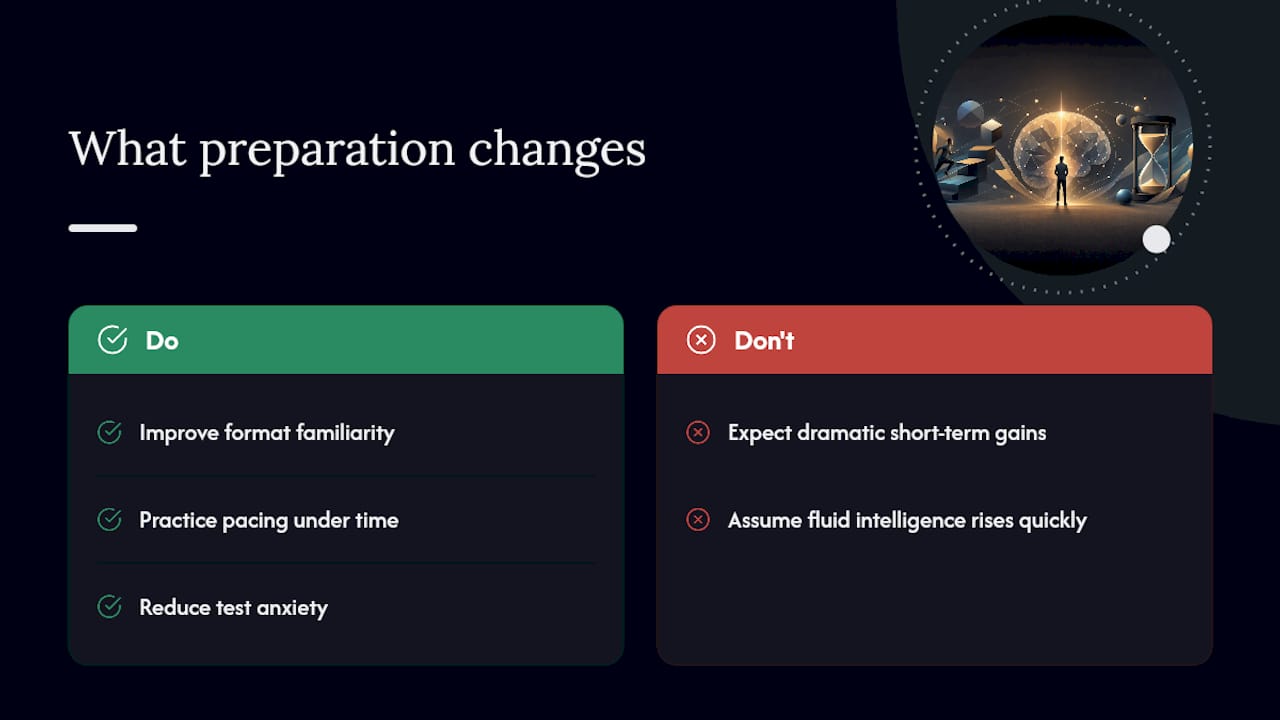
The evidence on this is fairly consistent: brief training raises scores mostly by reducing anxiety and closing the format-familiarity gap, not by boosting underlying fluid intelligence. You're not becoming smarter in a week. You're getting better access to the reasoning ability you already have, which is a real and useful gain, just not the one some marketing implies.
Fluid reasoning develops slowly and has a strong genetic component, so treat any promise of dramatic short-term increases with suspicion. What does change fast is your comfort with the format, your pacing, and your stress response, and those three things account for a meaningful chunk of the score variance between a rushed first attempt and a prepared one.
Tools exist that offer an IQ test with six research-grounded subtests in about 15 minutes, no sign-up required, with real-time percentile benchmarking so you can see where you land against a broader population rather than guessing.
Run a Timed Mock Before the Real Thing
If you take one thing from this guide, make it this: don't walk into your actual IQ test cold. The gap between someone who has seen a timed matrix section before and someone who hasn't is often the difference between a rushed guess and a calm, correct answer.

Testuno's quick IQ test gives you exactly that rehearsal in about 15 minutes, timed and scored, with no account required. It covers a spread of item types so you get an honest read on where your pacing breaks down before it matters. If you want the deeper version, with full subtest breakdowns and percentile benchmarking against other test-takers, the complete IQ test gives you that fuller picture. Either way, take one mock run this week under test-like conditions: quiet room, no interruptions, phone away. Then review what tripped you up and drill that specific gap before test day.
Sources
- How to Prepare for an IQ Test · JobCannon
- What do polygenic scores really predict? — King's College London