

Processing speed is the rate at which your brain takes in information, makes sense of it, and produces a response, and it operates on a timeline separate from raw intelligence or memory storage. A slow processor can be brilliant and still take twice as long to finish a test or follow a rapid-fire conversation. That gap between "how well you think" and "how fast you think" shapes reading, schoolwork, driving, and job performance in ways most people never connect back to a single cognitive skill.
TL;DR:
- Processing speed depends on the efficiency of neural wiring, especially the health of white matter and myelination, which continues developing into the twenties.
- Variations in processing speed are significant, with some older adults maintaining high speed while others experience notable decline, and individual differences surpass population averages.
- Improving processing speed can be achieved through targeted brain training, aerobic exercise, optimizing sleep, and reducing cognitive load, though expectations should remain modest.
- Using accommodations like extended time and clear written directions often yields better results than attempting to change processing speed through effort alone.
- A formal assessment is recommended if slow performance consistently impacts daily functioning or work, especially when paired with other cognitive weaknesses or sudden changes.
Table of Contents
- What Is Processing Speed, Really?
- The Neural Basis of Processing Speed
- How Is Processing Speed Measured?
- Signs and Real-World Effects Across Ages
- What Causes Slow Processing Speed?
- Can You Improve Processing Speed?
- Accommodations and Daily Strategies That Actually Help
- When Should You Seek a Formal Assessment?
- Where Testuno Fits Into the Picture
- The Take: Stop Treating Speed as a Proxy for Smart
- Sources
What Is Processing Speed, Really?
Processing speed describes the interval between something reaching your senses and your brain producing a usable response to it. Cleveland Clinic breaks this into a chain: sensory intake, classification of what you just perceived, a decision about what it means, and finally a motor or verbal response. Every one of those four steps takes measurable time, and a person can be quick at one stage and slow at another.
Think of it as the difference between a fast internet connection and a fast computer. One is about how quickly data arrives; the other is about how quickly the machine reads, sorts, and acts on that data once it's there. Intelligence and processing speed work the same way. You can have a razor-sharp analytical mind that simply runs on a slower clock speed, and that mismatch is often what confuses parents, teachers, and even the person experiencing it.
A few everyday moments make this concrete:
- Reading: decoding each word fast enough to hold onto the meaning of the sentence before it fades from working memory.
- Following multi-step directions: hearing "grab your coat, put your shoes on, and meet me at the car" and processing all three steps in the time it takes to say them.
- Conversation: catching a joke or a question fast enough to respond before the moment passes.
- Driving: registering a brake light ahead and converting that visual signal into a foot movement in a fraction of a second.
None of these examples measure how smart someone is. They measure how fast the brain's intake to output pipeline runs, and that pipeline can be trained, protected, or worn down independently of IQ. This is also the core distinction between processing speed and what people sometimes call "execution speed": processing speed is the perception and decision stage, while execution speed refers more narrowly to how fast the physical response gets carried out once the decision is made. The two overlap but aren't identical, which is part of why a person can think fast and still fumble the keyboard, or type quickly while thinking slowly.
The Neural Basis of Processing Speed
Processing speed depends heavily on the physical wiring inside your skull, specifically the white matter that connects different brain regions. According to the MGH Clay Center, myelination, the fatty insulation wrapped around neural pathways, and the degree of synchrony between firing neurons are major biological correlates of how fast someone processes information. Thicker, healthier myelin means signals travel faster and with less signal loss, similar to the difference between a frayed extension cord and a properly shielded cable.
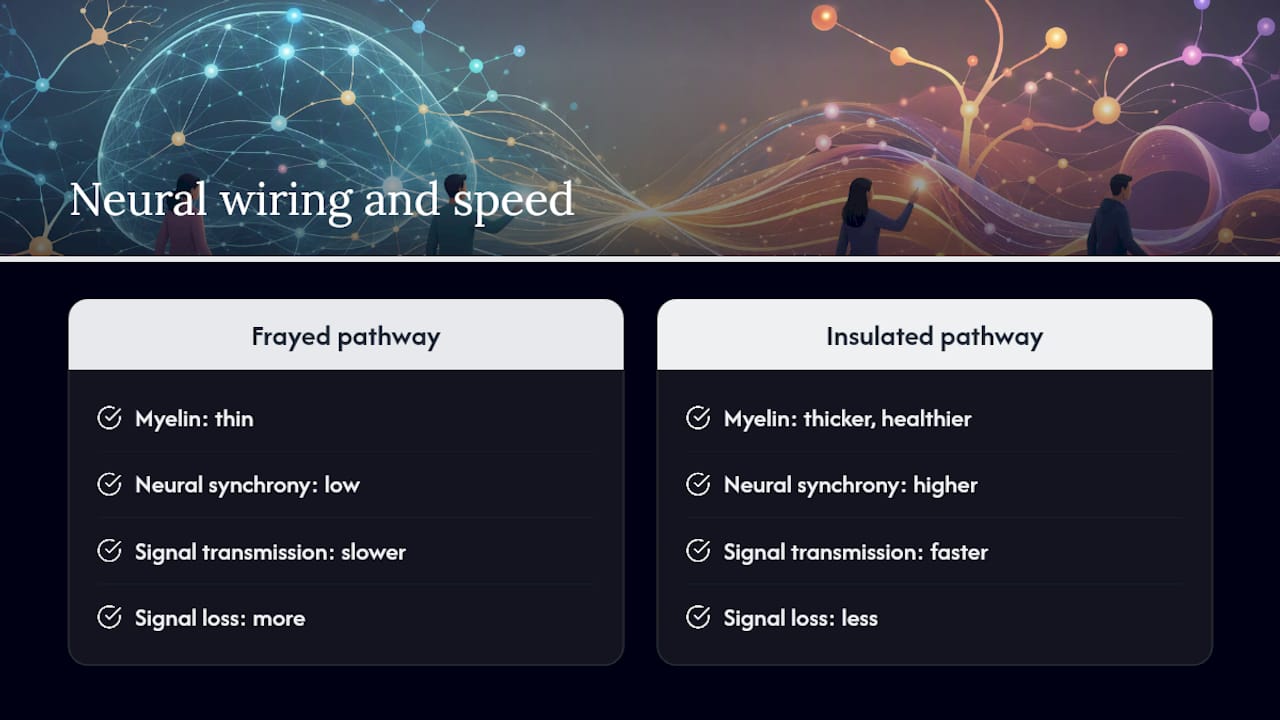
This wiring isn't static. White matter development continues into a person's twenties, which is one reason processing speed tends to peak in young adulthood before beginning a slow, gradual decline that accelerates later in life as white matter integrity erodes. That decline is not uniform. Some 70 year olds process information nearly as fast as they did at 30, while others notice a meaningful slowdown in their forties. Individual variation in this domain is larger than in almost any other cognitive measure, which is exactly why population averages are a poor guide for any one person.
Processing speed also occupies a specific slot in the Cattell-Horn-Carroll (CHC) model of intelligence, the framework most modern IQ tests are built around. It sits alongside fluid reasoning, working memory, and crystallized knowledge as one of several distinct abilities that combine to produce general intelligence, often abbreviated as g. Cleveland Clinic notes the correlation between processing speed and g typically runs in the range of 0.3 to 0.5, a moderate relationship. That number matters because it means processing speed contributes to intelligent behavior without being interchangeable with it. A person can score well below average on speed and still post a high overall IQ, provided reasoning and knowledge scores are strong enough to carry the composite.
How Is Processing Speed Measured?
Clinical psychologists most often measure processing speed through the Processing Speed Index (PSI), a component of the Wechsler Intelligence Scale for Children (WISC) and the Wechsler Adult Intelligence Scale (WAIS). The PSI typically combines two or three timed subtests:
- Coding or Symbol Search, where the person matches or copies symbols against a key as fast as accuracy allows.
- Cancellation tasks, which ask the test taker to scan a page and mark specific targets under a time limit.
- Simple reaction-time tasks, used more often in research settings than standard clinical batteries, which isolate the pure speed of a motor response to a stimulus.
Scores come back as age-normed standard scores, meaning a person's raw performance is compared only against others in the same age bracket, since an 8 year old and a 45 year old have very different baseline speeds. A PSI that falls well below a person's other index scores, particularly Verbal Comprehension or Fluid Reasoning, is what clinicians flag as a processing speed weakness worth exploring further, especially when it's paired with real-world struggles at school or work.
Online timed tasks, including Testuno's processing speed test, work on the same underlying principle: present a stimulus, measure the response latency, and repeat across enough trials to smooth out noise from a single lucky or unlucky attempt. These self-assessments are genuinely useful for a first-pass read on where you stand and for tracking whether a change you've made, like better sleep, shows up in your numbers over a few weeks. What they can't do is replace a comprehensive, age-normed clinical battery administered by a trained examiner, which controls variables like practice effects, motivation, and comorbid attention issues far more rigorously than a home browser test ever could.
Signs and Real-World Effects Across Ages
In classrooms, slow processing speed tends to show up as a mismatch between effort and output. A student might understand the material perfectly but consistently be the last to finish a worksheet, need to re-read the same paragraph three times to hold onto its meaning, or miss the third step of a set of spoken instructions because the first two already ate up their working memory.

Adults see a parallel pattern at work and in social settings. Meetings that move quickly can leave a slow processor feeling like they're always one beat behind, formulating a response just as the conversation has already moved on. Timed tasks, whether it's a certification exam or a fast-paced customer service queue, can feel disproportionately stressful even when the person's underlying knowledge is solid.
The consequences extend past the practical. A child who is regularly the last one done, or an adult who gets labeled "slow" in performance reviews, often internalizes that mismatch as a statement about their intelligence rather than their timing. That's a real risk to self-esteem, and it's one reason clinical guidance leans so heavily on reframing the issue early, before a kid decides they're "just not smart" based on a metric that has nothing to do with how well they actually think.
What Causes Slow Processing Speed?
Processing speed differences come from a mix of developmental, neurologic, and situational sources, and untangling which one applies to a given person is exactly why proper evaluation matters. On the developmental and neurologic side, differences in how white matter matures, along with neurodegenerative changes later in life, are established contributors to variation in speed. Some people are simply born with a slower baseline processing rate that has nothing to do with any diagnosis.
Slow processing speed also shows up frequently alongside other conditions rather than in isolation. Research summarized in a child psychiatric population study lists ADHD, dyslexia, dyscalculia, autism spectrum disorder, and anxiety as commonly co-occurring, though the same research is careful to note that a processing speed weakness is a distinct cognitive construct requiring its own assessment rather than something to assume automatically comes bundled with any one diagnosis. A person can have slow processing speed with no other condition present at all, and a person with ADHD can have perfectly average processing speed. The overlap is common, not universal.
Then there are state factors, temporary conditions that mimic or amplify a trait-level slowdown. Sleep deprivation is the biggest one. Even a single night of short sleep measurably slows reaction time and cognitive synchronization, according to research summarized by Neuronstudy, and chronic stress, certain medications, and general fatigue produce similar, if smaller, effects. This distinction matters practically: a bad week of sleep can make anyone's processing speed look temporarily impaired, which is exactly why a single off day of testing should never be treated as diagnostic.
Can You Improve Processing Speed?
Processing speed responds to intervention more than most people assume, though the size of the effect and how long it lasts depends heavily on which approach you choose. Three strategies currently have the strongest backing.
Aerobic exercise shows up repeatedly in the research as one of the more reliable levers, with regular physical activity linked to measurable gains in processing speed across a range of studies. Targeted speed-of-processing training has the most rigorous backing of all: research summarized in a peer-reviewed review points to the ACTIVE trial, a large randomized study, which found that a specific speed-of-processing training program produced improvements that in some participants persisted for years afterward, not just weeks. That's a meaningfully different result from most brain-training claims, and it's part of why speed-of-processing training gets singled out rather than lumped in with generic "brain games."

Pro Tip: Training tends to be specific. Getting faster at a symbol-matching task mostly makes you faster at that task and closely related ones, not automatically faster at everything. Pick practice that mirrors the real skill you're trying to speed up, whether that's reading, typing, or reacting on the road.
Sleep and stress management round out the list, and they may be the highest-value, lowest-risk changes available. Because sleep deprivation directly slows processing speed in the short term, fixing a chronic sleep deficit can produce a noticeable improvement in how fast someone thinks within days, not months. Reducing simultaneous cognitive load, meaning not trying to listen, write, and plan a response all at once, has a similar effect by freeing up the working memory that processing speed leans on heavily.
A few other habits worth building into a routine:
- Cut multitasking during tasks that require quick decisions; switching costs eat into the time you're trying to save.
- Practice timed tasks that resemble your real bottleneck, whether that's reading speed or mental arithmetic.
- Track your baseline occasionally so you can tell whether a change is actually helping.
The honest expectation to set is modest but real improvement, not a transformation. Processing speed has a strong biological floor and ceiling for any individual, and the goal of training and lifestyle changes is to move you toward your own ceiling, not someone else's average.
Accommodations and Daily Strategies That Actually Help
Speed differences respond better to structural changes than to willpower, which is why accommodations tend to outperform pure effort in both classrooms and workplaces.
- Request extended time on tests, assignments, or timed work tasks. This is the single most researched and most granted accommodation, and it directly targets the actual bottleneck rather than working around it.
- Ask for directions in writing, not just spoken aloud, so information doesn't disappear before it's fully processed.
- Reduce simultaneous demands by breaking large assignments or projects into single, sequential tasks instead of parallel ones.
- Build in single-tasking blocks at home or work where notifications and interruptions are off, since every switch costs recovery time.
- Use checklists for multi-step routines so working memory isn't doing double duty as a to-do list.
Advocating for these changes works best when it's framed around function rather than diagnosis. Telling a teacher or manager "I process information accurately but need more time to do it" lands very differently than a vague complaint about being slow, and it opens the door to specific, workable solutions. This mirrors a broader theme in accommodations research generally, including in high-stakes testing: reducing time pressure and anxiety around the clock, a point echoed in analysis of remote testing accommodations for standardized exams, consistently improves outcomes for people whose knowledge outpaces their speed.
Pro Tip: When requesting accommodations at work, lead with the specific task and the specific fix, not the label. "I need meeting agendas sent in advance so I can process the material before we discuss it" gets approved far more often than "I have slow processing speed."
When Should You Seek a Formal Assessment?
A few red flags suggest it's time to move past self-tracking and get a professional opinion. If slow performance is consistently affecting grades, job reviews, or daily functioning despite genuine effort, or if the slowdown appeared suddenly rather than gradually, that's worth a formal look.
Psychoeducational or neuropsychological testing typically includes the WISC or WAIS Processing Speed Index alongside working memory, reasoning, and verbal comprehension measures, giving a full profile rather than an isolated score. That fuller picture is what actually drives useful recommendations. A low PSI paired with strong reasoning points toward accommodations; a low PSI paired with other weak indices points toward a broader intervention plan. Either way, results feed directly into an individualized education plan, workplace accommodation request, or a targeted training program instead of a guess.
Where Testuno Fits Into the Picture
Testuno's processing speed test uses short, timed scroll, tap, and click tasks that take about 15 minutes and return instant feedback, no sign-up required. It's built for a quick, repeatable read on your speed, not a diagnostic replacement for the WISC or WAIS PSI.
Use it when you want to:
- Get a fast baseline before trying a new sleep or exercise routine.
- Track whether an intervention is actually moving your numbers over a few weeks.
- Get a first signal on whether your speed feels off relative to your own history.
If results are consistently concerning or paired with real academic or work struggles, the next step is a full cognitive profile or a licensed evaluator, not another round of casual retesting.
The Take: Stop Treating Speed as a Proxy for Smart
The biggest failure in how people talk about processing speed is conflating it with intelligence, and it happens in classrooms, offices, and living rooms every day. A kid who finishes last isn't the "slow" one in any meaningful sense; they're running a different clock speed on the same engine. Conventional advice tends to swing too hard toward remediation, endless brain games, drills, timed worksheets, when the research actually supports a more balanced mix of accommodation first, targeted training second.
If I had to prioritize one thing for a reader here, it would be sleep. It's unglamorous, it's free, and the evidence for its short-term impact on processing speed is more immediate than almost anything else on this list. Fix that before investing in any training program. And whatever a screening tool or self-test tells you, treat it as a compass, not a verdict. A single online score, including one from Testuno's own tools, should prompt curiosity and maybe a lifestyle change. It shouldn't prompt a label. That's what formal, age-normed testing is for.
— Steve
This article is general information, not a substitute for advice from a qualified doctor. Consult a qualified healthcare professional about your own circumstances before acting on anything here.
Sources
For deeper background, Cleveland Clinic's clinical overview covers definitions and conditions in more depth, while Understood's guide is written specifically for parents navigating school accommodations. The MGH Clay Center offers a practical framework for acceptance and advocacy.
- Processing Speed: What It Is, Conditions & How To Improve It
- What is a processing speed weakness? Importance of cognitive ability when defining processing speed in a child psychiatric population
- Slow Processing Speed Introduction: What It Is & What to Do
- Doi