

Risk tolerance psychology measures your general tendency to take non-financial risks, from career moves to physical adventure to social confrontation, not your comfort with market losses. It's a personality trait, related to but distinct from the Big Five, and researchers have found evidence for a general factor that shows up across situations. The fastest reliable way to learn where you stand is a validated, multi-item online test like the GRiPS or a comparable multi-item risk-personality assessment, not a one-question quiz.
TL;DR:
- Risk propensity scores can vary significantly with mood and stress, so retaking tests during different emotional states reveals how pressure influences your risk appetite.
- Validated, multi-item online assessments like GRiPS provide more reliable and nuanced measures than single-question or behavioral tests, which are less consistent over time.
- Your risk score indicates relative tendencies but does not accurately predict behavior in specific situations, especially if perception of danger differs from your willingness to accept risk.
- Demographic factors such as age, culture, and socioeconomic status shape risk tolerance, so interpret percentile results within the context of your background and group norms.
- Monitoring your risk score over time and pairing it with decision-making style assessments enhances understanding of how personality and emotional state interact with real-world risk decisions.
Table of Contents
- Understanding Risk Tolerance Psychology: General Trait or Situation?
- How Online Assessments Measure Risk Tolerance and Behavior
- What Your Risk Score Actually Tells You (and What It Doesn't)
- How to Choose a Credible Online Risk-Personality Test
- Why Testuno's Risk-Personality Test Fits This Standard
- The Brain Science Behind Risk Tolerance Psychology
- How Emotions and Mood Shape Risk Decisions
- Culture and Demographics: Why Risk Appetite Varies by Group
- Where Risk Tolerance Psychology Shows Up in Real Life
- Risk Tolerance vs. Risk Perception: Why the Difference Matters
- Using Your Risk Score Without Overreading It
- Try Testuno's Risk-Personality and Decision-Making Tests
- Sources
- FAQ
Understanding Risk Tolerance Psychology: General Trait or Situation?
Psychologists who study risk propensity have spent decades asking whether "risk-taking" is one trait or many. The answer, based on a bifactor analysis of 39 measures across 1,507 adults, is a bit of both. A general factor, often labeled R, captures shared variance across recreational, social, and ethical risk domains. Someone who scores high on R tends to lean into risk more broadly, not just in one area of life.
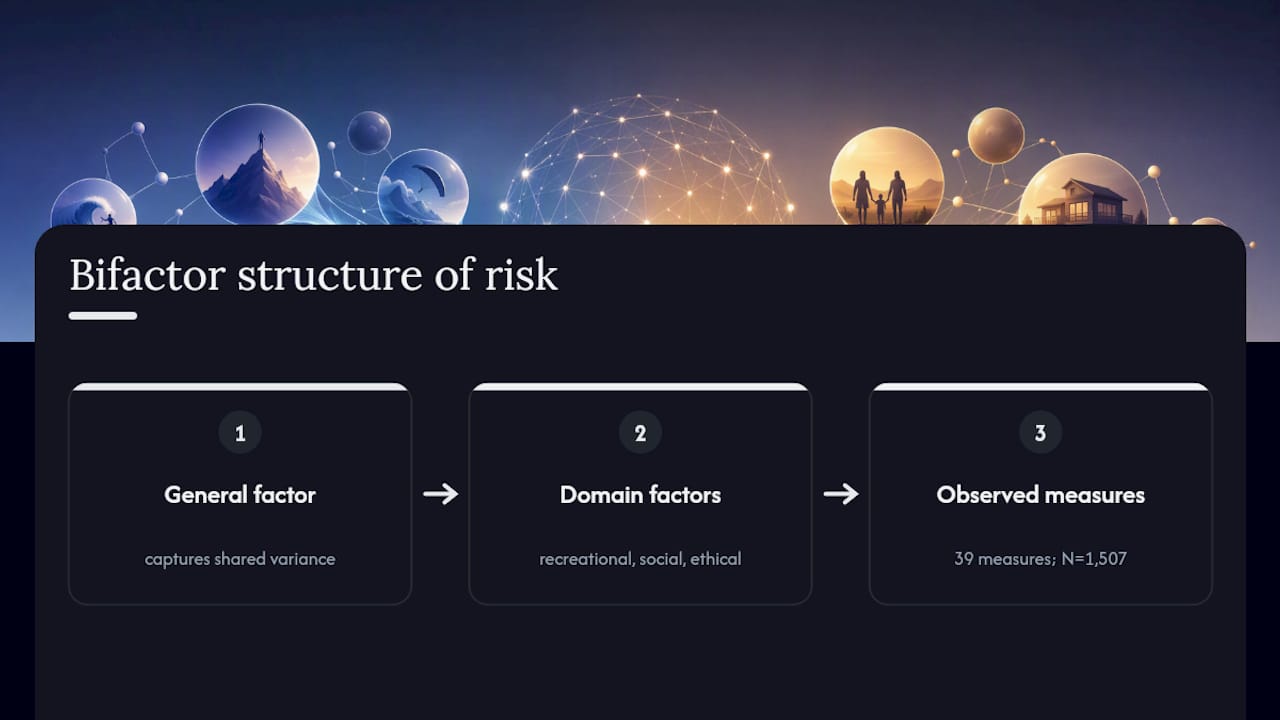
That doesn't mean domain-specific behavior disappears. A person might take real chances in their career while playing it safe socially. Single-score interpretations flatten that nuance, which is why the strongest assessments report both an overall propensity score and domain breakdowns.
Risk propensity also shifts over the lifespan. It tends to decline with age on average, though the rate and pattern vary by domain, staying relatively stable in some areas while dropping sharply in others like physical risk-taking.
How Online Assessments Measure Risk Tolerance and Behavior
Two broad approaches dominate risk measurement, and they don't always agree with each other. Self-report scales ask you directly how likely you'd be to do something risky. Behavioral tasks watch what you actually do under simulated stakes.
Within self-report instruments, quality varies a lot:
- General propensity scales like the GRiPS measure a broad risk-taking tendency with a handful of items validated across over a thousand participants in multiple studies.
- Domain-specific scales like DOSPERT break risk into categories (financial, health, recreational, social, ethical), which is useful when you suspect your risk appetite differs sharply by context.
- Short instruments like the Risk Propensity Scale (RPS) offer a compact option with good internal reliability and acceptable test-retest reliability.
- One-item measures, popularized by economist Thomas Dohmen, are fast but sacrifice nuance. They can predict some real-world behaviors, but multi-item domain-specific scales generally outperform them for interpretability.
Behavioral tasks, like the Balloon Analogue Risk Task (BART) or incentivized lottery choices, measure what people do rather than what they say they'd do. The catch: propensity scales show meaningfully higher test-retest reliability (averaging 0.68) than behavioral tasks (averaging 0.46), and correlations between the two types are often weak. If you want a stable read on your general tendency, a validated multi-item self-report scale is the more dependable tool.
What Your Risk Score Actually Tells You (and What It Doesn't)
A percentile score, say, "you scored higher than 72% of respondents on general risk propensity," tells you where you fall relative to others. It does not predict exactly what you'll do in any specific moment. Treat it as a tendency, not a forecast.
Personality correlates give useful context. Extraversion and openness are consistently linked to higher risk propensity, while conscientiousness and agreeableness tend to pull it lower. These associations are real but modest; personality explains part of the picture, not all of it. A 2025 mediation study of 110 university students found that overconfidence explained roughly 20.5% of extraversion's link to risk-taking, while confidence calibration explained a striking 72.8% of the effect tied to negative emotionality. In plain terms: some people take more risks because they genuinely feel less threatened by uncertainty, and others take fewer because they're more attuned to what could go wrong, not because they lack courage.
Situation matters just as much as trait. Researchers distinguish "hot" decision states, driven by stress, arousal, or social pressure, from "cold," deliberate ones, and risk-taking often spikes in hot states for many people, especially younger adults. If you take a test right after an argument or a big win, your score might skew from your baseline.
Pro Tip: Retake a validated risk test on a calm day and again after a stressful week. If your score shifts by more than a few percentile points, that gap is data, too. It tells you how much your risk appetite bends under pressure.
How to Choose a Credible Online Risk-Personality Test
Not every quiz calling itself a "risk personality test" deserves your time or your data. Before you commit either, run through this checklist:
- Confirm it's a multi-item scale. A single question can't capture a trait that psychologists measure with five to twenty items for good reason.
- Look for cited validation evidence. Credible tests reference published psychometric work, not just internal marketing claims.
- Check the sample size and reliability stats. Validation with hundreds or thousands of participants, plus reported test-retest reliability, signals real rigor.
- Verify domain labeling. Does it distinguish social, physical, or career risk, or lump everything into one vague number?
- Demand transparent scoring. You should understand how your raw answers become a percentile, not just receive a mystery label.
- Check the time commitment. A properly scaled test usually takes 10 to 20 minutes, long enough for signal, short enough to finish honestly.
- Read the privacy statement. Know what happens to your responses before you answer them.
- Try before you pay. A free sample or demo section is a strong signal the provider trusts its own instrument.
Red flags include quizzes with no visible psychometric background, scoring that changes with no explanation, and tests that promise a definitive personality "type" from a handful of yes-or-no questions. If a test can't explain its own math, skip it.
Why Testuno's Risk-Personality Test Fits This Standard
Testuno's risk-personality test is built as an interactive, multi-item assessment that takes about 15 minutes and requires no sign-up. You get instant feedback and percentile benchmarking against other respondents, the same kind of scoring transparency the checklist above calls for.
That structure maps directly onto what makes an assessment worth trusting: multiple items instead of one, a clear percentile rather than a vague label, and a fast turnaround that respects your time. Testuno also offers a downloadable report, useful if you want to compare your risk profile against other assessments over time, and it sits alongside a Big Five personality test and other trait measures if you want to see how risk appetite connects to your broader profile.
The Brain Science Behind Risk Tolerance Psychology
Risk decisions aren't purely rational calculations. They run through brain circuitry that evolved to weigh reward against threat, often faster than conscious reasoning can keep up. The prefrontal cortex handles deliberate cost-benefit analysis, while the amygdala and the brain's dopamine reward pathways drive the pull toward potential payoff and the flinch away from potential loss.
People with naturally stronger reward sensitivity tend to register the upside of a gamble more vividly than the downside, which shows up behaviorally as a higher risk-taking tendency even when the actual odds are identical to someone more loss-averse. This isn't a character flaw or a virtue; it's a difference in how strongly certain brain systems fire in response to uncertainty.
Cognitive style plays a role too. People who lean on fast, intuitive judgment often take risks more readily than people who default to slower, analytical processing, simply because deliberation tends to surface more of the reasons to hesitate. Working memory capacity matters as well: juggling multiple possible outcomes at once takes cognitive bandwidth, and under mental fatigue or distraction, that bandwidth shrinks, which nudges decisions toward whichever option feels simplest, sometimes the risky one, sometimes the cautious one, depending on the person.
None of this is fixed by a brain scan alone. It's the interaction between neural reward sensitivity, cognitive style, and the specific decision at hand that produces the risk-taking pattern a psychometric test picks up.
How Emotions and Mood Shape Risk Decisions
Mood is one of the biggest hidden variables in risk-taking, and it works in a direction that surprises a lot of people. Positive mood often increases risk-taking in some contexts because it broadens attention toward possible gains, while anxiety and negative mood can push people toward either extreme caution or, in some cases, impulsive risk-taking driven by a desire to escape the bad feeling.
Confidence, specifically overconfidence, turns out to be one of the strongest emotional levers on risk behavior. The 2025 study on university students found that people high in negative emotionality who nonetheless felt confident in a given moment took on far more risk than their baseline trait would predict, with confidence calibration explaining nearly three-quarters of that shift. That's a critical nuance: it's not that anxious people are simply cautious. It's that their risk behavior swings hard depending on how confident they feel right then.
This is also why the same person can look like a risk-taker on one day and risk-averse the next. Stress narrows attention toward immediate threats and can make people more conservative. Excitement or social pressure can do the opposite, pushing someone past their usual comfort zone. A single test score, taken during an ordinary week, gives you a baseline. It won't tell you how you behave during a bad breakup or a euphoric win streak, and that's worth remembering before you treat any score as permanent.
Culture and Demographics: Why Risk Appetite Varies by Group
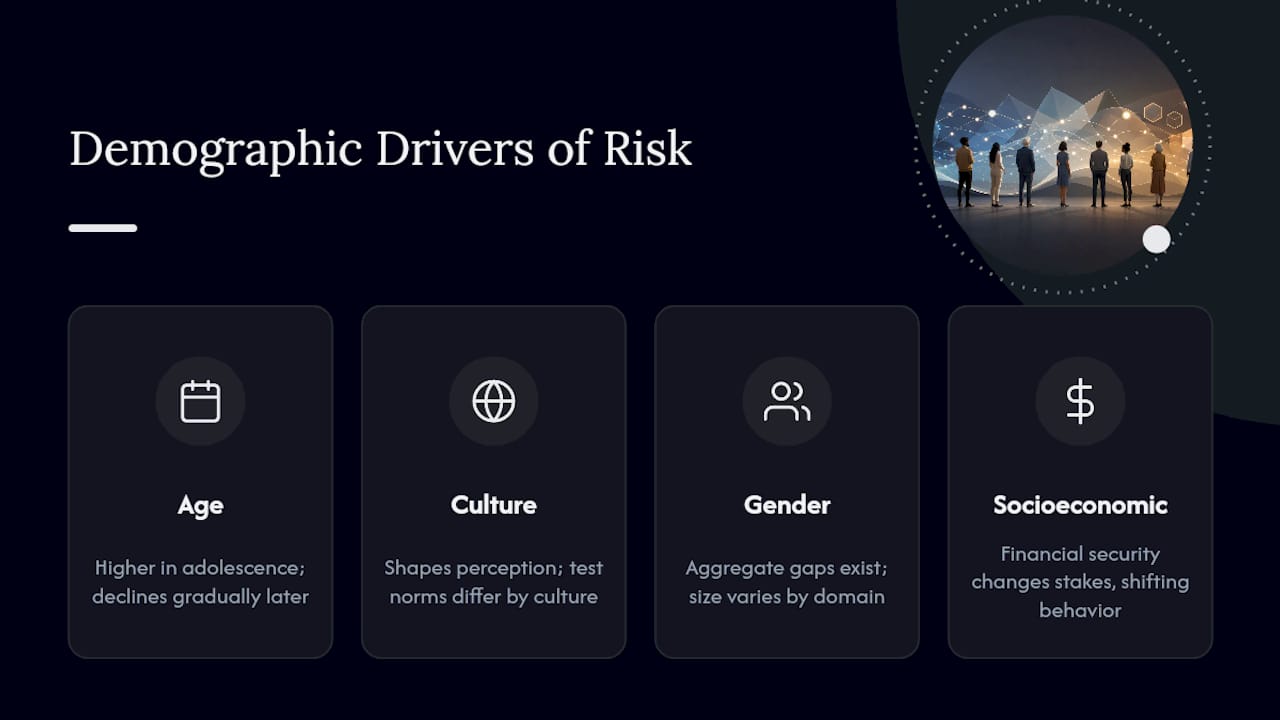
Risk tolerance isn't distributed evenly across populations, and the variation comes from more than individual personality. Age is one of the clearest patterns: risk propensity tends to run higher in adolescence and early adulthood and decline gradually afterward, though the decline isn't uniform across every domain of risk.
Cultural context shapes both risk perception and the social acceptability of acting on risk. Some cultures reward visible risk-taking in business or entrepreneurship; others prize stability and view caution as a mark of good judgment. Because psychometric risk tests are often normed on specific populations, a percentile score calculated against one cultural sample may not translate cleanly to another. This is a genuine limitation of many online tests, and it's worth checking whether a test discloses anything about its normative sample.
Gender differences show up consistently in aggregate data across many studies, though the size of the gap varies by domain and narrows or widens depending on how risk is framed and measured. Socioeconomic factors matter too: financial security or its absence changes the practical stakes of a given risk, which can shift behavior independent of underlying personality.
None of these demographic patterns are deterministic. They describe group tendencies, not individual destiny. A given person's percentile score reflects where they fall within whatever comparison group a test uses, so understanding that context helps you interpret the number honestly rather than treating it as an absolute measure of your character.
Where Risk Tolerance Psychology Shows Up in Real Life
Risk propensity isn't just an abstract trait; it quietly shapes decisions most people never label as "risk-taking." Career choices are a clear example. Someone with higher general risk propensity is more likely to leave a stable job for a startup, negotiate aggressively for a raise, or pivot into an unfamiliar industry. Lower-propensity individuals often prioritize security, benefits, and predictable advancement, even when the upside of a riskier path looks larger on paper. A partner analysis on personality and negotiation notes that understanding your own risk orientation, alongside broader personality traits, changes how effectively you can push for better terms without overplaying your hand.
Health decisions carry the same fingerprint. People higher in risk propensity may delay checkups, skip recommended screenings, or engage in riskier health behaviors, while highly risk-averse individuals sometimes over-monitor minor symptoms out of an abundance of caution. Financial behavior, despite this article's non-financial framing of the trait itself, is downstream of the same general tendency: people with higher general risk propensity are statistically more inclined toward speculative decisions in multiple areas of life, not because they calculated the odds differently, but because uncertainty itself feels less aversive to them.
Even relationship dynamics reflect this trait. Deciding whether to move cities for a partner, have a difficult conversation, or end a relationship all draw on the same underlying comfort (or discomfort) with uncertain outcomes that a psychometric risk test measures.
Risk Tolerance vs. Risk Perception: Why the Difference Matters
These two concepts get confused constantly, and the mix-up leads people to misread their own results. Risk tolerance is your willingness to accept uncertainty and potential negative outcomes in pursuit of a goal. Risk perception is how dangerous or uncertain a given situation feels to you in the first place.
Here's why the distinction matters: two people can have identical risk tolerance but behave completely differently because they perceive the same situation's danger differently. A review of personality and risk-taking points out that personality often changes behavior by altering perceived risk rather than by changing raw willingness to accept risk. Someone might not be more "tolerant" of skydiving risk than their friend; they might simply perceive the actual danger as lower.
This is one reason self-report risk tests and behavioral risk tests sometimes disagree. A person might report low risk tolerance on a survey while taking real chances in a scenario where they simply don't perceive much danger. Good psychometric instruments try to isolate tolerance from perception, but the two are tangled in practice, which is exactly why a single score should be read as a starting point for reflection, not a complete map of how you'll act in every uncertain situation you face.
Using Your Risk Score Without Overreading It
Test scores are a snapshot, not a verdict. If your result surprises you, retake the assessment a week later under different conditions, and pair it with a decision-making style test to see how your risk appetite interacts with how you actually process choices. Small behavioral experiments, deliberately trying a low-stakes risk you'd normally avoid, teach you more than a second retake ever will. Seek a professional's input for decisions with real financial or health consequences; use tests like this one for self-reflection, not diagnosis.
— Steve
Try Testuno's Risk-Personality and Decision-Making Tests
Testuno gives you a research-aligned way to measure your risk-taking tendencies without the sign-up friction or vague scoring that plagues most online quizzes. The risk-personality test runs on a multi-item format, delivers instant percentile benchmarking, and takes about 15 minutes, matching the exact criteria this article just laid out for choosing a credible instrument.

Start with the risk-personality test to get your baseline, then pair it with the decision-making style test to see how your risk appetite actually plays out when you're weighing options. If you want the fuller trait picture, Testuno's personality archetype test rounds out how your risk tendencies fit into your broader personality profile. All three are free to start, with downloadable reports available if you want to keep a record to compare against later.
Sources
- Development and validation of the General Risk Propensity Scale (GRiPS)
- Psychometrics of general risk preference (Large-scale bifactor analysis)
- Measuring an individual's tendency to take risks: The Risk Propensity Scale (RPS)
FAQ
What Is Risk Tolerance Psychology, Exactly?
It's the study of your general personality-based tendency to accept uncertainty and potential negative outcomes across situations, not your comfort with financial or investment losses specifically.
Is Risk Tolerance the Same as Risk Perception?
No. Risk tolerance is your willingness to accept uncertainty, while risk perception is how dangerous a situation feels to you; the two interact but measure different things.
Can My Risk Tolerance Change Over Time?
Yes. Risk propensity tends to decline gradually with age on average, and it shifts short-term with mood, stress, and situational context, which is why retesting under different conditions gives a fuller picture.
What's Wrong With a One-Question Risk Quiz?
Single-item measures sacrifice reliability and nuance; multi-item validated scales like GRiPS or the RPS capture the trait far more consistently.
Does Testuno's Risk Test Use a Validated Format?
Testuno's risk-personality test uses a multi-item, interactive format with instant percentile benchmarking, aligning with the psychometric standards this article recommends for online assessments.