
A syllogism reasoning test checks whether a conclusion follows logically from two given premises, regardless of whether the statements sound true in the real world. This page gives you an 8 question practice set, the six formal rules logicians use to test validity, a fast Venn diagram method, full worked answers, and a recommended next step through Testuno's timed logical reasoning practice.
TL;DR:
- More than half of the practice questions rely on correctly identifying valid syllogisms, with questions 2 and 8 demonstrating common structural errors.
- Syllogism validity hinges on strict rules, such as the middle term being distributed at least once and avoiding two negative premises.
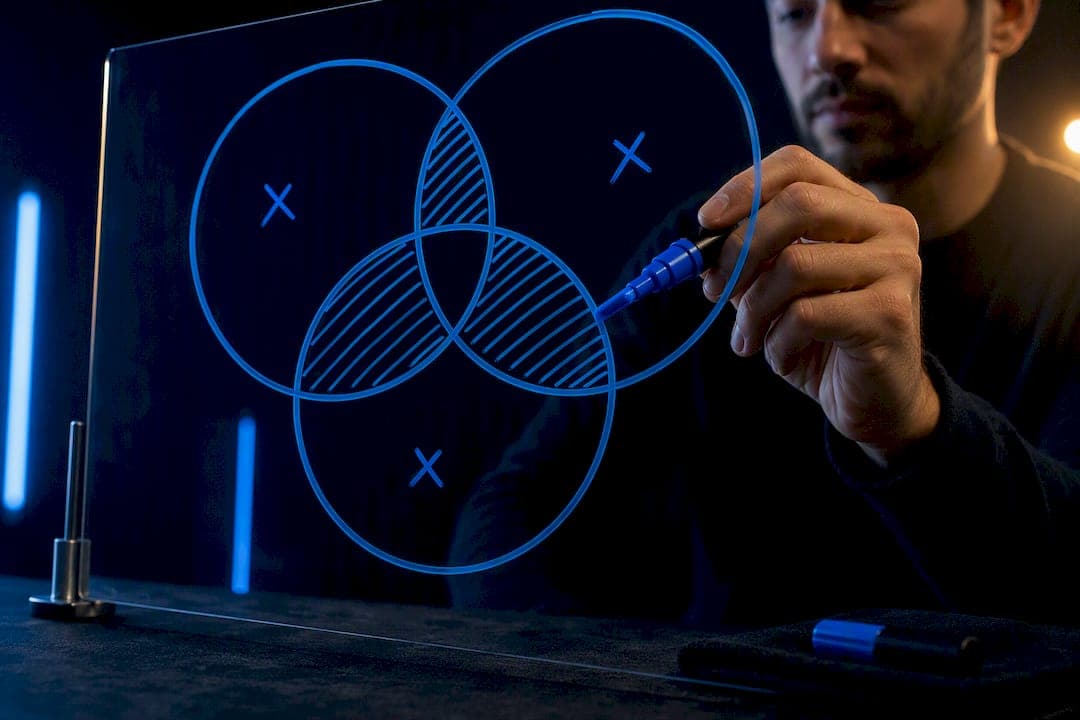
- The Venn diagram method can quickly verify validity by shading regions and placing Xs in open areas, simplifying complex logical checks.
- Many errors stem from intuitive reasoning, and deliberate checking or diagramming significantly reduces mistakes during timed tests.
- Testuno provides instant, scored practice with percentile benchmarks to track improvement across different reasoning question types.
Table of Contents
- Quick Practice: 8 Timed Syllogism Questions
- Core Concepts: Terms, Structure, and Statement Types
- How to Test a Syllogism Quickly
- Worked Solutions: Answers to the Practice Set
- Author Perspective: How Structured Practice Closes the Gap
- Types of Syllogisms: Categorical, Hypothetical, and Disjunctive
- Common Informal Fallacies to Watch For
- Where Syllogistic Logic Comes From
- Beyond Classical Syllogisms: Sorites and Other Extensions
- Why Most People Fail These Tests for the Wrong Reason
- Put Your Logic to the Test with Testuno
- Sources
- FAQ
Quick Practice: 8 Timed Syllogism Questions
Try these before reading the answer key. Treat every premise as true even when it sounds odd, and judge only whether the conclusion has to follow. Give yourself a brief time per item to practice, and jot down your start and end time so you can track improvement across sessions.
- All poets are dreamers. No dreamers are accountants. Therefore, no poets are accountants. Valid or invalid?
- All roses are flowers. Some flowers fade quickly. Therefore, some roses fade quickly. Valid or invalid?
- No reptiles are mammals. All snakes are reptiles. Therefore, no snakes are mammals. Valid or invalid?
- All doctors are educated. All educated people are respected. Therefore, all doctors are respected. Valid or invalid?
- Some athletes are vegetarians. All vegetarians are health conscious. Therefore, some athletes are health conscious. Valid or invalid?
- No fish are birds. Some birds can fly. Therefore, some fish cannot fly. Valid or invalid?
- All criminals are dangerous. No dangerous people are trustworthy. Therefore, no criminals are trustworthy. Valid or invalid?
- Some metals are magnetic. All magnetic things are useful in industry. Therefore, some metals are not useful in industry. Valid or invalid?
Mark each answer as valid or invalid before you check the explanations below, and note which items tripped you up because the conclusion sounded plausible rather than because it actually followed.
Core Concepts: Terms, Structure, and Statement Types
A categorical syllogism has three terms: the major term (the predicate of the conclusion), the minor term (the subject of the conclusion), and the middle term (the word that links the two premises but never appears in the conclusion). The mood of a syllogism refers to the combination of statement types it uses, and the figure refers to where the middle term sits in each premise. Both together determine whether a given form is valid.
Every premise and conclusion in classical syllogistic logic takes one of four shapes:
- A statements ("All S are P") make a universal affirmative claim.
- E statements ("No S are P") make a universal negative claim.
- I statements ("Some S are P") make a particular affirmative claim.
- O statements ("Some S are not P") make a particular negative claim.
For test purposes, judge only the logical relationship between the statements as written. Pulling in outside knowledge, such as remembering that snakes really are not mammals, is exactly the habit that causes evaluation errors when the premises happen to be false or the conclusion happens to be true for unrelated reasons.
How to Test a Syllogism Quickly
Logicians rely on six formal rules to check validity without guesswork, drawn from the classical checklist for testing categorical syllogisms:
- The syllogism must use exactly three terms, each used consistently throughout.
- The middle term must be distributed at least once across the two premises.
- Any term distributed in the conclusion must also be distributed in its premise.
- Both premises cannot be negative.
- A negative premise requires a negative conclusion, and vice versa.
- Two universal premises cannot yield a particular conclusion, and a particular premise usually blocks a universal conclusion.
Breaking any one of these rules produces a formal fallacy, and the syllogism is invalid no matter how reasonable the conclusion sounds.
The Venn diagram method turns this checklist into a picture. Draw three overlapping circles for the major, minor, and middle terms. Shade out regions ruled out by universal statements first, since shading is permanent and unambiguous. Then place an X for particular claims, always in the region left open by the shading rather than on a boundary line. Once both premises are drawn, look at the region the conclusion describes: if it is fully shaded or holds a required X, the syllogism is valid.
Pro Tip: Check middle term distribution first, then look for illicit distribution in the conclusion, then scan for a negative and affirmative mismatch. That order eliminates most invalid syllogisms in seconds without needing a full diagram.
Worked Solutions: Answers to the Practice Set
Validity depends only on structure, so several of these conclusions feel true or false independent of whether they logically follow, which is the trap the practice set is built to expose.
- Question 1 is valid. All P are D, no D are A, so no P are A. The middle term "dreamers" is distributed in the second premise, and the negative premise correctly produces a negative conclusion.
- Question 2 is invalid. "Some flowers fade quickly" does not distribute "flowers," so nothing guarantees that the roses specifically are among the fading ones. This is a classic undistributed middle term error.
- Question 3 is valid. No R are M, all S are R, so no S are M. Shading the reptile-mammal overlap and placing snakes fully inside the reptile circle leaves no room for snakes to touch the mammal circle.
- Question 4 is valid. This is a straightforward chain: all D are E, all E are R, so all D are R. Two universal affirmative premises in this arrangement always support a universal affirmative conclusion.
- Question 5 is valid. Some A are V, all V are H, so some A are H. The X mark for "some athletes" lands inside the vegetarian circle, which is entirely inside the health conscious circle, so it also falls inside health conscious.
- Question 6 is invalid, and it is a belief bias trap: the conclusion sounds sensible, but "no fish are birds" and "some birds can fly" share no valid link back to fish, since the middle term "birds" is never distributed.
- Question 7 is valid. All C are D, no D are T, so no C are T, following the same pattern as question one.
- Question 8 is invalid, and it is the second trap: the premises support "some metals are useful," not "some metals are not useful." This reverses the polarity the rules require.
Notice that questions 6 and 8 fail for structural reasons, not because the topic is unfamiliar. Separating what a statement claims from whether the argument's shape supports it is the entire skill this test measures.
Author Perspective: How Structured Practice Closes the Gap
The most common mistake is not misunderstanding the rules, it is skipping the check when a conclusion already feels right. Building a habit of drawing the Venn diagram or running the rule checklist even on "obvious" items catches more errors than memorizing definitions ever will.
Timed, scored practice adds something self-study cannot: a percentile benchmark that shows whether your accuracy or your speed is the weaker link. Testuno's logical reasoning test times each attempt and reports where you land against other test takers, which makes it easier to see whether a slow but accurate approach or a fast but error-prone one needs more work.
Types of Syllogisms: Categorical, Hypothetical, and Disjunctive
Classical logic recognizes three broad families of syllogism, and categorical syllogisms are only one of them. A categorical syllogism uses class membership statements like the A, E, I, and O forms covered above, for example "All mammals are warm blooded, all whales are mammals, so all whales are warm blooded."
A hypothetical syllogism instead chains conditional statements. If the first premise is "If it rains, the game is canceled" and the second is "If the game is canceled, the team practices indoors," the valid conclusion is "If it rains, the team practices indoors." The pattern relies on if-then structure rather than class membership, and its validity depends on correctly following the conditional chain without reversing it.
A disjunctive syllogism works from an either-or premise. "Either the package was lost or it was delivered late. It was not lost. Therefore, it was delivered late" is valid because eliminating one branch of a genuine either-or leaves only the other. Disjunctive syllogisms fail when the "either-or" is not actually exclusive, since both options could then be true at once.
Most syllogism reasoning tests focus on categorical forms because they map cleanly onto Venn diagrams and rule checklists, but hypothetical and disjunctive patterns show up often enough in general critical thinking assessments that recognizing all three is worth the extra few minutes.

Common Informal Fallacies to Watch For
Formal rules catch structural errors, but syllogism style arguments also fail for informal reasons that no rule checklist flags directly. The undistributed middle, already seen in question 2 and question 6 above, is technically a formal fallacy but shows up so often in everyday arguments that it deserves separate attention outside a strict test setting.
Affirming the consequent is a related informal error common in hypothetical reasoning: "If it rains, the game is canceled. The game was canceled. Therefore, it rained." The game could have been canceled for other reasons, so the conclusion does not follow even though the pattern feels similar to a valid chain.
Equivocation occurs when a term shifts meaning between premises, such as using "light" to mean both "not heavy" and "not dark" across two statements that otherwise look like a valid syllogism. Because the six formal rules assume each term keeps one fixed meaning throughout, equivocation breaks the argument in a way a Venn diagram cannot catch unless you first confirm every term means the same thing in both appearances.
Recognizing these patterns matters as much for reading arguments in the real world as for passing a formal test, since informal fallacies are far more common in everyday persuasion than clean formal ones.

Where Syllogistic Logic Comes From
Syllogistic reasoning traces back to Aristotle, who systematized the categorical syllogism in his work on logic and built the first framework for judging an argument's validity by its form rather than its content. His system organized syllogisms into figures based on where the middle term appeared, a structure still reflected in the figure and mood terminology used to test syllogisms today.
Medieval logicians later expanded on Aristotle's work, cataloging the valid syllogism forms and giving many of them mnemonic Latin names to help students memorize which combinations of A, E, I, and O statements actually produce a valid conclusion. The Venn diagram method came much later, developed in the 1800s as a visual alternative to memorizing lists of valid forms, and it remains the most direct way to confirm validity without recalling terminology.
This history matters for a practical reason: the six rules and the diagram technique used on a modern syllogism reasoning test are not arbitrary conventions. They are a distillation of centuries of logicians checking which argument shapes hold up regardless of subject matter, from ancient Greek philosophy through medieval scholasticism to the diagrammatic tools taught today.
Beyond Classical Syllogisms: Sorites and Other Extensions
Classical syllogisms use exactly two premises and three terms, but real arguments often chain together longer sequences. A sorites (plural sorites, from the Greek word for "heap") links several categorical statements into one extended chain, such as "All A are B, all B are C, all C are D, therefore all A are D." Each step follows the same logic as a standard syllogism, but testing a sorites means checking every adjacent pair for a shared, properly distributed middle term rather than just one.
Modern logic also extends well past Aristotle's categorical forms into propositional and predicate logic, which handle relationships that categorical statements cannot express cleanly, such as "some numbers are both even and prime" or multi-variable relationships across more than three classes. A source on Venn diagram limits notes that the technique only works cleanly for arguments built from three classes and the standard universal or particular forms, so more complex reasoning problems require different tools entirely.
For most syllogism reasoning tests and critical thinking assessments, however, the classical two-premise categorical form and its sorites extension cover the overwhelming majority of questions you will actually see.
Why Most People Fail These Tests for the Wrong Reason
The conventional advice on syllogisms tells you to memorize the rules and practice diagramming, and that is not wrong, it is just incomplete. The bigger issue is that most errors on these tests are not knowledge gaps, they are moments where a conclusion sounds so plausible that the reader skips checking it at all.
Research on belief bias backs this up: experimental work on fluency and validity judgments found that detecting whether a syllogism is genuinely valid takes deliberate, resource-demanding processing, not the quick intuitive read most people default to. That means the highest-leverage habit is not more rule memorization, it is training yourself to pause on every item, including the ones that feel obviously right or obviously wrong.
If you take one thing from this page, take this: treat the "obvious" conclusions with the same suspicion as the strange ones. That single habit shift closes more of the gap between a mediocre score and a strong one than any amount of extra rule review.
Put Your Logic to the Test with Testuno
Reading about validity is different from proving you can spot it under a clock, and that gap is exactly what Testuno's logical reasoning test is built to close. It runs on a timer, scores you instantly, and places your result on a percentile benchmark so you know exactly where your accuracy and speed stand against other test takers, all without creating an account.

- Take the timed test now and get an instant percentile score with no sign-up required.
- Compare your result against the worked answers above to see which rule or trap cost you the most points.
- Retake it in two weeks and check whether your percentile moved, which is the clearest sign the practice is working.
If you want to branch out from categorical syllogisms specifically, Testuno also offers deductive reasoning and abstract reasoning practice, or you can start from the main test catalog to see the full range of cognitive assessments available.
Sources
For deeper study, see the six formal rules for testing syllogisms, the Venn diagram method, guidance on treating premises as true, and research on belief bias in syllogistic reasoning. For structured timed practice routines, the LSAT logical reasoning strategy guide and this exam practice workflow guide offer useful session structures.
- Faculty
- Venn diagrams for syllogisms — Lander University Philosophy
- Truth, validity and logical form — Peters (Earlham College)
- PLOS ONE paper on fluency, belief bias, and syllogistic reasoning
FAQ
What Is a Syllogism Reasoning Test?
A syllogism reasoning test presents two premises and asks whether a given conclusion logically follows from them, independent of whether the statements are factually true. It typically uses categorical statement forms (all, no, some, some not) and checks your ability to judge structure rather than content.
How Is Syllogism Different from General Deductive Reasoning?
A syllogism is one specific type of deductive argument built from exactly two premises and three terms, while deductive reasoning is the broader category that also includes hypothetical and disjunctive syllogisms and longer argument chains. Every valid syllogism is a deductive argument, but not every deductive argument follows the categorical syllogism format.
What Are the Six Rules for Testing a Syllogism?
The six rules require exactly three terms used consistently, a distributed middle term, no term distributed in the conclusion unless it was distributed in its premise, not both premises negative, a negative premise paired with a negative conclusion, and no particular conclusion drawn from two universal premises, as laid out in the classical rules for testing categorical syllogisms. Breaking any single rule makes the syllogism invalid regardless of how the conclusion sounds.
Why Do Believable Conclusions Sometimes Fail the Test?
This is called belief bias, where a conclusion that matches real-world knowledge gets accepted even though the argument's structure does not actually support it. Research on fluency and validity judgments shows that spotting this gap takes deliberate effort rather than a quick intuitive read, which is why treating every premise as strictly true and checking the structure matters more than checking the plausibility of the conclusion.
Where Can I Practice Syllogisms with Instant Feedback?
Testuno's logical reasoning test offers timed practice with instant scoring and percentile benchmarking, letting you compare your results against other test takers without creating an account. It works well alongside the worked practice set and rule checklist covered on this page.