
The most effective test anxiety reduction combines two things: a rehearsed physical reset (box breathing or a 5-4-3-2-1 grounding drill) you can trigger in under a minute, and longer-term prep built on spaced retrieval practice and full-length timed practice tests. Add consistent sleep and lighter caffeine intake, and most students see real, measurable relief. None of this eliminates nerves entirely. If anxiety is disrupting sleep, grades, or daily functioning, that's a signal to talk to a counselor, not push harder alone.
TL;DR:
- Using a physical reset like box breathing before and during the test significantly reduces immediate anxiety when practiced regularly beforehand.
- Spaced retrieval practice and full-length simulated exams are proven to lower test anxiety by increasing familiarity and reducing uncertainty.
- Maintaining consistent sleep, limiting caffeine intake, and engaging in light exercise during prep improve memory retention and decrease anxiety levels.
- Cognitive reframing techniques, including evidence logs and expressive writing, help challenge negative thoughts and clear working memory during high-stakes tests.
- Students with persistent or severe anxiety signs should seek professional support, such as counseling or accommodations, rather than relying solely on self-help strategies.
Table of Contents
- A Same-Day Checklist For Reducing Test Anxiety
- How Does Studying Differently Reduce Test Anxiety?
- What Can You Do In the Moment To Calm Down During a Test?
- Sleep, Exercise, and Caffeine: What Actually Helps
- Cognitive Reframing and Quick CBT Exercises
- When Should You Get Outside Help For Test Anxiety?
- What Does the Research Actually Say?
- What I'd Actually Tell a Student Starting This Today
- Get a Clearer Picture of Your Own Study Bottlenecks
- Sources
A Same-Day Checklist For Reducing Test Anxiety
You don't need ten strategies. You need three or four, rehearsed enough that they work automatically when your hands are shaking and the clock just started. Here's the sequence worth memorizing.
The night before:
- Stop studying new material by early evening; review a condensed summary sheet instead of cramming.
- Lay out everything you need (ID, calculator, pencils, water bottle) so morning decisions are minimal and less stressful.
- Get to bed at your normal time, even if you feel like you should study later. Research links sleep loss the night before an exam with higher measured anxiety.
The morning of:
- Eat something balanced with protein rather than only sugar or straight caffeine.
- Do a five-minute pretest ritual: two minutes of box breathing, then read (or write) three lines about what's worrying you.
- Arrive early enough to sit down without rushing. Rushing spikes cortisol before you've read question one.
During the test, when panic hits:
- Box breathing: inhale four counts, hold four, exhale four, hold four. Repeat four times.
- 5-4-3-2-1 grounding: silently name five things you see, four you hear, three you can touch, two you smell, one you taste.
- Expressive micro-writing: a brief moment scribbling exactly what you're afraid of on scratch paper, then setting it aside.
Pro Tip: Practice your chosen reset during a boring homework session, not for the first time on exam day. A technique you've never used before adds its own novelty, and novelty is precisely what spikes test anxiety in the first place.
Pick two lifestyle changes and one accountability partner (a friend, a parent, a study group) who checks whether you actually did the sleep and caffeine adjustments. Accountability is the difference between a plan and a habit.
How Does Studying Differently Reduce Test Anxiety?
A large share of test anxiety isn't really about the test. It's about uncertainty: not knowing whether the knowledge will be there when you need it. Retrieval practice, also called active recall, attacks that uncertainty directly by forcing your brain to pull information out of storage repeatedly, rather than just re-reading it. Evidence on retrieval practice and student wellbeing shows it's among the most consistently supported study techniques for both retention and anxiety tied to memory failures, because you stop fearing the blank page once you've faced it fifty times in low-stakes practice.
Spaced practice works alongside it. Instead of one six-hour cram session, you study the same material in shorter sessions spread across days or weeks, with gaps that force your memory to work slightly harder each time. That extra effort is what makes the memory stick.
Building a backward study schedule
Start from the exam date and work backward:
- Mark the exam date, then block out four weeks (or however many you have) on a calendar.
- List every topic the exam covers, and rank them by how shaky you currently feel on each.
- Assign your weakest topics to earlier weeks so you get more spaced repetitions before test day.
- Break each week into 25 to 40 minute sessions rather than marathon blocks. Shorter, more frequent sessions support the spacing effect better than long ones.
- Reserve the final week almost entirely for retrieval practice and full simulations, not new content.
Running a realistic practice test
A practice test only reduces anxiety if it resembles the real thing. That means matching the actual time limit, the mix of question types, whatever materials are or aren't allowed, and even the break schedule. Performance psychology guidance on nervous-system prep recommends running at least two full-length simulated tests under conditions that mirror test day as closely as possible, because familiarity is what lowers your body's threat response. The first time your brain encounters a timed, high-stakes format, it treats it as a threat. The fifth time, it treats it as Tuesday.
A sample 4-week plan
Week 1: Diagnostic practice test, no time pressure. Identify weak topics. Begin daily 30-minute retrieval sessions on those topics.
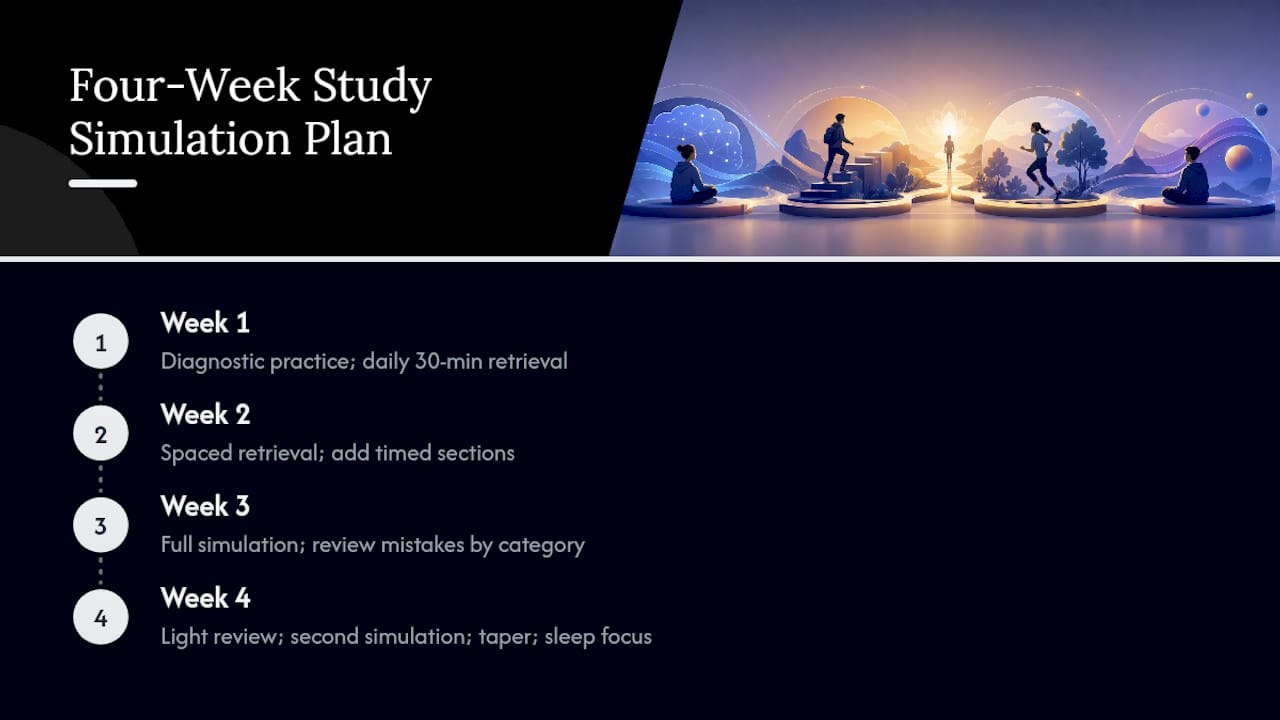
Week 2: Continue spaced retrieval, layer in timed sections (one subject at a time, real clock).
Week 3: Full-length timed simulation under near test-day conditions. Review mistakes by category, not just by score.
Week 4: Light review, second full simulation, taper study volume in the final two days, and shift focus to sleep and the in-the-moment resets below.
For students who want a clearer picture of where their study habits or working memory might be creating friction, a study preference test can help match tactics to how you actually learn instead of guessing. If you're building your own recall drills, guides like this active recall approach for math show how the technique applies to problem sets specifically, not just fact recall.
Pro Tip: If a topic still triggers a stomach drop during week 3's simulation, that's not a sign to panic. It's a sign that topic needs one more spaced session before test day, not five.
What Can You Do In the Moment To Calm Down During a Test?
The techniques that work fastest when your heart rate has already spiked are physical, not mental. Cognitive reframing has its place, but when your breathing is shallow and your hands are cold, your body needs to come down first before your thoughts can follow.
Box breathing (also called four-square breathing): inhale for four counts, hold for four, exhale for four, hold for four, repeat for one to two minutes. It's used by military and clinical performance training precisely because it's simple enough to execute under stress.
Diaphragmatic breathing: place a hand on your stomach, breathe so the stomach rises more than the chest, six breaths per minute for ninety seconds. Slower than box breathing, and better for a sustained low hum of anxiety rather than a sudden spike.
Progressive muscle relaxation, short version: tense your shoulders and jaw for five seconds, release, repeat once. You don't have time for the full body-scan version mid-exam, but this ten-second version releases physical tension fast enough to use between sections.
5-4-3-2-1 grounding: name five things you can see, four you can hear, three you can touch, two you can smell, one you can taste. This interrupts the spiral of catastrophic thinking by forcing your attention onto concrete sensory input instead of the exam.
Expressive micro-writing: research on expressive writing and exam performance found that spending about ten minutes writing about your worries before a high-stakes test improved scores, apparently by freeing up working memory that anxious thoughts had been occupying. A shorter thirty-second version on scratch paper mid-test can do a smaller version of the same job.
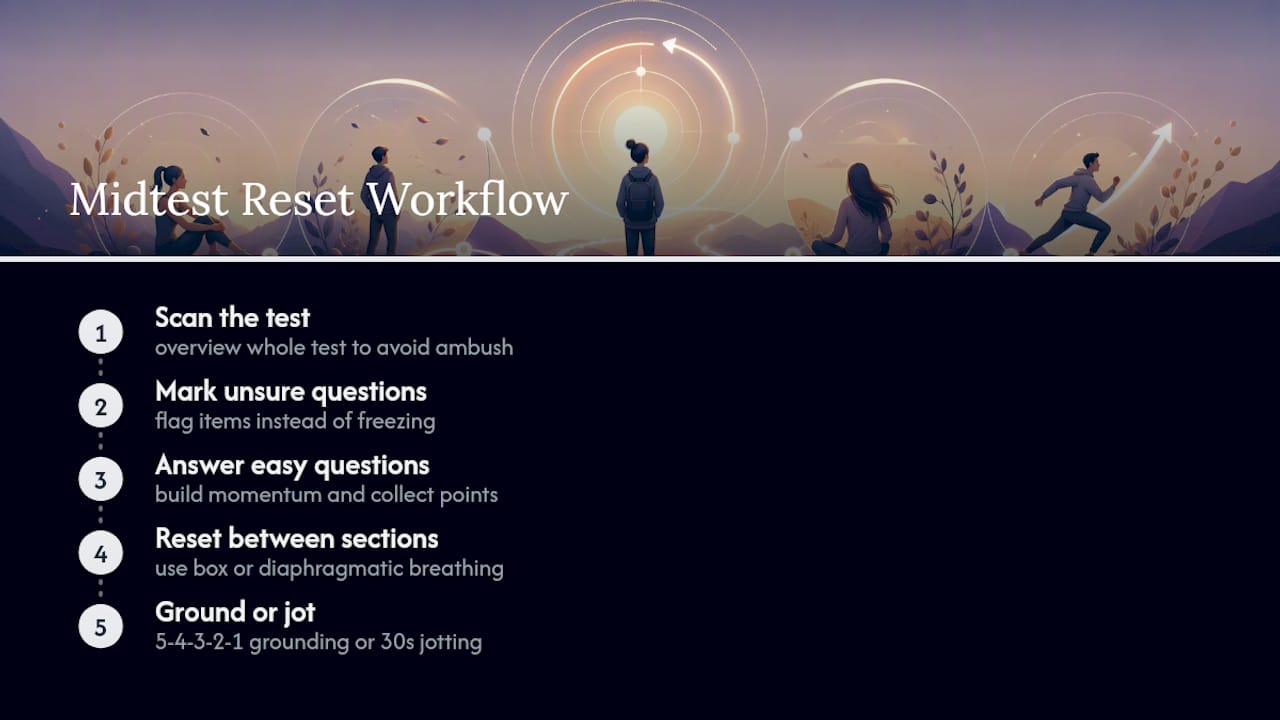
A simple midtest workflow ties these together: scan the whole test first so nothing ambushes you later, mark questions you're unsure about instead of freezing on them, move on to easier points, and reset with one of the breathing techniques between sections. Students using imagery rescripting, a technique where you mentally rewrite a feared exam scenario into a manageable one, showed significantly reduced test anxiety in a controlled trial, with benefits still measurable six months later. That's a longer-term tool, but it illustrates a broader point: your brain responds to rehearsed alternatives, not just willpower in the moment.
Sleep, Exercise, and Caffeine: What Actually Helps
Sleep does more for exam performance than another hour of review. Memory consolidation, the process where your brain files new information into long-term storage, happens largely during sleep. Research on sleep and cognitive performance links poor sleep to weaker memory retention and higher measured anxiety, which makes an all-nighter one of the worst trades a student can make before a test.
Caffeine is more nuanced. A moderate amount can sharpen focus, especially if you're already a regular coffee or tea drinker and your body expects it. But a large dose, or caffeine on top of an already anxious body, tends to amplify jitteriness and can make it harder to tell the difference between "caffeinated" and "panicking." A 2024 study on university students found that higher caffeine intake correlated with higher test-anxiety scores, while relaxation practices and time spent with friends or family correlated with lower ones.
Practical guidelines for the days around an exam:
- Keep your sleep schedule consistent for at least three nights before the test, not just the night before.
- Cap caffeine at your normal daily amount. Don't experiment with a bigger dose on test day.
- Get 20 to 30 minutes of movement, even a walk, most days during your prep window. Regular movement lowers baseline anxiety over time, not just in the moment.
- Eat a real breakfast with protein rather than skipping it or relying on sugar.
- Drink water steadily rather than a large amount right before you sit down.
Cognitive Reframing and Quick CBT Exercises
Physical resets calm your body. Cognitive strategies target the actual thought loops, like "I'm going to fail" or "everyone else gets this but me," that keep anxiety running even after your heart rate settles.
The core skill is catching an automatic negative thought and rewriting it into something accurate and workable. The script is short: notice the thought, ask "is this fact or fear," then replace it with a specific, true alternative. "I'm going to fail" becomes "I've practiced this material for three weeks and I know most of it cold." That's not empty positive self-talk. It's an evidence-based correction, which is why it holds up better under pressure than a vague affirmation.
Two exercises worth practicing during study sessions, not saving for exam day:
- The evidence log: after each practice test, write down one specific piece of proof that you're more prepared than your anxiety is telling you. Over weeks, this becomes a real, defensible case against the panic.
- The worst-case walkthrough: spend two minutes writing out the actual worst realistic outcome and what you'd do next. Anxiety often feeds on vague dread; naming the specific outcome usually shrinks it.
Expressive writing fits here too. The same 10-minute protocol that helps in the moment works even better as a scheduled exercise two or three times during your prep, since it trains you to offload worry deliberately rather than carry it silently through a whole study session. Pair cognitive work with your study schedule rather than treating it as separate. A five-minute reframe after a rough practice test round is more useful than doing it in isolation.
Pro Tip: If your self-talk during practice tests sounds harsher than anything you'd say to a friend, that's worth noticing. Reframing isn't about forced positivity. It's about applying the same fairness to yourself that you'd give someone else.
When Should You Get Outside Help For Test Anxiety?
Some anxiety before a big exam is normal, and even useful; a moderate amount sharpens focus. It becomes a problem when it interferes with sleep, concentration, or your ability to study at all, not just how nervous you feel walking into the room.
Watch for these signs that self-help strategies aren't enough on their own:
- Physical symptoms (nausea, racing heart, panic) that show up days before the exam, not just during it.
- Avoidance: skipping practice tests or study sessions because thinking about the exam feels unbearable.
- Anxiety that persists across most or all tests, not just one high-stakes exam.
- Sleep or appetite disruption lasting more than a few days.
If that describes your experience, campus counseling centers typically offer short-term CBT-based support specifically for test and performance anxiety, and clinical guidance from Mayo Clinic recommends combining preparation, relaxation training, and professional support rather than treating any single approach as sufficient. Medication is sometimes part of a treatment plan for diagnosed anxiety disorders, but that decision belongs with a licensed provider, not a study guide.
If test anxiety seems tied to a specific learning difference, like ADHD or dyslexia, disability services offices can evaluate you for accommodations such as extended time. Extended time measurably reduces the time pressure that drives anxiety on high-stakes tests, which is worth exploring even if you've never requested accommodations before. The process usually requires documentation from a healthcare provider or prior school records, submitted to your school's disability office well before the exam date.
What Does the Research Actually Say?
Some of these techniques rest on stronger evidence than others, and it's worth knowing the difference before you build your whole strategy around one tactic.
| Intervention | Evidence type | Key finding |
|---|---|---|
| Imagery rescripting | Randomized controlled trial | Reduced test anxiety significantly, effects held for six months |
| Relaxation/meditation, social support | Exploratory cross-sectional study | Associated with lower test-anxiety scores among university students |
| Retrieval practice | Evidence synthesis, behavioral research | Consistently linked to better retention and reduced anxiety around memory failure |
| Expressive writing | Controlled research | Improved exam performance by freeing working memory |
The RCT on imagery rescripting is the strongest single piece of evidence here, since randomized trials control for factors that cross-sectional surveys can't. The 2024 exploratory study on sleep, caffeine, and social support is useful and consistent with broader anxiety research, but it shows correlation, not proof that changing one factor alone fixes anxiety. Retrieval practice and expressive writing both have solid, repeated support behind them, though most studies involve college-age samples, so results may not translate identically to younger students or different testing formats. Treat all of this as a strong starting toolkit, not a guaranteed formula.
What I'd Actually Tell a Student Starting This Today
Don't try all of this at once. That's the single biggest mistake I see: a student reads a list like this, adopts six new habits the week before finals, and ends up more anxious because now they're also anxious about doing the anxiety-reduction correctly.
A realistic rollout looks more like this. Week one, pick one physical reset (box breathing works for most people) and one study change (start retrieval practice on your weakest topic). Week two, add a full timed practice test and start winding down caffeine if it's been heavy. Week three, run a second simulation and start the ten-minute expressive writing habit before you study, not just before the exam. Week four, taper everything back and lean on the resets you've already rehearsed.
The other common failure is cramming disguised as "extra prep," and leaning on caffeine to cover for lost sleep. Both feel productive and both usually backfire. If you only take one thing from this, take the plan, not the whole list.
— Steve
Get a Clearer Picture of Your Own Study Bottlenecks
Most anxiety advice treats every student the same, but the actual bottleneck is often different from person to person. Some students freeze because their working memory gets overloaded under time pressure, not because they didn't study enough. There are online tools that can help answer that specific question in about 15 minutes, without any sign-up, so you can see which cognitive factor is actually working against you before you build a study plan around the wrong assumption.

The working memory test shows whether memory load, rather than lack of preparation, is what's driving your blanks under pressure. The cognitive profile goes further, mapping strengths and weaknesses across several domains so you can prioritize retrieval practice where it matters most instead of studying everything equally. If you're deciding how to organize study sessions around how you actually process information, the study preference test gives you a starting point in a few minutes flat. Start with the cognitive profile if you want the fullest picture before your next study cycle.
This article is general information, not a substitute for advice from a qualified doctor. Consult a qualified healthcare professional about your own circumstances before acting on anything here.
Sources
- Test anxiety and coping strategies among university students: exploratory study (2024)
- Test anxiety: Can it be treated? (Mayo Clinic)