

The fastest way to raise your verbal reasoning score is repeated short timed practice with evidence-first review. Not endless studying. Not vocabulary flashcards. Timed reps, checked against the text, tracked over time.
Here's how to start in the next five minutes:
- Open a timed verbal reasoning practice test (10 to 20 questions).
- Set a 60 to 90 second per-question limit and stick to it.
- Write down your raw score and your average time per question before you do anything else.
Pro Tip: Don't review your answers until you've logged your baseline score. That number is what tells you if week two is actually working.
Testuno's verbal reasoning test is a solid place to run that first timed set. No signup, instant scoring, done in a few minutes.
Key Takeaways
Raising your verbal reasoning score comes down to timed repetition, proof-first reading, and tracking errors by type rather than by overall percentage.
| Point | Details |
|---|---|
| Start with a baseline | Run one timed practice test before studying anything, and record score plus time per question. |
| Read for proof, not impression | Locate the exact line that confirms or denies a statement before answering true/false/cannot say items. |
| Watch qualifier words | Terms like "some," "all," "only," and "never" frequently change a correct answer into a wrong one. |
| Follow a 2 to 4 week cycle | Move from untimed diagnostic to timed drills to mixed simulations, logging errors each session. |
| Practice with Testuno | Testuno's verbal reasoning test offers no-signup timed practice with instant scoring and percentile benchmarking. |
Table of Contents
- Where to Find Realistic Verbal Reasoning Practice
- The Verbal Reasoning Question Types You Must Master
- High-Impact Strategies That Actually Raise Your Score
- A Repeatable 2 to 4 Week Verbal Reasoning Practice Plan
- Try These Five Timed Verbal Reasoning Sample Questions
- Why Proof-First Reading and Timed Drills Actually Work
- How to Interpret Your Verbal Reasoning Score
- Managing Test Anxiety and Staying Focused Under Time Pressure
- Format, Timing, and Scoring: What to Expect
- Try Testuno's Free Verbal Reasoning Practice
- Frequently Asked Questions
- Sources
Where to Find Realistic Verbal Reasoning Practice
A practice test is only useful if it mirrors the real thing. That means a genuine timer, the true/false/cannot say format employers actually use, and explanations for every wrong answer, not just a final score.
Free hubs like Practice Aptitude Tests and AssessmentDay offer exactly this: timed sets, worked solutions, and downloadable PDFs you can revisit. Testuno's verbal reasoning test adds instant scoring with percentile benchmarking, so you see not just whether you passed but how that result stacks against other test takers.
Run each source the same way:
- First pass: untimed, no clock, just to learn the format.
- Second and third pass: fully timed, treated like the real assessment.
- Fourth pass onward: drill only the question types you keep missing.
Track two numbers every time: seconds per question and which error type keeps showing up (misread qualifier, outside knowledge, rushed guess). That log is what turns random practice into an improvement plan.
Pro Tip: If you're prepping for a job application with multiple test sections, alternate a verbal set with a logical reasoning test so you build stamina across formats, not just one.
The Verbal Reasoning Question Types You Must Master
Most tests recycle the same handful of formats. Learn these five and you've covered most of what you'll see.
- True/False/Cannot Say: You judge a statement against a passage using only what's written. "Cannot say" means the passage doesn't give enough evidence either way, not that the statement sounds wrong to you.
- Reading comprehension: A single correct answer exists and it's retrievable from the text. This is different from evidence-only items because there's no "cannot say" option; you're finding the one right answer.
- Vocabulary items: Synonyms, antonyms, and sentence completion test word precision under time pressure, not raw vocabulary size.
- Analogies: You're matching a relationship between two words to a second, parallel pair.
- Odd-one-out: Identify the item that breaks a shared pattern among a word group.
Watch qualifier words closely across all five formats: "some," "all," "only," "most," and "never" routinely flip a correct answer into a wrong one. Practice guidance from Practice Aptitude Tests confirms these evidence-only judgment questions are the format most candidates lose points on by rushing.
High-Impact Strategies That Actually Raise Your Score
Read the statement first, then go find the exact lines in the passage that prove or disprove it. That order matters. Reading the whole passage first and forming a general impression is slower and less accurate than hunting for proof on demand.

Treat your gut answer as a hypothesis, not a final call. Your first instinct is often right, but it's built on skimming, not verification. Check it against the text before locking it in.
Four mistakes account for most lost marks, according to analysis from The Human Capital Hub:
- Bringing in outside knowledge instead of sticking to what's on the page.
- Misreading quantifiers like "some" as "all."
- Rushing under time pressure and answering on impression alone.
- Missing double negatives, which flip meaning entirely.
Fix each one the same way: force yourself to locate the exact sentence that proves your answer before you select it.
On test day, budget 30 to 90 seconds per question depending on the test's overall length and question count. If a question is taking longer than that, mark your best guess and move on. Coming back with fresh eyes beats grinding on one question and running out of time for five others.
Pro Tip: Read the question stem twice before you touch the passage. A surprising number of wrong answers come from misreading what's actually being asked, not from misunderstanding the text itself.
A Repeatable 2 to 4 Week Verbal Reasoning Practice Plan
You don't need months. A focused month, or even two weeks if you're prepping for an imminent interview, is enough to see real gains if you follow a structure instead of practicing randomly.
- Week 1: Diagnostic untimed test, then drills targeting qualifiers and assumption control.
- Week 2: Fully timed practice sets with an error log after every session.
- Week 3: Mixed timed simulations combining question types, reviewing patterns in your error log.
- Week 4: One final full-length timed simulation, then a review session focused on remaining weak spots.
Each session, record three things: your score, your average time per question, and the category of any mistake. Psychometric Institute's improvement guidance recommends exactly this diagnostic-to-timed-to-review sequence for fast score gains, and it works because it shows you where to spend your next session instead of guessing.
If your error log shows the same mistake three sessions running, drop everything else and drill that one category until it clears.
Try These Five Timed Verbal Reasoning Sample Questions
Set a 60 second timer per question. Answer all five before checking the explanations below.
- Passage: "All senior analysts at the firm hold a professional certification. Maria has worked at the firm for six years." Statement: "Maria holds a professional certification." (True / False / Cannot Say)
- Choose the word closest in meaning to "candid": (a) secretive (b) frank (c) elaborate (d) cautious
- Passage: "The bridge was closed for repairs from March through May, delaying the town's spring festival by six weeks." Question: Why was the festival delayed? (a) funding issues (b) weather (c) bridge repairs (d) not stated
- Complete the analogy: Pen is to Write as Knife is to ___. (a) Sharp (b) Cut (c) Kitchen (d) Metal
- Odd one out: Whisper, Shout, Murmur, Mumble
Answers and explanations:
- Q1: Cannot say. The passage never states Maria is a senior analyst, so her certification status isn't confirmed either way.
- Q2: (b) frank. "Candid" means open and honest, matching "frank" most closely.
- Q3: (c) bridge repairs. The passage states this directly; no inference needed.
- Q4: (b) Cut. The relationship is tool-to-primary-function, matching Pen/Write.
- Q5: Shout. The other three describe quiet speech; "shout" is the loud outlier.
Why Proof-First Reading and Timed Drills Actually Work
Most verbal reasoning errors happen when your brain defaults to fast, intuitive judgment instead of checking a statement methodically against the text. Psychologists call this dual-process reasoning: a quick, automatic system and a slower, deliberate one that verifies. Under time pressure, the fast system takes over, and that's exactly when qualifier words and double negatives slip past unnoticed.
Proof-first reading forces the slow system back into the driver's seat. You're not asking "does this feel true?" You're asking "where's the line that proves this?"
Consistent, structured practice teaches specific strategies, like skimming for structure and reading for proof, that measurably raise scores and reduce test anxiety, according to guidance from LSE's careers resource.
Timed repetition matters just as much. Practicing under the real clock from the start builds the pacing instinct that untimed study never develops, according to Practice Aptitude Tests. That's why a diagnostic-then-timed sequence outperforms unlimited untimed review every time.
How to Interpret Your Verbal Reasoning Score
A single score means less than the trend across several sessions. What matters is whether that number moves after a week of targeted drills.
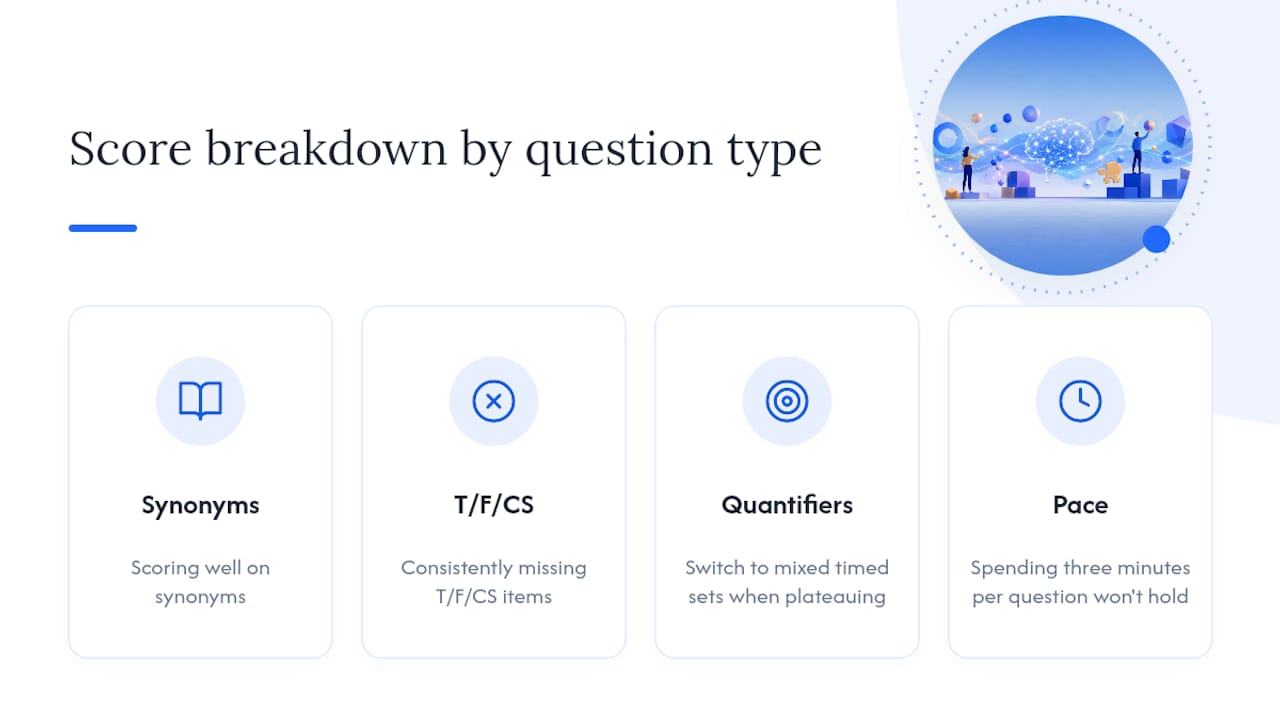
Break your score down by question type rather than treating it as one lump figure. If you're scoring well on synonyms but consistently missing true/false/cannot say items, that tells you exactly where to spend next week's practice time. A flat overall percentage hides that kind of pattern completely.
Percentile benchmarking, when a test offers it, gives you a second data point: how you compare against other test takers rather than just against a pass mark. Testuno's timed tests include percentile results, which is useful context if you're prepping for an assessment where you'll be ranked against other applicants, not just graded pass or fail.
Watch your time-per-question figure alongside accuracy. A high score achieved by spending three minutes per question won't hold up under real test conditions. A realistic target is a score that stays stable, or only drops slightly, once you compress your pace to the actual time limit.
If your score plateaus for two consecutive sessions despite drilling the same error type, that's usually a sign to change the drill itself, not to keep repeating it. Switch from practicing quantifier statements in isolation to full mixed timed sets, so the skill transfers to realistic conditions instead of staying isolated in a narrow drill format.
Managing Test Anxiety and Staying Focused Under Time Pressure
Anxiety and rushed reading feed each other. Nerves push you toward faster, more intuitive answers, which is exactly the mode where qualifier words and double negatives get missed.
Familiarity is the most reliable anxiety reducer available, and it's free. Running several timed practice sets before the real test means the format, the clock, and the pressure all feel routine rather than foreign by the time it counts. Test anxiety research consistently points to exposure and rehearsal as more effective than any single relaxation technique performed once.
A few practical habits help during the test itself:
- Take one slow breath before starting the timer on each new passage; it resets your reading pace.
- If you catch yourself rereading the same line three times without progress, mark your best guess and move to the next question. Circling back with fresh eyes almost always works better than forcing a decision mid-panic.
- Keep a visible running count of questions remaining versus time left. Vague time anxiety is worse than a concrete number you can plan around.
Sleep and timing also matter more than most people expect. Practicing at the same time of day you'll take the real test, and getting a full night's sleep beforehand, does more for focus than any last-minute vocabulary cramming. If nerves are a recurring problem rather than a one-time issue, treat it the same way you'd treat an error pattern: log it, and address it with repeated exposure rather than avoidance.
Format, Timing, and Scoring: What to Expect
Standardized verbal reasoning tests generally run 15 to 30 minutes and include 15 to 30 questions, though exact numbers vary by test provider and employer. Most follow one of two structures: a series of short passages each paired with several true/false/cannot say statements, or a mixed set combining comprehension, synonyms, analogies, and sentence completion.
Timing is usually fixed per test, not per question, which means pacing yourself is your responsibility. A 20-question test with a 20-minute limit gives you roughly a minute per item, but harder comprehension questions may eat more time than a quick synonym match, so budgeting flexibly within that total matters more than rigid per-question timing.
Scoring typically works one of two ways: raw score (number correct out of total) or scaled/percentile score, which compares your raw result against a norm group of other test takers. A raw score tells you how many you got right. A percentile tells you how that result stacks up, which matters more in competitive hiring contexts where employers set a percentile cutoff rather than a fixed pass mark.
Some tests apply a penalty for guessing incorrectly, though many modern assessments do not, since unanswered questions and wrong answers are scored the same way. Check the specific test's guidelines before assuming either way, since guessing strategy should shift depending on whether wrong answers cost you anything beyond a missed opportunity.
A quick note on realistic expectations
Steve here, part of the team behind Testuno. Verbal reasoning is a trainable skill, and disciplined practice over two to four weeks typically produces a real, measurable score improvement, not a dramatic overnight jump. Run a timed practice test now and log your baseline before you do anything else.
Try Testuno's Free Verbal Reasoning Practice
Testuno's verbal reasoning test gives you exactly the setup this article recommends: a real timer, instant scoring, and no signup wall standing between you and your first baseline attempt.

Three things map directly to what actually moves your score:
- Timed practice mode, so you build real pacing instead of untimed guesswork.
- Answer explanations on every question, so wrong answers become data instead of dead ends.
- Percentile benchmarking and a downloadable summary, so you can track whether your score is actually improving session over session.
If you want a fuller picture of your reasoning ability beyond verbal skills alone, Testuno's cognitive profile assessment pairs verbal results with memory, processing speed, and problem-solving scores in one downloadable report. Start with the timed verbal test, log your baseline, and go from there.
Frequently Asked Questions
How much can verbal reasoning practice actually improve my score? Gains vary by starting point, but structured practice over two to four weeks typically produces a measurable improvement, particularly if you're correcting specific error patterns like misread qualifiers rather than practicing randomly.
Is timed practice better than untimed practice? Both matter, but at different stages. Untimed practice teaches the format first; timed practice builds the pacing skill that untimed study never develops, which is why the recommended sequence moves from one to the other.
What's the difference between "false" and "cannot say" in verbal reasoning tests? "False" means the passage directly contradicts the statement. "Cannot say" means the passage simply doesn't provide enough information to judge it either way, even if the statement seems plausible.
Do I need to buy paid materials, or are free verbal reasoning quizzes enough? Free timed practice tests with worked explanations, like those on Testuno, Practice Aptitude Tests, and AssessmentDay, cover the same core skills as most paid programs: format familiarity, pacing, and error review.
How many practice tests should I take before a real assessment? There's no fixed number, but most candidates see the clearest gains after four to six timed sessions spread across two to three weeks, with an error log reviewed after each one.
Sources
- Free verbal reasoning test: 20 questions + answers (Practice Aptitude Tests)
- Verbal reasoning tests (LSE careers resource)
- Verbal reasoning questions: how to approach them and the mistakes that cost marks (The Human Capital Hub)
- Online verbal reasoning, free preparation tests (AssessmentDay)